When securing your personal history, business inventory, or seasonal gear in a self-storage facility, you are fighting a battle against time. Physical testing reveals that standard open-shackle padlocks can be quietly defeated with a standard 30-inch (750 mm) bolt cutter in a shocking 5.91 to 10.03 seconds. Thieves do not want to use noisy, spark-producing angle grinders that instantly alert facility staff; they rely on quick, silent physical defeat. To protect your belongings, your primary objective is to survive the “30-second rule.” If a lock cannot be cut within half a minute, opportunistic thieves will almost always abandon the attempt and move on to a weaker target.
To achieve this level of security, you face a critical decision: choosing between a disc (or discus) lock and a heavy-duty shrouded padlock. Both are engineered to resist cutting, but they do so through entirely different mechanical and geometric approaches.
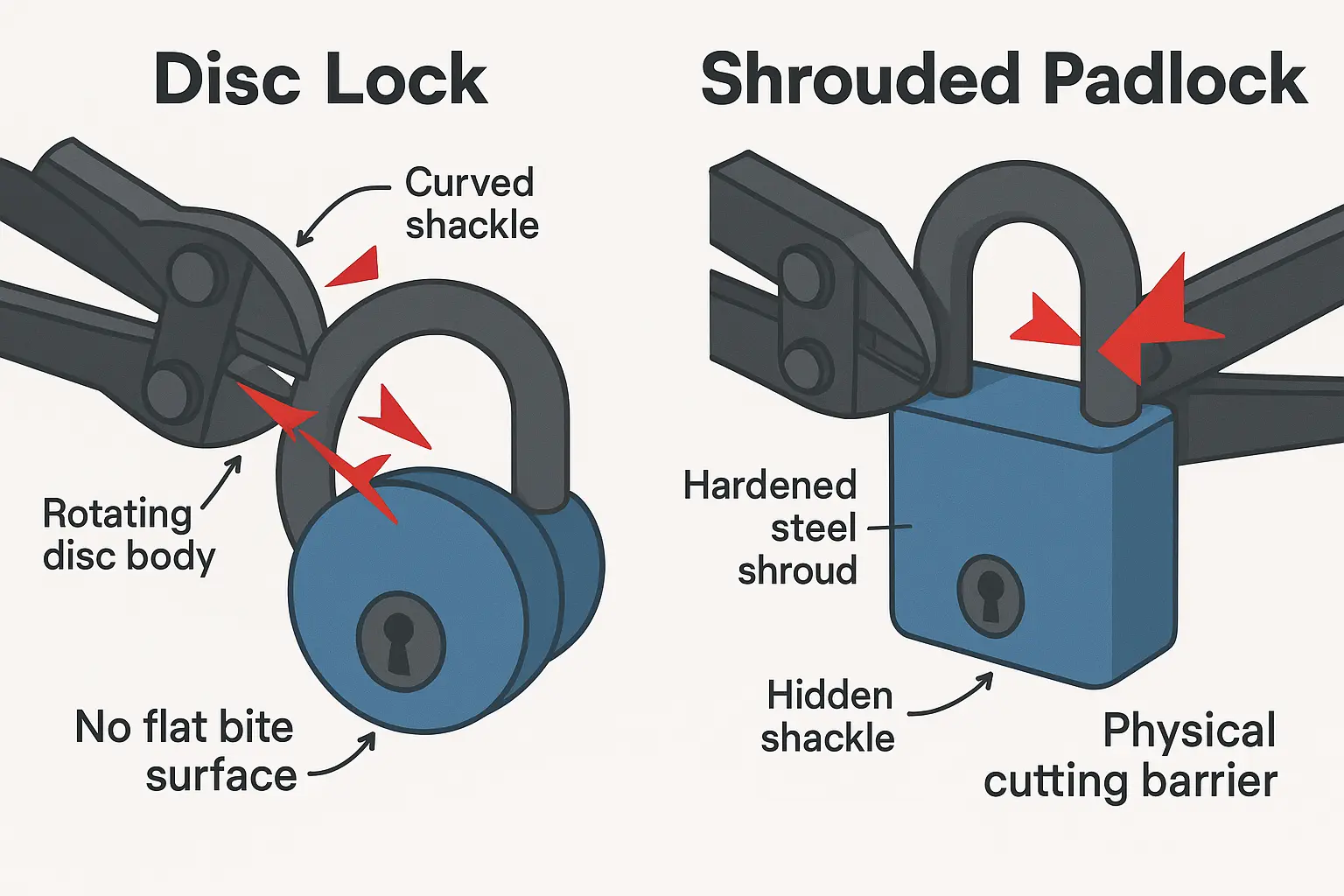 This visual explains how the unique curved design of disc locks prevents bolt cutters from gaining a flat purchase angle, while shrouded padlocks physically shield the shackle to block cutting. Understanding these mechanics helps you choose the most secure lock for your storage unit.
 This metallurgy scale helps you remember the practical hardness of lock materials and their vulnerability to common thief tools. Knowing the metal behind your lock is key to choosing a cut-resistant storage lock.
 This flowchart guides you through checking your storage door latch type to select a lock that physically fits. Avoid costly mistakes by ensuring your chosen lock matches the spatial constraints of your facility’s hardware.