Choosing the Right Storefront Door Locks: The Professional Retrofit Guide


Published: Sep 23, 2026 | Updated: Sep 24, 2026

Standard commercial doors typically support robust, deep-pocket locking systems. However, narrow-stile aluminum storefront doors present a completely different engineering challenge. With stiles measuring a mere 1-3/4″ to 2″ wide, standard cylindrical locksets cannot physically fit.

To secure these glazed commercial entryways, the industry relies on narrow-stile commercial door lock types optimized for the standard “MS Prep” footprint (a 6-7/8″ x 1″ routed cut-out). Selecting the correct hardware configuration requires a clear understanding of your building’s traffic patterns, physical dimensions, and regulatory obligations.
The Great Storefront Debate: Deadlatches vs. Deadlocks


Choosing between a deadlatch and a deadlock is about more than picking a model number; it directly dictates how your business operates on a daily basis. While a deadlock requires manual locking and offers high security after hours, a deadlatch automatically engages upon closing, making it ideal for managing continuous daytime traffic. Selecting the right mechanism ensures seamless accessibility and perimeter control, much like integrating automatic sliding doors for storefronts to balance customer convenience with secure entry management.
  • Adams Rite MS1850S Deadlock: This is the benchmark for maximum physical security. Using an “over-center” toggle mechanism, any forced-entry prying pressure converts into compressive force against internal steel stops, keeping the bolt locked. If you are securing sliding glass doors, you must use a hooked bolt variation (MS1850S-X5X) to prevent intruders from prying the doors apart. This represents one of the most secure types of sliding glass door locks available.
  • Adams Rite 4510 / 4900 Series Deadlatches: Ideal for high-traffic retail or commercial entries. Unlike deadlocks, deadlatches feature a spring-loaded latch bolt and an auxiliary deadlocking plunger to prevent shimming. They allow for “dogging”—using a key or hex wrench to hold the latch retracted during business hours for free keyless passage.
  • Adams Rite MS1890 Hookbolt/Latch: A hybrid solution providing single-point locking for doors requiring both egress and security. However, note that because of its swinging hook design, the MS1890 cannot be paired with traditional electric strikes.

Regardless of your chosen system, performing routine commercial lock maintenance is vital to prevent binding and ensure smooth mechanical operation over hundreds of daily cycles.

Sizing Workflow: How to Prevent the #1 Ordering Error (Backset Sizing)


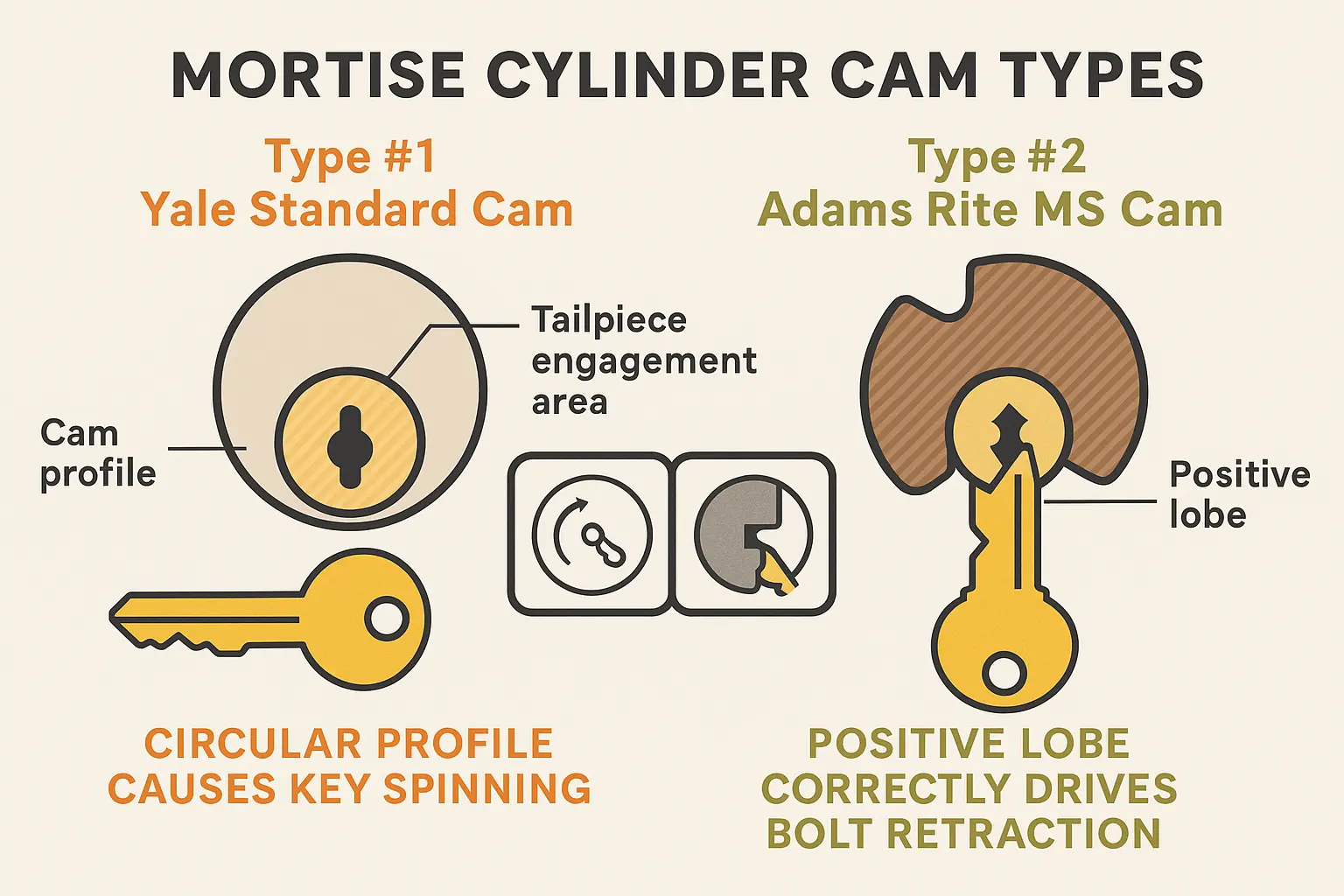
Visual comparison of Type 1 Yale Cam vs Type 2 Adams Rite MS Cam

Ordering the incorrect backset is the single most common mistake made during storefront hardware procurement. Because narrow stiles have incredibly tight tolerances, even a 1/8″ error will prevent the lock from mounting or cause it to strike the glass glaze inside the stile pocket.

There are four standard industry backsets: 7/8″, 31/32″, 1-1/8″, and 1-1/2″, with 31/32″ and 1-1/8″ serving as the standard for narrow-stile doors.

To accurately measure your backset:

  1. Locate the centerline of the cylinder hole or the lock faceplate.
  2. Measure with a high-precision ruler from the exact center of the cylinder hole to the outer edge of the door stile.
  3. Account for your faceplate type: Flat, Radius, Beveled, or Weatherstripped. If the door edge is beveled, measure from the high side of the bevel to keep your replacement flush.

The Anatomy of a Mortise Cylinder: Cams, Lengths, & Mismatches


Step-by-step storefront door backset measuring guide

When managing a lock cylinder replacement, facility managers are often baffled when a newly installed, premium cylinder spins completely in place without actually retracting the latch. This is the notorious “spinning key” issue, and it is almost always caused by a mismatched cam profile.

A standard mortise lock used on commercial wood or hollow-metal doors typically ships with a Type #1 Standard Yale Cam. However, Adams Rite storefront locksets feature a smaller, highly specific pocket that requires a Type #2 Adams Rite Cam (MS Cam). The MS Cam features a unique, pronounced rotating lobe designed to engage the internal tailpiece slide of the deadlatch or deadlock. If you are learning how to replace mortise lock systems, ensuring your replacement cylinder is outfitted with an MS-compatible cam is non-negotiable.

Upgrading to Access Control: Electric Strikes vs. Electrified Deadlatches


When integrating narrow-stile glass entries into modern types of access control systems, physical security integrators face a choice between two main pathways:

  • Adams Rite 7100 / 7400 Series Electric Strikes: Sized specifically to fit inside narrow storefront frames, these strikes allow the mechanical latch to stay locked until an electric current releases the strike keeper. They offer field-selectable fail-safe or fail-secure modes.
  • Adams Rite 4300 Steel Hawk Electrified Deadlatch: This is the ultimate retrofit solution. Instead of cutting or routing the aluminum door frame to accommodate an electric strike, the Steel Hawk replaces the mechanical 4510/4900 deadlatch inside the door stile itself. Operating at 12 or 24 VDC, it works seamlessly with existing mechanical key cylinders, push paddles, or egress bars, offering a clean, non-disruptive installation.

Frequently Asked Questions


Why is my storefront door key spinning without unlocking the door?

This issue is almost always caused by a mismatched mortise cylinder cam. Standard replacement cylinders are outfitted with a Type #1 Yale Cam, which is too wide and rounded to catch the internal slide of a storefront lock. You must install a mortise cylinder with a Type #2 Adams Rite MS Cam to resolve this.

Can I replace an Adams Rite deadlock with a deadlatch directly?

While they both utilize the standard MS Prep door cutout (6-7/8″ x 1″), they require different strike plates on the frame. Additionally, a deadlatch requires an auxiliary latch entry pocket to function correctly, meaning some modification to the door frame strike area will be necessary.

What is the standard backset for a narrow-stile aluminum door?

The vast majority of modern narrow-stile storefront doors utilize a 31/32″ or an 1-1/8″ backset. However, legacy systems and custom installations can occasionally feature 7/8″ or 1-1/2″ backsets, which is why precise physical measurement prior to ordering is essential.

ADA Compliance & Life Safety Code Checklist


ADA and life safety compliance checklist infographic for commercial door hardware

Before finalizing any commercial door lock replacement, you must verify that your configuration satisfies the local Authority Having Jurisdiction (AHJ) and national life-safety codes:

  • Operating Force: Egress paddles and push bars must operate with a maximum of 5 lbs of force, requiring no tight grasping, pinching, or twisting of the wrist.
  • Mounting Height: Operating hardware must be installed between 34″ and 48″ above the finished floor.
  • Egress Compliance: In commercial occupancies, exiting the building must always be a single-motion action. Double-cylinder deadlocks that require a key to exit during business hours are highly restricted and often violate fire codes.

Need more information? Get a free quote

Call us now

Get A Free Call From Our Experts!

Floating Button Form