The Hidden Vulnerability: Securing the Door Between Your Garage and Your House


Published: Sep 29, 2026 | Updated: Sep 30, 2026

When we think of home security, we naturally picture our front door or ground-floor windows. Yet, there is a far more critical vulnerability hiding right behind your garage door.

Once an intruder breaches your roll-up garage door, they gain something incredibly dangerous: visual and acoustic cover. Hidden inside a closed garage, a burglar can take their time, using your own stored power tools to attack the interior door leading into your living space without being seen or heard by neighbors.

According to the FBI Uniform Crime Reporting (UCR) Program, approximately 9% to 10% of all residential burglaries occur through the garage. While a standard residential interior hollow-core door can be kicked in with less than 100 lbs of force in under 5 seconds, treating this passage as a secondary interior door is a major security risk. It must be as robust as your main entry door.
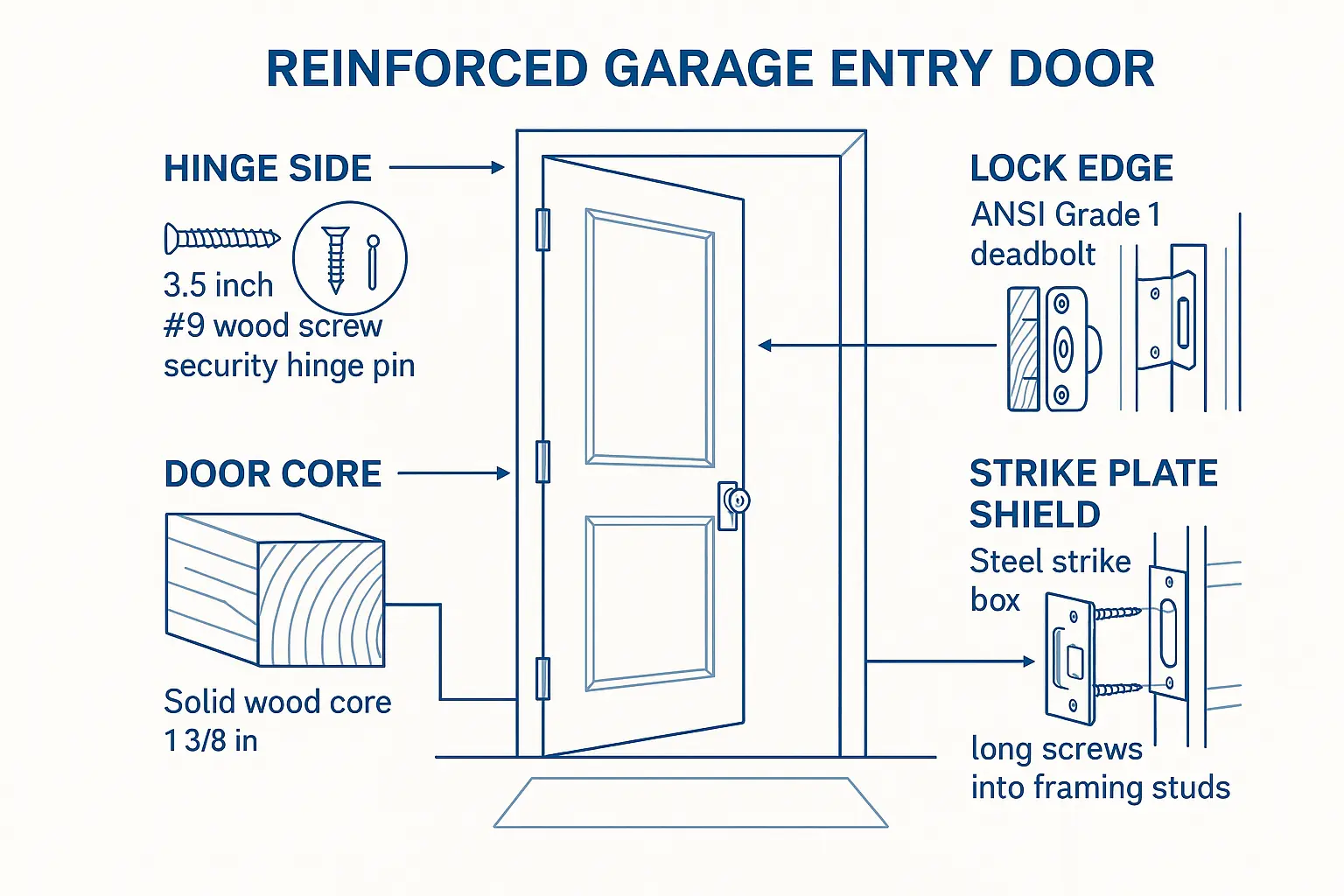

Anatomy of a Secure Garage Entry Door (The 4-Point Hardening Blueprint)


To stop a motivated intruder, you must view your entryway as a complete structural system. Reinforcing just one component while neglecting the rest simply shifts the failure point.

The 4-Point Hardening Blueprint breaks down the garage entry door into its critical physical security zones, making it clear how each part must be reinforced to stop an intruder.

  1. The Core (Door Material): Never use a standard hollow-core door. Your house-access door should be a solid wood or steel-faced honeycomb-core door at least $1frac{3}{8}$ inches thick. This solid core provides the necessary mass to resist blunt physical impacts.
  2. The Strike Edge: A lock is only as strong as the frame holding it. Most builders secure strike plates with flimsy 1-inch screws that only grab the decorative door trim. You must how to reinforce door structures by replacing these with heavy-duty 3-inch or 3.5-inch #9 wood screws. These bypass the jamb entirely and anchor deep into the double 2×4 framing studs behind the wall.
  3. The Lock Edge Shield: To prevent pry bars from splitting the door frame, install a heavy-duty metal strike box and wrap-around brass or steel reinforcer plates. Understanding what is a door strike plate and upgrading it to a high-security model prevents the latch from slipping or tear-shearing through the wood frame.
  4. The Hinge Edge: If your door swings outward into the garage, the hinge pins are exposed. Burglars can tap these pins out to remove the door. Install security hinges with non-removable pins or stud hinges, and drive 3-inch screws through the hinge leaves directly into the wall studs.

Resolving the Security vs. Fire Code Dilemma


Hardening your door is not just about physical strength; it must also align with safety standards. Because garages house combustible fluids, vehicles, and carbon monoxide hazards, the door between your garage and house acts as a vital firewall.

The International Residential Code (IRC R302.5.1) strictly outlines the fire rated door hardware requirements for this entryway. The door must be a 20-minute fire-rated assembly, solid wood, or steel honeycomb-core door.

Crucially, the code mandates an active automatic self-closing device. If a fire starts in the garage, a self-closing door prevents toxic fumes and flames from instantly entering the living space. Implementing a heavy-duty hydraulic door closer ensures the door shuts reliably behind you every time.

One common safety mistake is installing a single vs double cylinder deadbolt on this door. While double-cylinder deadbolts (keyed on both sides) prevent intruders from reaching through broken glass to unlock the door, they violate fire safety codes. In an emergency like a house fire or carbon monoxide leak, you cannot afford to search for a key to escape. Stick to single-cylinder deadbolts with an interior thumbturn.


The Convenience Problem: Best Lock Types Compared


Because the garage entry door is a high-traffic threshold, manual locking often creates friction. When people carry groceries or rush inside, they frequently leave the door unlocked.

This lock comparison matrix helps homeowners quickly grasp the trade-offs between security, convenience, and fire safety compliance when choosing the perfect lock for their garage entry door.

Lock Type Security Level Convenience Rating Fire/Life Safety Code Compliance Best Suited For
ANSI Grade 1 Single-Cylinder Deadbolt Maximum Low (Requires manual throwing every time) Fully Compliant Homeowners with strict safety habits who don’t mind manual locking.
Smart Lock with Auto-Lock Geofencing High Maximum (Auto-locks when closed) Fully Compliant (Select fire-rated models) Busy families, those prone to forgetting to lock, or high-traffic households.
Keypad/Electronic Deadbolt (Timer) High High (Numeric code entry, auto-locks after 30 seconds) Fully Compliant Users who want keyless convenience without relying on smartphone apps.
Double-Cylinder Deadbolt Maximum Extremely Low (Requires key to exit and enter) NON-COMPLIANT (Dangerous in fire emergencies) Do not use on residential interior garage doors.
Heavy-Duty Security Bar (Drop-Bar) Extreme Very Low (Can only be engaged from inside) Compliant only when occupied/sleeping Overnight security or when leaving the home empty for extended travel.

If you opt for a digital solution, choosing a model designed for a smooth smart lock installation ensures your hardware aligns with modern smart ecosystems. Evaluating a smart lock vs traditional deadbolt configuration will help you resolve the balance between hands-free convenience and heavy-duty manual security.


Step-by-Step DIY Reinforcement Guide


Improving your door’s physical strength can be completed in an afternoon using basic tools.

Follow this clear DIY guide to mechanically reinforce your garage-to-house door, addressing the most common vulnerabilities with precise hardware upgrades and proper installation techniques.

Replace the Strike Plate Screws

Remove the existing 1-inch screws from your deadbolt strike plate. Drill pilot holes using a $frac{1}{8}$-inch drill bit straight into the wood studs. Drive 3-inch #9 or #10 wood screws into the plate. This simple change distributes kick-in force deep into your home’s structural framing.

Install an ANSI Grade 1 Deadbolt

If your current deadbolt is unrated or is a basic latch, upgrade it. Follow a professional guide on how to install a deadbolt to ensure the cylinder is perfectly aligned and the 1-inch throw fully extends into the frame without binding.

Reinforce the Hinges

Unscrew two screws from each hinge leaf on the frame side. Drive 3-inch wood screws into those positions to ensure the hinge side is as firmly anchored to the studs as the strike side.


Frequently Asked Questions


Should I lock the door between my garage and house?

Yes, always. Treat this door as an exterior front door. Because garages are primary targets for burglaries, an unlocked interior door gives intruders immediate, unhindered access to your entire home.

Can I put a smart lock on my garage entry door?

Yes. Installing a smart lock with an auto-lock timer is highly recommended. It solves the human convenience problem by securing the entryway automatically, provided the smart lock model is rated for use on fire-barrier assemblies.

What are the building code requirements for a garage fire door?

According to the International Residential Code (IRC), the door must be made of solid wood (not less than $1frac{3}{8}$ inches thick), solid-core or honeycomb-core steel, or have a 20-minute fire rating. It must also be equipped with an automatic self-closing device.


Securing Your Home with Confidence


At Sure Lock & Key, we believe true peace of mind comes from combining heavy-duty physical engineering with everyday convenience. With over 35 years of industry experience, our licensed technicians operate a fleet of fully equipped mobile service vans across Connecticut, New York, Texas, Florida, and beyond. Whether you need a code-compliant fire-rated closer, a premium lock upgrade, or expert hardware installation, we are here to help. Contact Sure Lock & Key today to secure every entry point of your home.

Need more information? Get a free quote

Call us now

Get A Free Call From Our Experts!

Floating Button Form