Navigating Key Control: The Business Guide to Restricted Keyways


Published: Sep 24, 2026

For commercial facility managers, operations directors, and business owners, physical security is a balancing act between risk mitigation and operating costs. If your organization relies on standard physical keys, you are likely exposed to a vulnerability you don’t even realize exists: the ease of unauthorized duplication. Modern automated kiosks and mobile scanning apps can duplicate a standard commercial key in under 60 seconds with zero identification checks.

To secure your perimeter and protect sensitive areas, you must move beyond basic hardware and establish a true key control program. This guide will help you evaluate restricted key systems, understand their long-term economic benefits, and avoid common procurement traps.
The Real Cost of "Cheap" Locks: Standard vs. Restricted Keyways


Many businesses default to standard commercial lock cylinders because of their low upfront cost, typically $15 to $30 per cylinder. However, this initial savings is a mirage. When employees leave, keys go missing, or cleaning contractors change, you must address how often to rekey a commercial lock to maintain security.

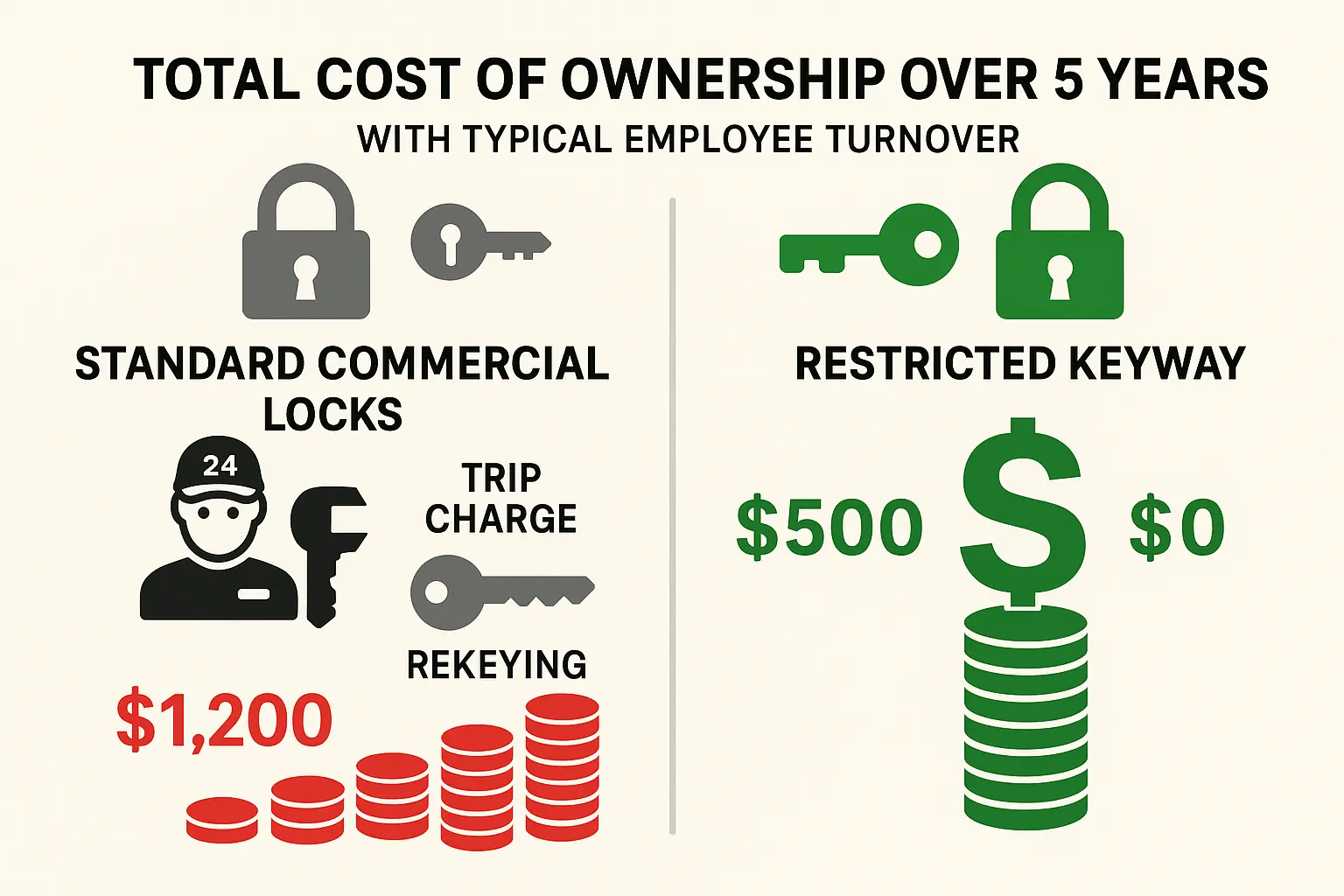
Standard commercial rekeying costs average $40 to $75 per cylinder, plus a mobile locksmith trip charge of $75 to $150. For a business with 25 doors, rekeying just twice a year due to staff turnover translates to over $2,350 annually in maintenance fees.

Visualizing how restricted keyways incur higher initial costs but drastically reduce long-term rekeying expenses, helping businesses save money over time despite staff turnover.

By contrast, high-security restricted cylinders cost between $50 and $120+ upfront. While the initial hardware investment is higher, restricted keys cannot be copied at local hardware stores or self-service kiosks. When an employee departs and returns their key, you have absolute certainty that no duplicate exists. This eliminates the need to rekey your facility, reducing your ongoing rekeying costs to $0. Over a five-year lifecycle, a restricted key system consistently delivers a lower Total Cost of Ownership (TCO).

The Mechanics of Duplication Control: How Physical Restrictions Work


To understand how restricted keyways prevent unauthorized duplication, we must look at the difference between physical design and simple visual warnings. Many businesses rely on a standard do not duplicate key to protect their facility. However, “Do Not Duplicate” stamps carry no legal weight; they are merely requests that retail key cutters frequently ignore.

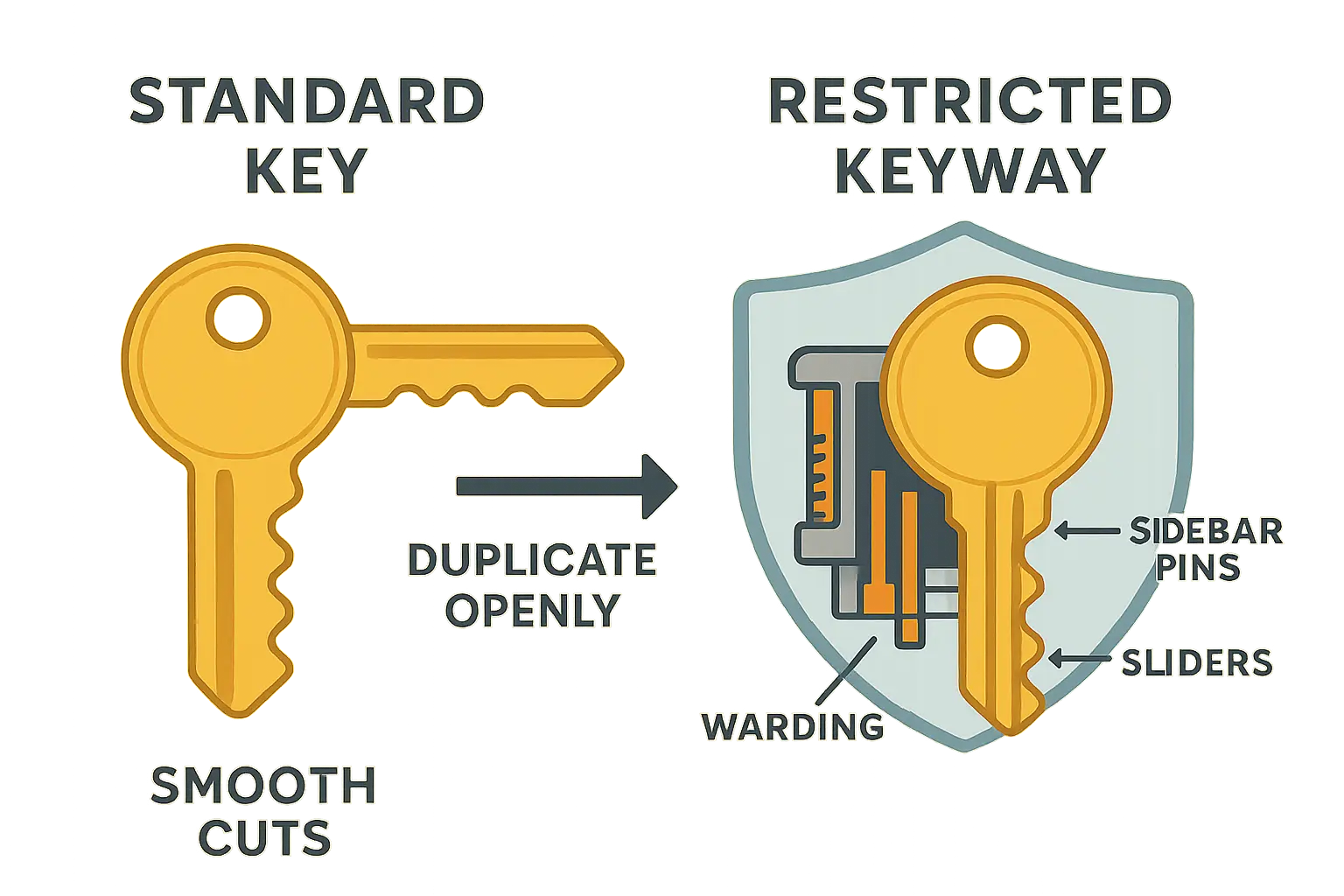
Understanding how restricted keyways physically prevent unauthorized key duplication by using specialized components like sidebars and sliders, unlike standard keys that can be copied easily at kiosks.

True key control relies on patented mechanical designs. Restricted keyways feature unique physical warding, specialized sidebars, and slider mechanisms that require custom-milled key blanks. These blanks are not sold to the general public or aftermarket distributors.

Furthermore, these blanks are protected by federal utility patent laws. Under U.S. Patent Law, unauthorized manufacturing or distribution of patented key blanks constitutes federal patent infringement. When you invest in these systems, you are securing your property through both physical engineering and federal legal protection.

The Patent Expiration Trap (The Technical Details Competitors Hide)


A critical detail that many commercial lock providers overlook is the lifespan of utility patents. Under federal law, utility patents grant 20 years of protection from their filing date. Once a keyway’s patent expires, aftermarket manufacturers like Kaba Ilco or JMA can legally produce compatible blanks. When blanks enter the open market, your “restricted” system becomes vulnerable to unauthorized commercial key duplication.

Older, legacy systems like the original Schlage Primus or Medeco B have already seen their primary utility patents expire. If your building still uses these older keyways, your security may be compromised. When evaluating new high-security office locks, always ask your vendor for the exact patent expiration date. To maximize your investment, choose a modern keyway (such as Medeco X4 or Schlage Everest 29) that offers at least 10 to 15 years of active patent protection.

The Decision Matrix: Restricted Keyways vs. Electronic Access Control


When upgrading physical security, decision-makers often choose between mechanical restricted keyways and electronic access control. While electronic systems offer unmatched flexibility, deploying them across an entire facility can be cost-prohibitive.

An electronic door access control system can cost anywhere from $1,500 to $3,000 per door to install, plus ongoing software licensing and battery maintenance. For a facility with dozens of interior doors, the budget can quickly escalate.

The most cost-effective solution is a hybrid security strategy using different types of access control systems:

  • Exterior Doors & High-Turnover Areas: Install electronic access control on main entryways, loading docks, and high-traffic communal zones. This allows you to easily revoke credentials when staff leave.
  • Interior Offices, IT Closets, & Low-Turnover Rooms: Secure these doors with a patented commercial master key system. At approximately $100 per door, this delivers high-security physical protection at a fraction of the cost of electronic locks.

How to Avoid the "Locksmith Hostage" Situation


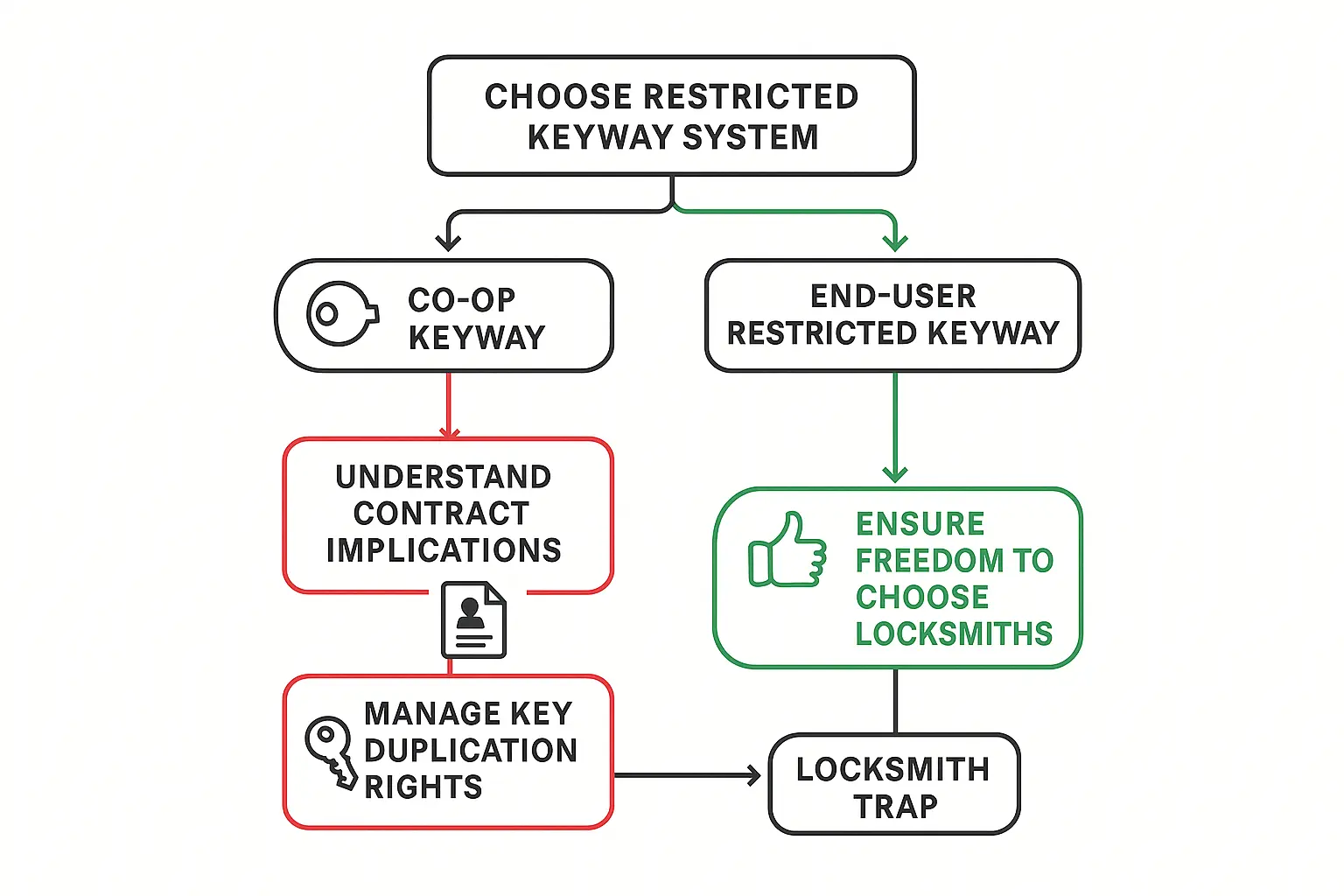
A common fear among business owners is getting locked into an exclusive contract with a single local locksmith. This happens when a business unknowingly purchases a dealer-restricted keyway. In this setup, the manufacturer grants exclusive rights for a specific key profile to one local locksmith in a geographic region. If that locksmith raises their prices or provides poor service, you cannot hire a competitor because no other locksmith can legally obtain your key blanks.

Step-by-step guide showing how businesses can avoid being locked into exclusive locksmith deals by selecting the right type of restricted keyway and managing key control legally.

To maintain your operational freedom, always request an end-user restricted keyway or a system with a nationally managed commercial program. In this arrangement, the patent rights and keyway codes are registered directly to your business. You retain full ownership of your security data and can authorize any certified provider of commercial locksmith services to service your system, cut keys, or manage your master key systems.

Frequently Asked Questions


Why is a "Do Not Duplicate" stamp insufficient for business security?

A "Do Not Duplicate" stamp carries no legal or physical weight. Most hardware store key cutters and automated kiosks will duplicate these keys without hesitation. True duplication control requires patented restricted keyways where key blanks are physically restricted by patent laws and are only available to authorized dealers.

What happens to my key control system when its utility patent expires?

When a utility patent expires, third-party manufacturers can legally produce and distribute compatible key blanks. This allows anyone to acquire blanks and duplicate your keys at standard retail kiosks, rendering your system open and stripping away the physical security protections of your restricted keyway.

How does a hybrid key control system lower total security costs?

A hybrid system combines electronic access control with physical restricted keyways. By installing electronic locks ($1,500–$3,000/door) only on high-traffic exterior doors and using patented mechanical locks ($100/door) on interior spaces, you get high-level security, audit trails, and physical key control while keeping equipment and installation costs low.

Implementation Checklist & Operational Best Practices


Upgrading your hardware is only half the battle; maintaining long-term security requires strong operational discipline. Use these best practices to keep your system secure:

  1. Implement Blind Stamping: Never stamp functional labels like “Server Room,” “Master,” or “HR” directly onto a physical key. If a key is lost or stolen, these labels tell a thief exactly which door it opens. Instead, use random, alphanumeric serial codes (e.g., ALP305) and track them in a secure, offline database.
  2. Establish a Dual-Signature Policy: Require two authorized signers for any key duplication request. This prevents a single employee from bypassing security protocols to order extra keys.
  3. Conduct Regular Audits: Perform bi-annual key audits. Require key holders to physically present their assigned keys to confirm they are still in the proper hands.

Need more information? Get a free quote

Call us now

Get A Free Call From Our Experts!

Floating Button Form