Remote Head Key Diagnostics and Replacement Guide


Published: Sep 7, 2026 | Updated: Sep 9, 2026

Imagine this scenario: your key fob buttons stop responding, so you carefully swap in a fresh lithium coin cell. You walk out to your vehicle expecting a satisfying click, but nothing happens. You are locked out, frustrated, and staring at a key that should work. This is the post-battery replacement wall, an incredibly common hurdle for vehicle owners using remote head keys.

To solve this mystery, we must look beyond a simple power swap and dissect the hidden mechanics, signal dynamics, and physical design of your key’s hardware.
Anatomy of a Remote Head Key: Physical & Electromagnetic Design


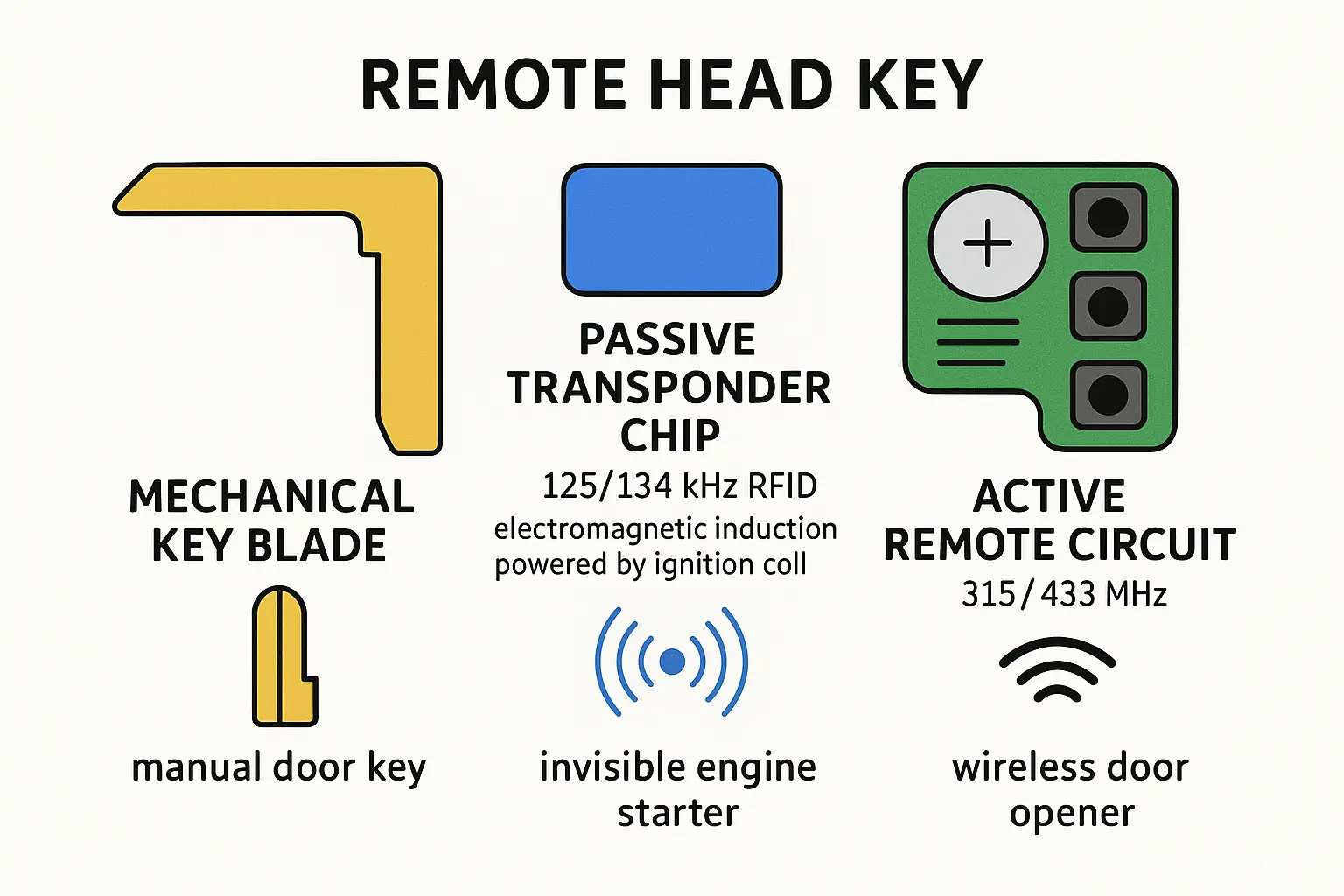
A remote head key is a sophisticated hybrid design. Unlike basic types of key fobs, a remote head key integrates three distinct security systems into one single device:

  1. The Mechanical Blade: This brass or nickel-silver alloy blade may feature a standard edge-cut profile or a high-security sidewinder key track. It physically turns the mechanical lock cylinder in the door or ignition.
  2. The Passive transponder key Chip: Operating at low frequencies (typically 125 kHz or 134.2 kHz), this glass or ceramic RFID chip does not need battery power. Instead, it relies on electromagnetic induction from your vehicle’s ignition excitation coil to complete a cryptographic handshake.
  3. The Active RF Transmitter: This battery-powered circuit board handles your remote locks, trunk release, and panic alarm, transmitting at 315 MHz (North America) or 433.92 MHz (Europe and Asia).

This internal separation explains why your vehicle can start perfectly even if your remote buttons are completely unresponsive.

Understanding the anatomy of a remote head key clarifies why the key blade can start your car even when remote buttons fail: the passive transponder communicates independently from the battery-powered remote functions.

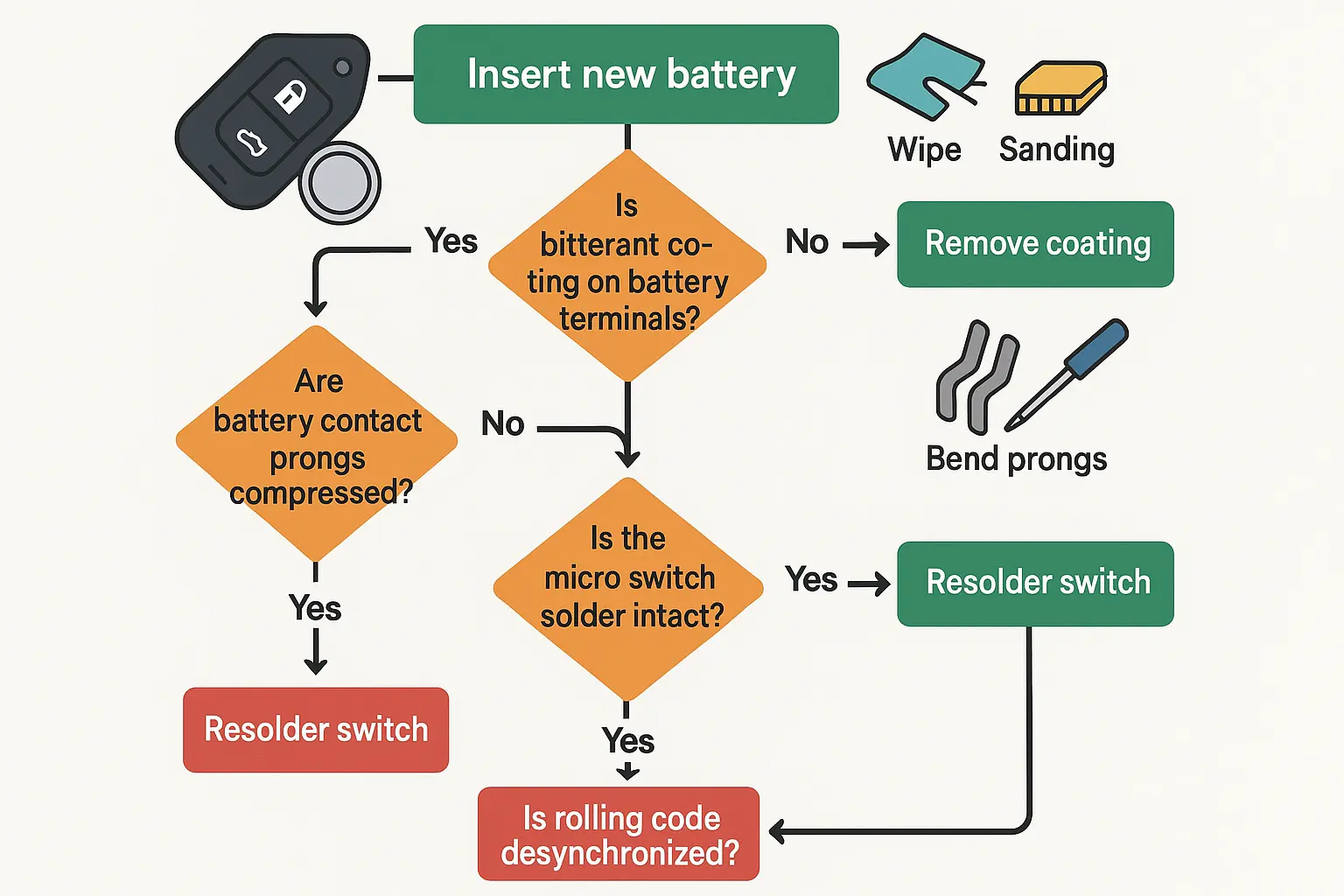
Diagnostic Tree: "New Battery in Key Fob Not Working"


If a fresh key fob battery replacement failed to restore your remote functions, the issue usually boils down to a few overlooked mechanical or chemical flaws:

  • The Bitterant Barrier: In 2020/2021, battery manufacturers introduced a highly bitter coating (denatonium benzoate) on CR2032 and CR2025 coin-cell batteries to prevent child ingestion. This bitterant acts as a non-conductive dielectric insulator. In compact remote heads with flat terminal contacts, this coating prevents electrical connection. Wiping the battery surface with 90%+ isopropyl alcohol or lightly sanding it resolves nearly 35% of post-battery failure complaints.
  • The Compressed Prong Syndrome: During battery installation, the internal metal contact prongs can easily get flattened or bent out of shape. Using a sewing pin to gently pull terminal contacts upward restores the physical tension required for a reliable electrical connection.
  • Rolling Code Desynchronization: High-security systems utilize rolling code algorithms (like Keeloq cryptography). If your remote buttons are pressed repeatedly while out of range of the vehicle, the transmitter and receiver can fall out of sync, causing the car to lock out the remote.
  • PCB Damage: Solder micro-fractures can occur at the base of the physical tactile buttons on the circuit board after years of aggressive pressing.

A systematic diagnostic process helps users identify the root cause of remote head key failures even after battery replacement, reducing anxiety and enabling effective DIY fixes.

How to Reprogram Your Remote Head Key


When rolling codes fall out of sync, you must perform a manual override sequence. While some modern systems require professional OBD2 car key fob programming, many vehicles allow On-Board Programming (OBP) to recover your remote connection:

  • Ford Sequence: Turn the ignition switch from “Off” to “Run” eight times within ten seconds, ending in “Run.” Listen for the doors to cycle lock and unlock, indicating programming mode is active.
  • Toyota Sequence: Open and close the driver’s door while inserting and removing the key from the ignition barrel in a rapid, rhythmic pattern.
  • Nissan Sequence: Insert and remove your mechanical key from the ignition lock cylinder six times within ten seconds.

If these diagnostic steps fail to clear up your key fob issues, a full system diagnostic or hardware replacement is the logical next step.

Frequently Asked Questions


Why does my car start but the remote buttons won't work?

This happens because starting the car and unlocking the doors rely on completely separate internal systems. The transponder chip in your remote head key is passive and draws its operational energy electromagnetically from the ignition barrel, allowing it to start the engine even with a dead battery. The lock and unlock buttons utilize a battery-powered transmitter that requires physical power and active radio signals.

Can I cut a remote head key myself?

No, cutting a remote head key requires specialized diagnostic and mechanical equipment. Edge-cut keys need precise mechanical duplication, while modern high-security or laser-cut sidewinder keys require computer-controlled CNC key cutters to ensure smooth ignition lock operation and prevent mechanical binding.

Will major retail chains program my aftermarket remote head key?

Typically, no. While large auto parts retailers or big-box stores can duplicate basic residential keys and sell replacement batteries, they lack the advanced diagnostic OBD2 programming tools and transponder software needed to synchronize a new remote head key to your car’s immobilizer system.

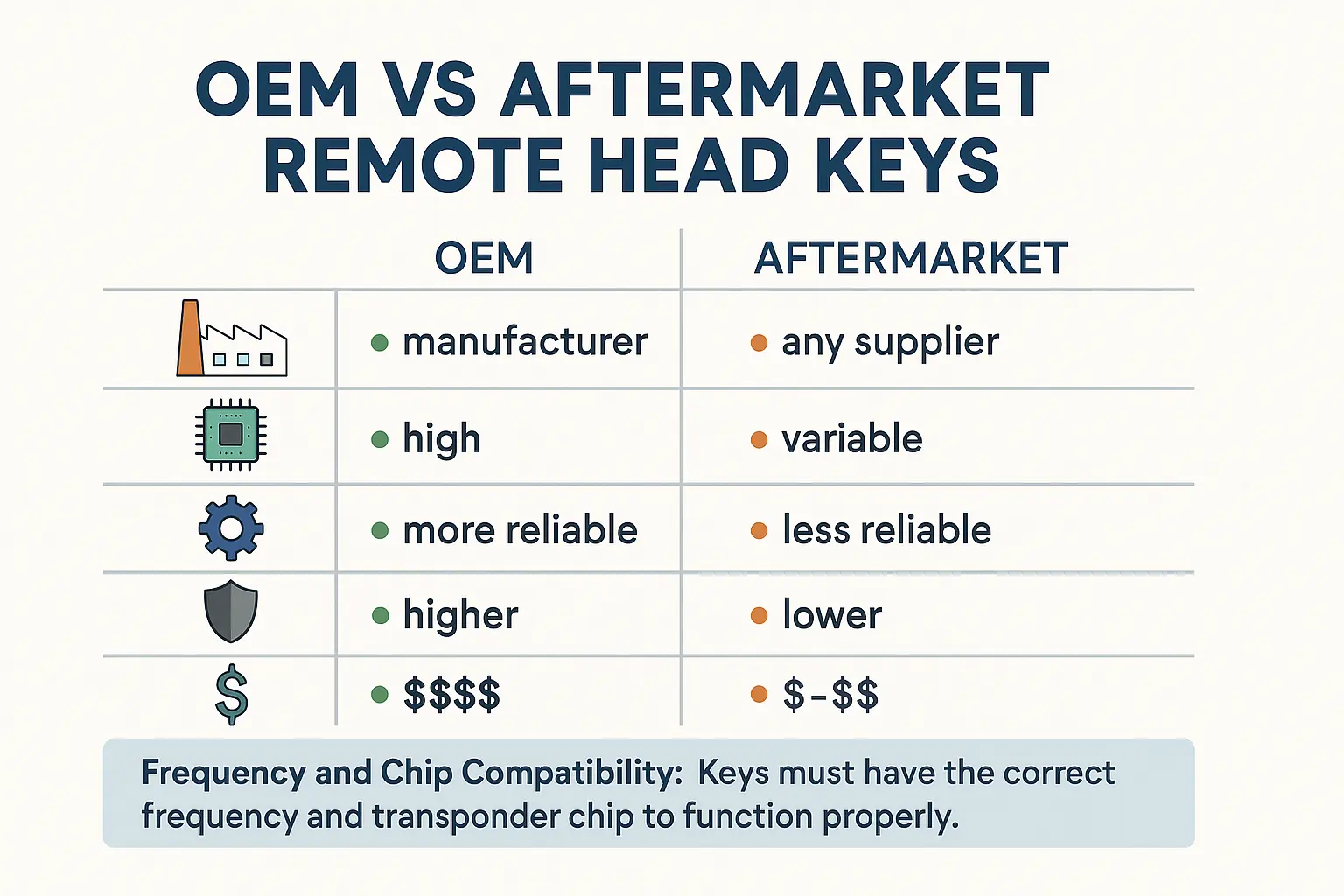
OEM vs. Aftermarket Remote Head Keys: The Evaluation Guide


If your original remote head has suffered physical PCB damage, you must choose between an OEM replacement or an aftermarket alternative.

  • OEM (Original Equipment Manufacturer): Sourced from factory-authorized suppliers (such as Valeo, Denso, or Continental), these feature rugged plastics, automotive-grade circuit boards, and a 99% programming success rate.
  • Aftermarket Alternatives: While a reliable aftermarket key fob offers a 60% to 80% price reduction compared to dealer prices, you must carefully verify FCC IDs and operating frequencies. High-quality aftermarket keys are highly effective, but cheap universal replicas often suffer from brittle plastics and high passive battery draw.

Partnering with an experienced mobile locksmith to cut and configure your new car key fob replacement bypasses steep dealership fees while ensuring your vehicle’s security system remains uncompromised.

Memorize the essential differences between OEM and aftermarket remote head keys to make confident purchasing choices that balance cost and reliability.

Need more information? Get a free quote

Call us now

Get A Free Call From Our Experts!

Floating Button Form