
Unified Building Security: Integrating Office Key Systems with Modern Access Control
Published: Oct 5, 2026 | Updated: Oct 29, 2026
Introduction: The Physical-Digital Security Disconnect
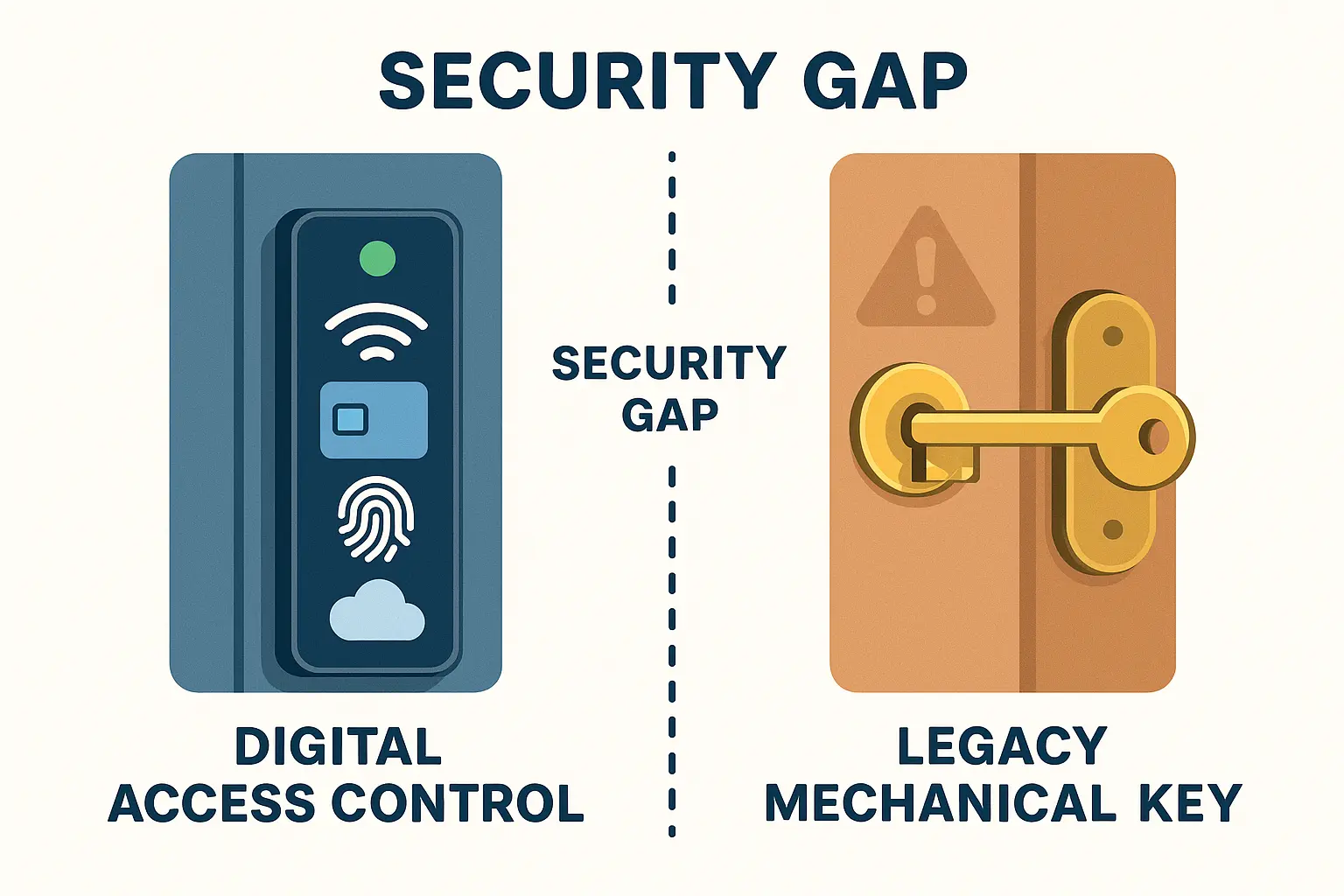
Many organizations operate under a costly illusion of safety. They invest heavily in a cutting-edge door access control system to protect their perimeter, only to secure high-value internal areas like server rooms, inventory cages, and executive suites with traditional, unmonitored mechanical brass keys. When physical keys exist outside your digital security network, you create an invisible back door that bypasses your entire software-defined security posture.
This blind spot carries measurable financial and operational risks. Facility security data reveals that a medium-to-large corporate office building spends between $15,000 and $25,000 annually on emergency locksmithing and re-keying when master keys are lost or unaccounted for. More critically, physical security audits indicate that over 37% of unauthorized entries involve the misuse of legitimate physical keys that were unmonitored or failed to be returned by contractors or former employees. Mitigating this risk requires migrating from isolated mechanical hardware to unified restricted key systems integrated directly into your building’s central infrastructure.
Technical Architecture: How Key Cabinets Integrate with PACS
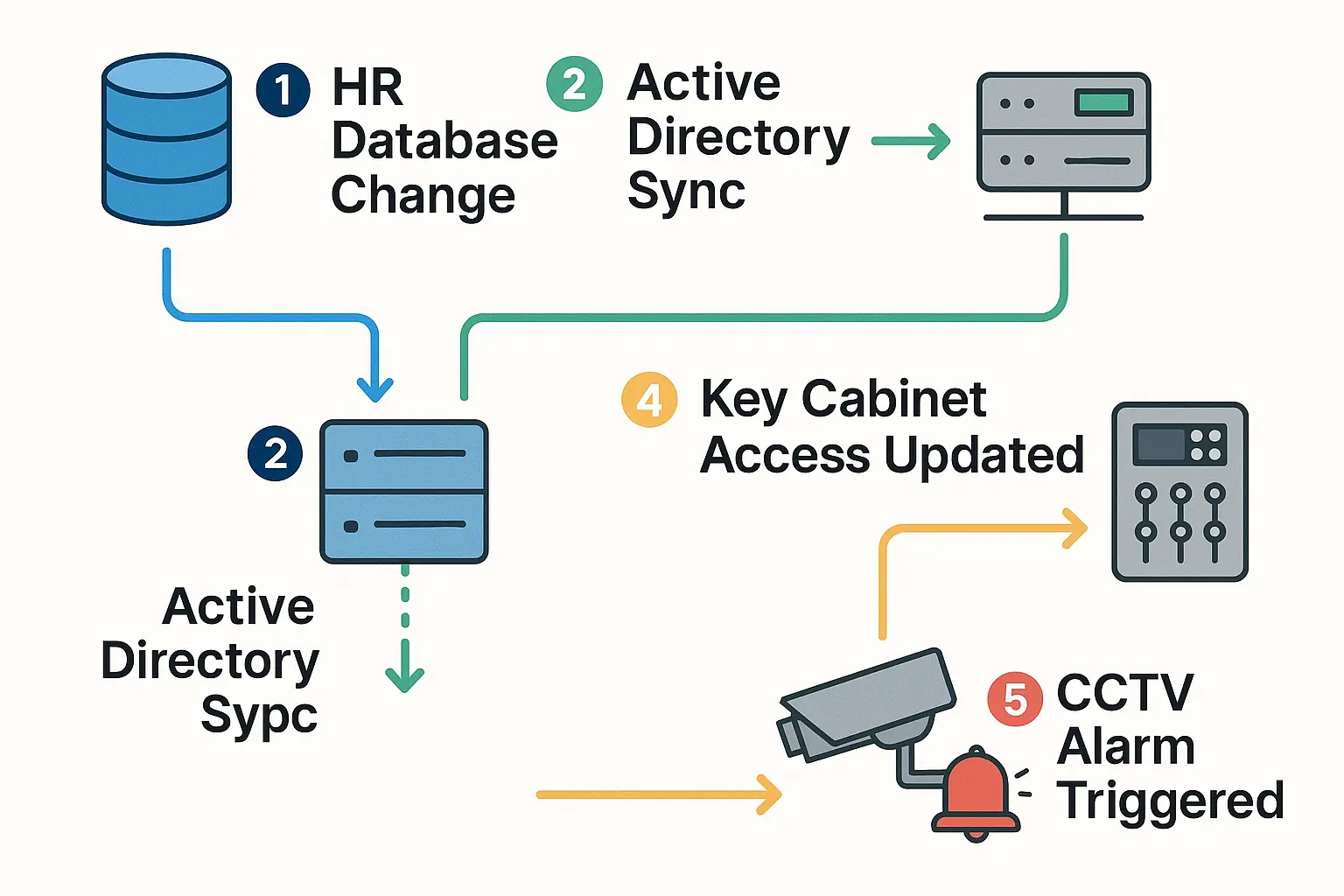
Bridging physical and software-defined security requires linking electronic key cabinets to your digital Physical Access Control Systems (PACS). Rather than managing two separate databases, a modern API-driven integration allows your key cabinets to dynamically sync with enterprise directory services like Active Directory or LDAP. If an employee’s access is revoked in your HR portal, their permission to pull critical physical keys is terminated instantly.
Integrating these types of access control systems requires shifting from legacy Wiegand wiring to Open Supervised Device Protocol (OSDP) v2.2. While older Wiegand systems are vulnerable to simple, low-cost packet sniffers that intercept badge data, OSDP v2.2 utilizes AES-128 channel encryption to secure transmissions. This ensures your key cabinet readers and main entry portals share the same high-security cryptographic standard, preventing signal interception and replay attacks.
Furthermore, this digital synergy transforms how you handle incident response. When a high-security key cabinet is tampered with, or a critical key is overdue, the integrated system automatically triggers nearby security cameras. By optimizing your planning security camera placement near access points and deploying specialized cctv camera types, operators receive real-time, bookmarked video footage linked directly to the alarm event, eliminating search fatigue.
Compliance Silo: Meeting Global Standards (IATA SeMS & Airport Security)
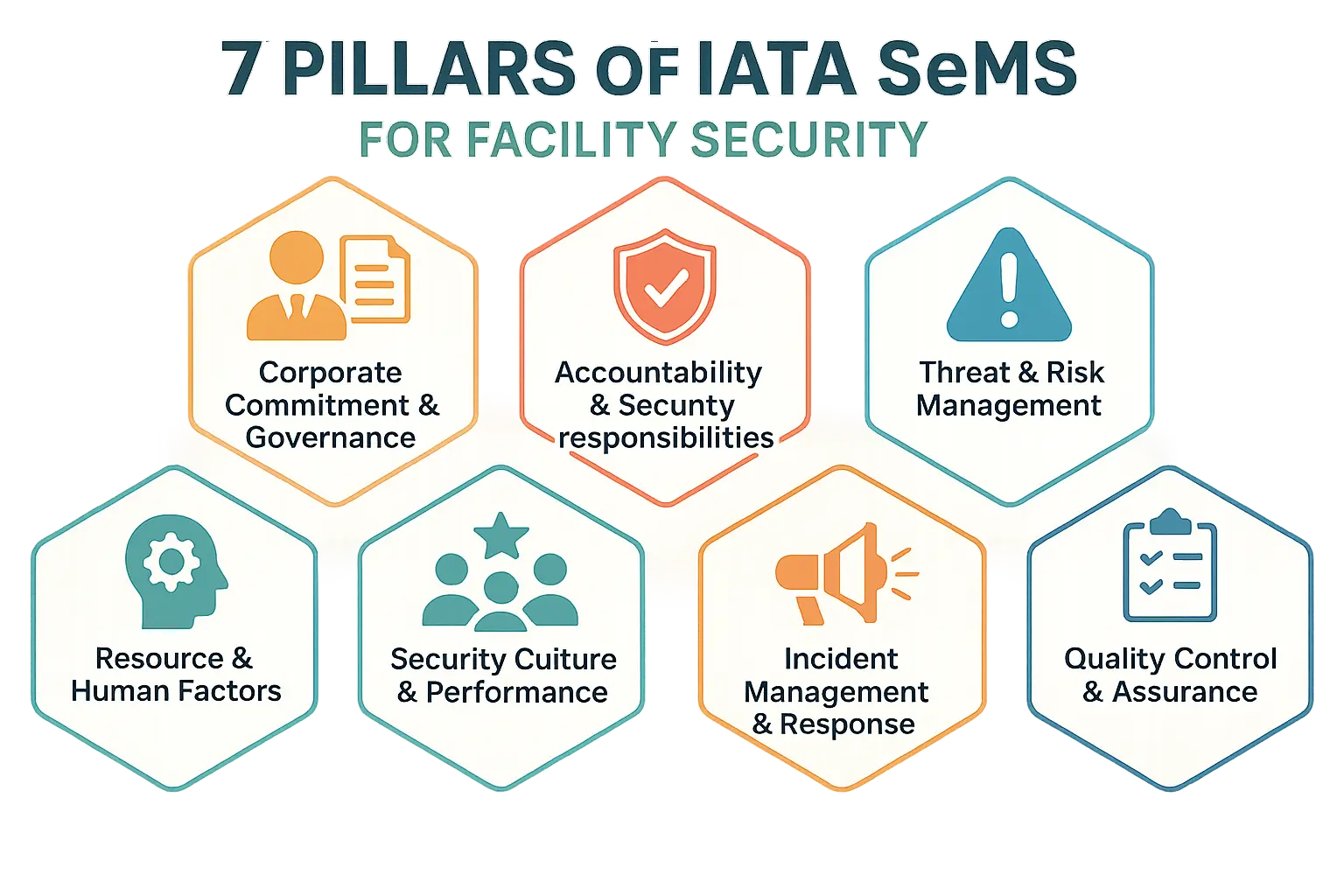
In high-security environments like aviation terminals, physical key security is a regulatory necessity. The International Air Transport Association (IATA) Security Management System (SeMS) framework mandates strict accountability and risk-reduction protocols across its seven core pillars, which include Corporate Governance, Incident Response, and Resource Management.
A manual logbook for brass keys cannot meet these auditing standards. By transitioning to a smart, digitized network of electronic lockers, airport operators can automate compliance. Each key transaction is stamped with a precise digital ID, confirming that only verified personnel access sensitive airside zones. This integration ensures that key tracking, real-time alerts, and visitor logging align flawlessly with global SeMS benchmarks, converting compliance audits from complex logistical headaches into automated, verifiable routines.
Frequently Asked Questions
Why is OSDP v2.2 preferred over legacy Wiegand wiring for key cabinets?
Legacy Wiegand wiring transmits credential data in unencrypted, raw pulses, making it highly vulnerable to inexpensive physical tap devices that steal badge data. OSDP v2.2 addresses this structural risk by using AES-128 channel encryption, ensuring that communication between the key cabinet’s badge reader and the main control system remains fully secure and immune to interception.
How does integrating key systems with PACS lower annual operating costs?
Unintegrated mechanical keys frequently go missing, costing businesses between $15,000 and $25,000 annually in lock replacement and labor. By integrating smart cabinets with your Physical Access Control System, you eliminate manual auditing, instantly revoke access to lost credentials, and enforce automated return deadlines, preventing expensive, recurring re-keying cycles.
What role does physical key management play in passing IATA SeMS security audits?
The IATA Security Management System framework requires clear oversight of who has access to airport assets and sensitive zones. Integrating smart key systems with the facility’s broader security network provides automated, tamper-proof audit logs that satisfy IATA requirements for accountability, risk control, and incident reporting.
Decentralized and Zero-Trust Corporate Security Blueprints
Modern forward-thinking tech enterprises are moving away from centralized gatekeeping toward “zero-trust” physical networks. In this model, physical spaces are treated like digital servers. Employees use high-security key fob door entry system credentials or mobile NFC tokens to authenticate access continuously. Real-time micro-segmentation ensures that access to a physical asset is only granted for the specific duration of a work order.
Applying zero-trust to physical assets requires unified hardware solutions. Whether managing an apartment building keyless entry system or integrating high-density office layouts, a central dashboard must monitor all access points. Incorporating highly encrypted solutions equivalent to cryptography equipment for homeowners scaled up to enterprise-level PKI (Public Key Infrastructure) protocols provides unbreakable endpoint security.
This unified architecture is essential across rapidly expanding commercial hubs. In Egypt’s New Administrative Capital, systems integrators face the unique challenge of connecting legacy installations to high-performance, centralized networks. Meanwhile, Bahrain’s cloud-first government policies encourage operators to link localized electronic cabinets with robust cloud-hosted PACS platforms. In Dubai, meeting the stringent Security Industry Regulatory Authority (SIRA) standards means having an airtight digital record of every door movement and physical key pull. Integrating physical key cabinets with software-defined security isn’t just about convenience—it is the foundation of regional compliance and future-proof protection.
Need more information? Get a free quote