Types of Mobile EV Charging Services And Solutions


Published: Aug 17, 2026

A quiet revolution is happening on our roads. The mobile EV charging landscape is undergoing a structural paradigm shift, moving rapidly from small consumer “range anxiety” suitcase batteries toward robust, commercial-grade fleet logistics and rapid roadside dispatch. For fleet managers minimizing operational downtime and drivers stranded with a depleted battery, understanding the technical and practical differences between mobile charging methods is essential to making fast, cost-effective decisions.

Just as a driver locked out of their vehicle needs immediate, specialized roadside assistance—relying on a comprehensive guide to avoid lockouts to navigate their options—EV operators must understand the exact capabilities, delivery models, and electrical parameters of off-grid mobile charging.
Range Anxiety vs. The Reality of Mobile Delivery


Mobile EV charging is no longer just a luxury safety net for individual road trippers. Today, it serves as a critical infrastructure bridge. Businesses awaiting utility grid upgrades (which frequently face 12-to-24-month delays) rely on mobile solutions to keep electrified fleets moving.

The global mobile EV charging market is expanding aggressively, valued at USD 1.45 billion in 2025 and projected to reach USD 9.33 billion by 2035. This growth is driven by a simple truth: stationary infrastructure cannot cover every edge case. Whether it is an emergency roadside rescue or programmatic fleet staging, mobile charging brings the grid directly to the vehicle.


The Taxonomy of Mobile Charging (L2 AC vs. Mobile DCFC)


To evaluate your options, you must first distinguish between the two primary electrical delivery methods:

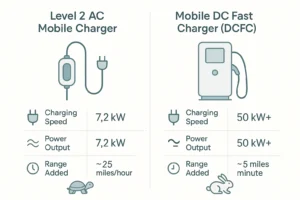
This diagram clarifies the fundamental difference between Level 2 AC mobile chargers and Mobile DC Fast Chargers by visualizing their power outputs and relative charging speeds, helping readers grasp why DC Fast Charging delivers significantly faster range restoration.

  • Level 2 Mobile AC Charging: These systems deliver power using alternating current (AC), typically at rates of 7.2 kW to 9.6 kW. Because the vehicle’s onboard charger must convert this to direct current (DC) for the battery, recovery is slower—usually adding about 10 to 25 miles of range per hour of connection.
  • Mobile DC Fast Charging (DCFC): Operating at 20 kW to 50 kW (and up to 350+ kW for heavy industrial skids), mobile DCFC bypasses the vehicle’s onboard converter, feeding DC power directly to the battery. This speed allows recovery crews to add 40 to 60 miles of range in just 20 to 25 minutes.

However, off-grid charging is bound by thermodynamics. Depending on the battery chemistry (such as LiFePO4 vs. NMC) and inverter quality, mobile systems suffer a 15% to 25% conversion efficiency loss. A nominal 3.6 kWh battery pack, for instance, typically delivers only about 2.7 kWh of usable energy to the vehicle.


Delivery Models: CaaS, On-Demand Roadside, and Van-Based Services


Depending on the operational scale, mobile charging is deployed through three primary models:

On-Demand Emergency Dispatch

For stranded drivers, programmatic networks operate mobile units across metropolitan areas. With average arrival times of 30 to 45 minutes, these services charge flat call-out fees (typically around $165) to deliver emergency range. If you have ever wondered, “does car insurance cover locksmith” services or flatbed towing, you will find that mobile EV dispatch often serves as a faster, safer, and comparably priced alternative to a traditional flatbed tow.

Van-Based Retrofits

Equipped with high-output battery banks or low-emission clean generators, retrofitted commercial cargo vans act as highly agile mobile service fleets. Much like the way specialized mobile locksmith services bring precision tools and security solutions directly to a client’s location, these vans carry the necessary physical and electrical equipment to resolve charging emergencies right on the shoulder of the highway.

Charging-as-a-Service (CaaS) & BESS Trailers

For enterprise logistics, construction sites, and major events, heavy-duty Battery Energy Storage Systems (BESS) offer trailer- or skid-mounted configurations up to 1,000+ kWh. These industrial units require no upfront CapEx and can be deployed rapidly to support fleets during peak operational hours.


The Technical Blueprint (Solving the Floating Ground Issue)


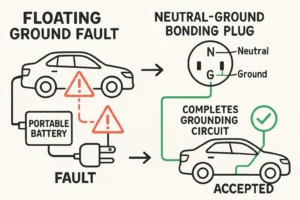
This visual explains the common technical barrier of floating ground fault errors with portable EV chargers and demonstrates how a neutral-ground bonding plug safely solves the issue, demystifying the electrical safety logic for readers.

A common obstacle when using portable generators or consumer-grade power stations for DIY off-grid charging is the “floating ground” fault.

Electric vehicles perform automatic safety diagnostics before accepting power. They check to ensure the electrical system is properly grounded. Because standard portable batteries operate with an unbonded neutral line, the vehicle detects a “floating ground” and throws a safety fault error, refusing to charge.

To resolve this issue, operators use a Neutral-Ground Bonding Plug. This plug connects the neutral terminal to the ground terminal within the generator’s outlet. This configuration safely satisfies the EV’s diagnostic check, enabling a seamless transfer of power.


Frequently Asked Questions (FAQ)


Why won't my standard portable solar generator charge my EV?

Standard power stations feature floating grounds. Your EV’s onboard diagnostic system detects this lack of physical grounding as a safety hazard and blocks the flow of current. Using a neutral-ground bonding plug resolves this issue.

Is mobile fast charging safe for my vehicle's battery health?

Yes. Modern mobile fast chargers communicate directly with your EV’s Battery Management System (BMS) to regulate power delivery, ensuring voltage and thermal limits are never exceeded.

What should I do if my EV battery dies completely on the highway?

If you are stranded without a charge, calling an emergency locksmith service or roadside charging network with mobile dispatch capabilities is the safest option. A dedicated roadside unit can deliver enough emergency range in 20 minutes to get you safely to the nearest stationary DCFC station.

Hardware Specs & Economics Matrix (Suitcase vs. BESS Trailers)


Selecting the right solution requires weighing hardware acquisition costs, weight restrictions, and delivery rates.

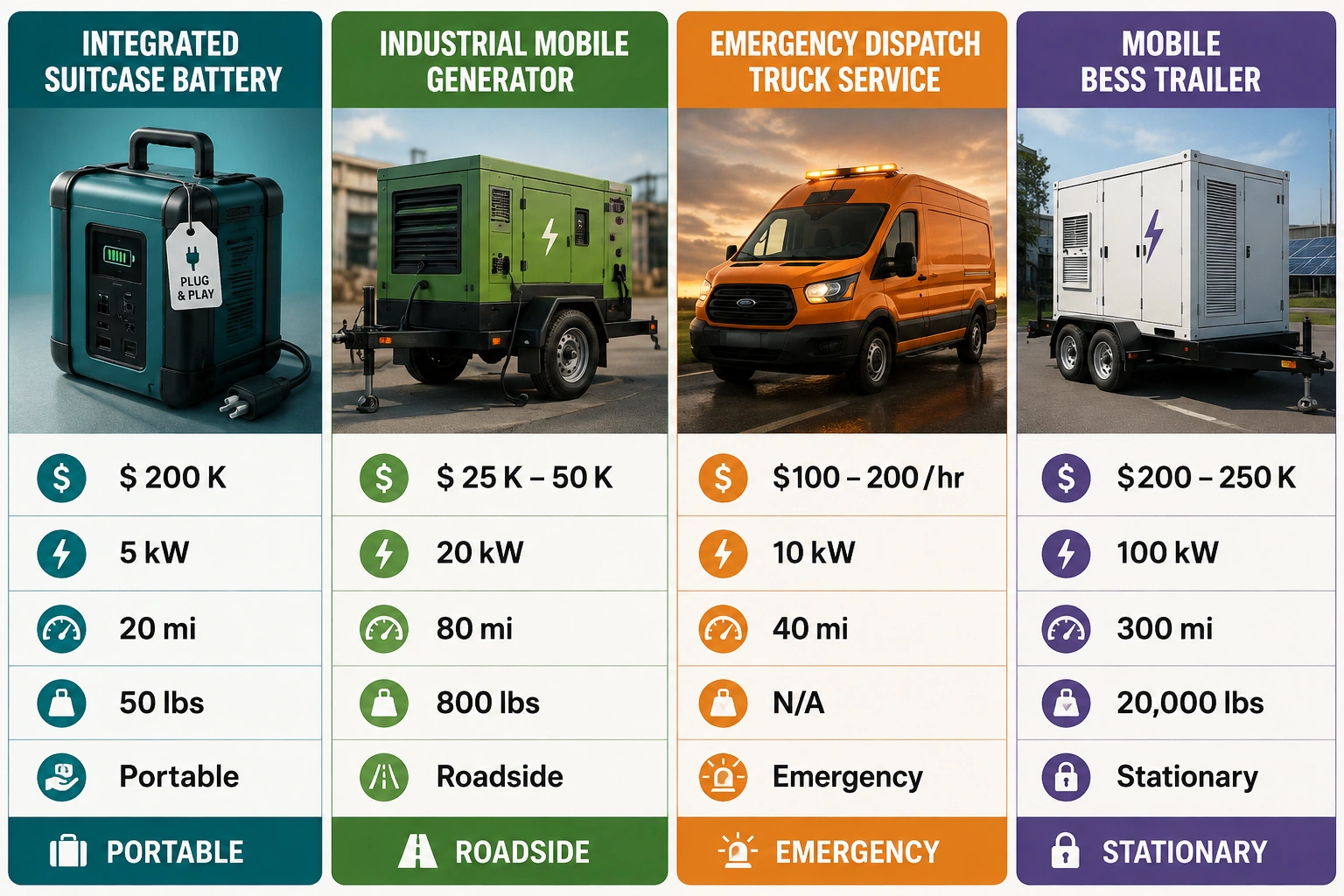
Mobile Solution Type Average Unit/Service Cost Output Rate (kW) Range Added (per 30 min) Physical Weight (lbs) Best Suited For
Integrated Suitcase Battery $2,000 – $3,500 7.2 kW ~15–20 miles 50 – 75 lbs Individual Road-Trippers & Off-grid Campers
Industrial Mobile Generator $6,500+ 9.6 kW ~25–30 miles 350+ lbs Roadside Assistance Providers & Commercial Fleets
Emergency Dispatch Truck $165 flat call-out fee 20 kW – 50 kW ~40–60 miles N/A (service-based) Stranded Urban & Suburban Drivers
Mobile BESS Trailer Managed CaaS ($0 upfront) 350+ kW Full charge in < 30 min Trailer-mounted Commercial Depots, Event Venues & Logistics Fleets


This infographic summarizes mobile EV charging options by comparing physical form factors, economics, charging power, and typical users, giving readers a memorable visual anchor to confidently compare diverse solutions.


Need more information? Get a free quote

Call us now

Get A Free Call From Our Experts!

Floating Button Form