Keyed Alike: One Key for Every Exterior Door in Your Home
Published: Sep 28, 2026
Fumbling with a heavy keyring in the dark is a frustrating routine most homeowners know too well. Carrying different keys for your front door, back door, garage, and side entries is not only inconvenient but entirely unnecessary. Consolidating your home security to a single key is one of the easiest ways to streamline your daily routine.
Before diving into a physical hardware overhaul, it is essential to understand how locks interact, what constraints you will face, and the overall pros and cons of one key house systems to determine if this setup meets your household’s security needs.
The Golden Rule of Keying Alike: Brand & Keyway Compatibility
The most common mistake homeowners make is assuming any lock can be set to match any key. Locks can only be keyed alike if they share the exact same keyway profile. The keyway is the internal shape of the cylinder plug where the key is inserted. If a key cannot physically slide into the keyway, the lock cannot be keyed to match.
In North America, two manufacturing giants dominate the landscape: Schlage (using the SC1 keyway profile) and Kwikset (using the KW1 keyway profile). Together, these brands command over 70% of the residential lock market. Because their physical keyway designs are fundamentally incompatible, a standard Kwikset key will never fit into a Schlage cylinder, and vice versa.
To determine your starting point, examine your current keys and hardware brands.
The Kwikset (KW1) Profile: Typically features a rounded key bow (head) with three holes. It is cross-compatible with brands like Defiant and Weiser.
The Schlage (SC1) Profile: Typically features an angular, pentagonal key bow. It is cross-compatible with premium brands like Baldwin and Yale.
Understanding what is a lock cylinder and identifying your keyway is the critical first step before purchasing any new hardware or planning a rekey project.
Visual guide to identify your home’s keyway profile and understand which lock brands can be keyed alike. Matching keyway shapes ensure your exterior doors can share one key safely and effectively.
The Locksmith "Cheat Code": The Kwikset SC1 SmartKey Cylinder
If your home currently features a mix of Kwikset and Schlage locks, you do not necessarily have to replace all your locks to achieve a one-key setup.
Locksmiths and security professionals often use a highly effective workaround: the Kwikset Specialty SC1 SmartKey Cylinder (Part #85174). This specialty cylinder can replace the standard KW1 cylinder inside many Kwikset handlesets and deadbolts. Once installed, it allows the Kwikset lock to accept and function with an SC1 Schlage key. This cross-brand hybrid solution saves you from having to purchase entirely new matching hardware.
The Three Paths to a One-Key Home
Once you have verified your lock compatibility, you have three primary pathways to transition your home to a single-key system.
Path A: Buy Pre-Keyed Retail Packs
If your existing locksets are worn, outdated, or visually mismatched, purchasing new retail “project packs” is a straightforward solution. Manufacturers sell multi-packs of deadbolts and entry locks packaged together that are already keyed alike. Look for the matching “Key Code” printed on the back of the packaging to ensure all boxes in your cart use the exact same key.
Path B: The DIY Rekeying Approach
For hands-on homeowners with compatible hardware, DIY rekeying is a cost-effective alternative. You can purchase a brand-specific pinning kit online, which includes a plug follower, tweezers, and color-coded pins. If you have newer Kwikset locks equipped with SmartKey technology, you can rekey them in about 15 seconds using only their proprietary learn tool.
If you are working with traditional pin-tumbler systems, taking the cylinder apart requires patience and precision. For detailed steps, you can read our guides on how to rekey door lock mechanisms or learn how to rekey a deadbolt lock yourself. If you are starting from scratch with new locks, you can also learn how to install a deadbolt to complete the project.
Path C: Hire a Professional Locksmith
If you have high-security cylinders, commercial-grade hardware, or a complicated mix of lock brands, hiring a professional locksmith is the safest and most efficient path. A mobile locksmith can assess your existing locks, swap out incompatible cylinders on-site, and repin your locks to a single key in a single visit, saving you time and avoiding the risk of ruining a lock cylinder during a DIY attempt.
Step-by-step guidance and cost comparison to help homeowners choose the best path to simplify their keys, balancing cost, effort, and convenience.
Security & Access Control: Is Keyed Alike Safe?
A common reservation homeowners have about a keyed-alike system is the single point of failure: “If I lose my key, doesn’t someone have access to my entire house?”
Statistically, opportunistic burglars rarely attempt to pick locks or use lost keys; they exploit physical structural weaknesses like weak door frames, standard strike plates, or unlocked windows. A lost key is a security risk regardless of whether it opens one door or four, and replacing or rekeying your locks is recommended any time physical keys are lost or unaccounted for.
It is also vital to distinguish between a keyed-alike system and a master key system. For residential use, keyed-alike systems are structurally much safer. Master keying introduces multiple shear lines within a single lock cylinder to allow two different keys to work. This structural compromise mathematically increases the cylinder’s vulnerability to lock picking and lock bumping by up to 300%. Understanding master key vs keyed alike mechanics helps you maintain high physical security standards at home.
Frequently Asked Questions
Can any lock brand be keyed alike to match another?
No. Locks can only be keyed alike if they share the exact same keyway profile. For example, a Kwikset lock (KW1 keyway) cannot be keyed to match a Schlage lock (SC1 keyway) because the keys cannot physically fit into each other’s cylinders. However, brands that share keyway styles, like Baldwin and Schlage, can easily be keyed alike.
Does keying all my doors alike make my home less secure?
Practically, no. If an unauthorized person obtains your house key, your security is compromised whether that key opens one door or all of them. Burglars rarely target lock cylinders; they look for open windows or weak frames. For peace of mind, keyed-alike systems are actually more secure than master-keyed systems, because master keying introduces extra internal shear lines that make locks easier to pick.
Is it cheaper to rekey my existing locks or buy brand-new ones?
Rekeying your existing locks is almost always more cost-effective than buying new hardware, especially if your current handlesets and deadbolts are in good structural condition. Rekeying only requires replacing the inexpensive internal brass pins, whereas replacing the hardware means buying entirely new locksets for every door.
Smart Lock Integration: The Future of the One-Key Home
With the global smart lock market projected to reach $13.52 Billion by 2035—growing at a rapid CAGR of 19.9%—more homeowners are transitioning to hybrid entry systems. A very popular modern security layout involves installing a smart lock on the primary entry door (like the front door) while keeping traditional mechanical locks on secondary doors (side, back, or garage doors).
To maintain a true one-key home in this hybrid configuration, make sure the physical emergency key bypass on your smart lock matches the keyway profile of your secondary mechanical locks. If your back door uses a mechanical Schlage deadbolt, choose a smart lock for the front door that features a matching physical Schlage keyway cylinder. This allows you to go completely keyless on a daily basis while carrying a single physical backup key that opens every door in an emergency, such as a dead battery or electronics failure.
Selecting among the different types of smart locks with compatible keyways ensures your home remains secure, accessible, and elegantly simple.
Memorize how to integrate smart locks with traditional keyed-alike mechanical locks to ensure seamless security and emergency access in your home.

 Visual guide to identify your home’s keyway profile and understand which lock brands can be keyed alike. Matching keyway shapes ensure your exterior doors can share one key safely and effectively.
 Step-by-step guidance and cost comparison to help homeowners choose the best path to simplify their keys, balancing cost, effort, and convenience.
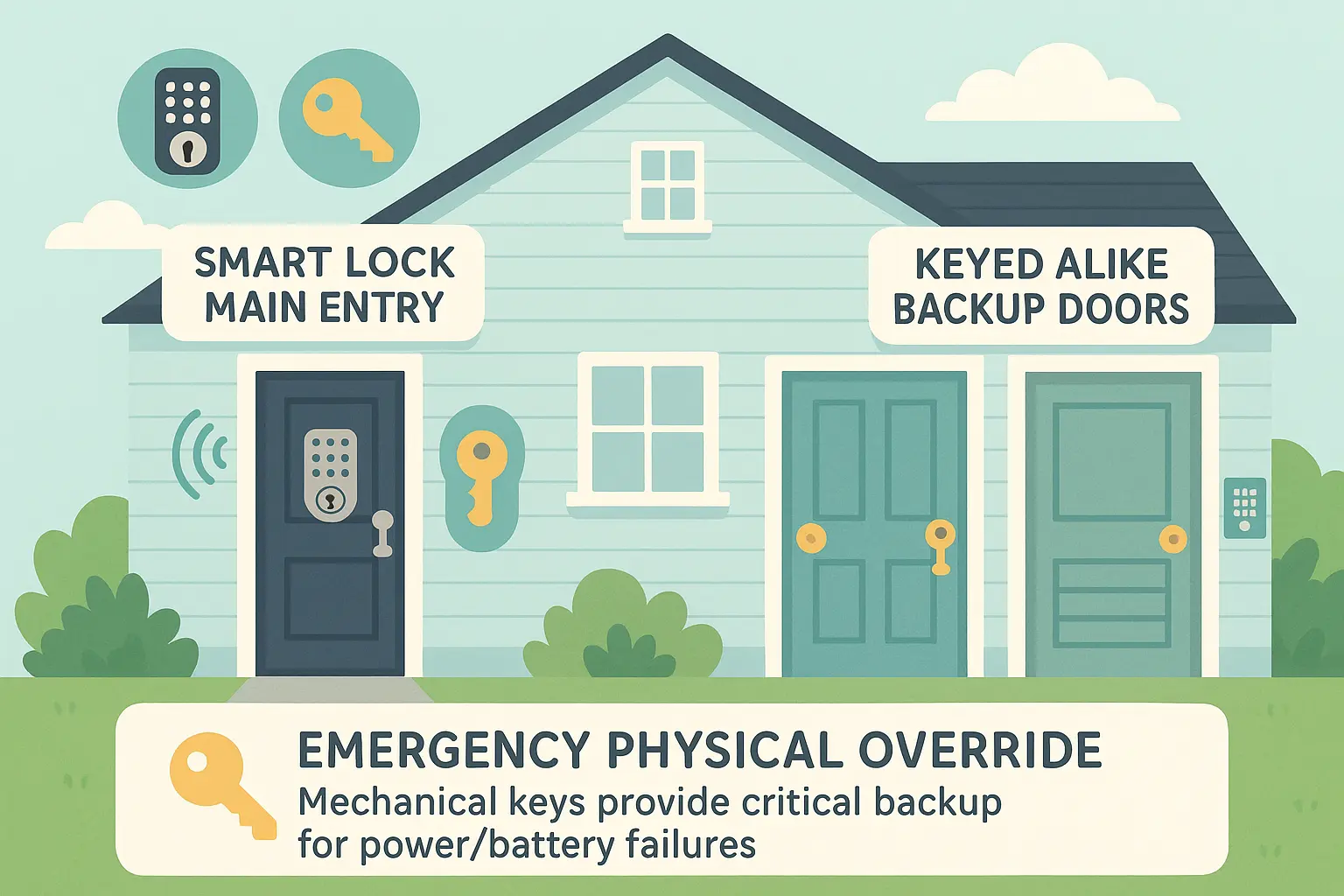 Memorize how to integrate smart locks with traditional keyed-alike mechanical locks to ensure seamless security and emergency access in your home.