A Visual And Functional Guide to Identifying Your Car Key Type


Published: Sep 7, 2026

When you lose your car keys or need a spare, you are suddenly hit with confusing terms like “transponder,” “proximity fob,” and “laser-cut.” Dealerships often exploit this confusion, charging anywhere from $150 to $500+ for a single smart key replacement. However, understanding exactly what technology is inside your key can save you 50% to 70% of that cost by helping you choose the right duplication path.

At sure lock and key, we believe in transparent, expert guidance. Whether you need an emergency spare from a locksmith dallas technician or are comparing lock options with an expert locksmith new york team, this guide will help you accurately identify your key type.
The 10-Second Visual & Functional Checklist (Above the Fold)


To diagnose your key type, look for specific visual markers and functional behaviors:

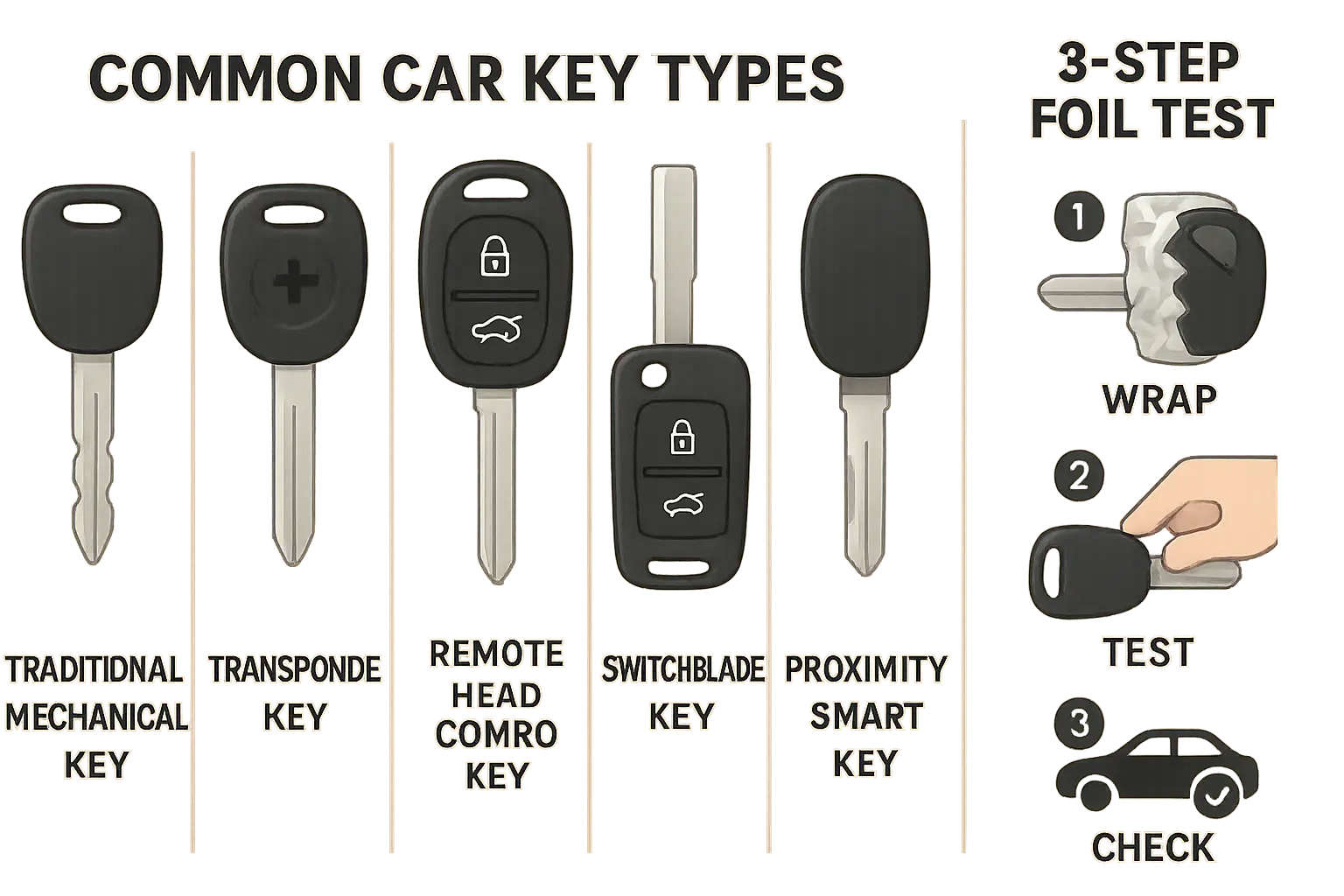
  • Traditional Mechanical Key: Flat metal with no plastic head. It only turns the physical locks.
  • Transponder Key: Features a molded plastic head covering a passive RFID chip. Look for stamped symbols like “+”, “G”, “S”, or a circle-plus on the metal blade.
  • Remote Head Combo Key: Remotes with lock/unlock buttons built directly into the key’s plastic head.
  • Switchblade/Flip Key: The metal blade folds away into a plastic fob with buttons, springing out at the press of a button.
  • Proximity Smart Key: A buttonless entry fob. As long as it is in your pocket, the vehicle starts via a push-to-start button.

Visual comparison of car key types with a simple 3-step Foil Test to instantly identify transponder keys by blocking their RFID signal.

The 3-Step “Foil Test”: If you are unsure if your plastic-headed key has a chip, wrap the plastic head tightly in several layers of heavy aluminum foil, leaving only the metal blade exposed. Insert it into the ignition and try to start the car. If the engine cranks but won’t start (or dies immediately), you have a transponder key. Since 1995, over 95% of US vehicles require this programmed RFID signal to bypass the engine immobilizer.

Retail Feasibility Matrix Section (Near Decision-Making Tools)


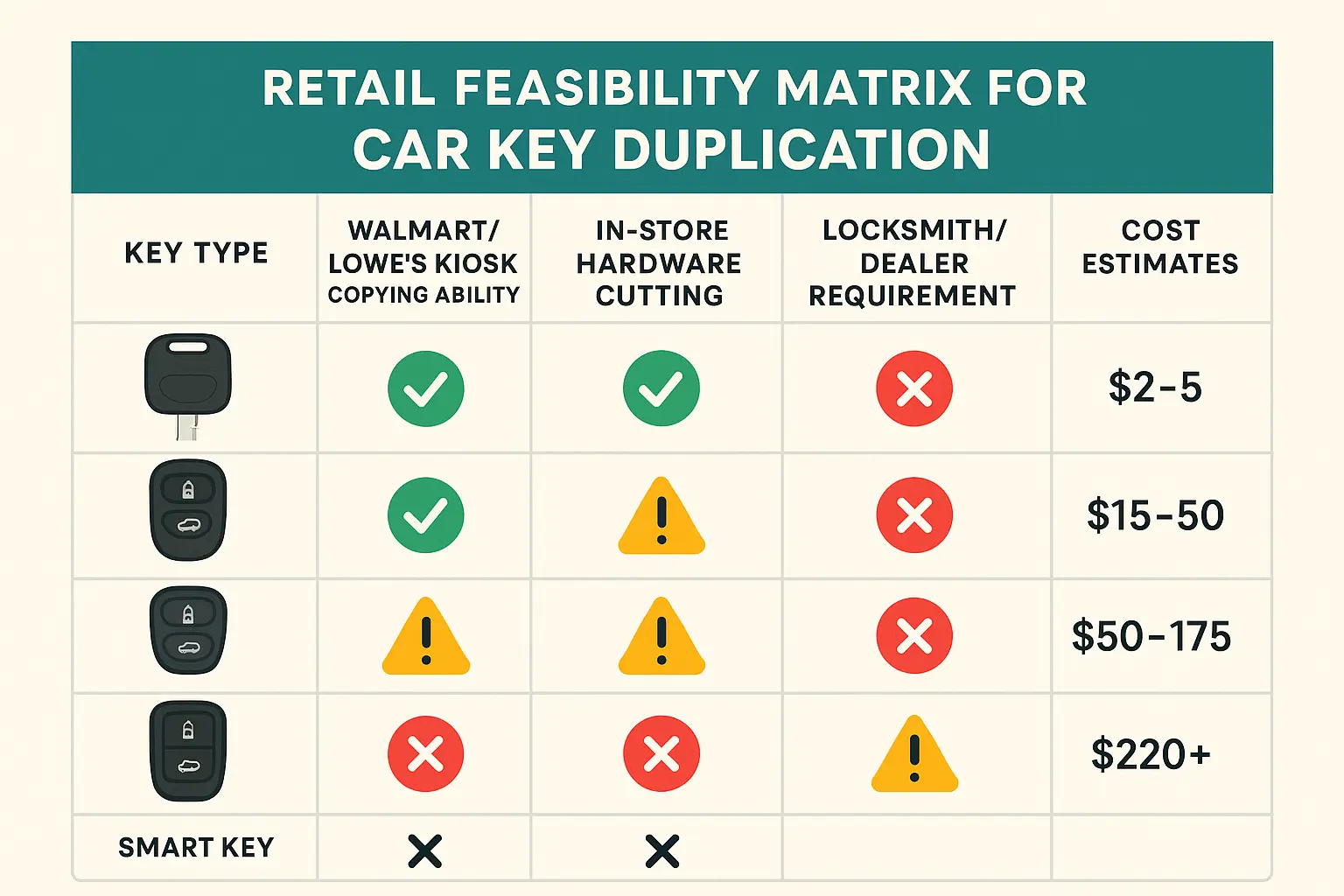
Many car owners ask: “Can I just copy my key at a retail kiosk?” The answer depends entirely on your key’s technology. Self-service kiosks can clone simple signals, but they cannot handle active OBD-II vehicle programming.

Step-by-step guide to where and how different car key types can be duplicated or programmed, with clear indicators of DIY options and professional service needs.

  • Mechanical Keys: Easily copied at any kiosk or hardware store ($1.50–$5.00).
  • Transponder Keys: Kiosks can clone basic RFID chips, but a professional is recommended to pair the key to your car’s system ($30–$90).
  • Remote Head Keys: Retail stores struggle with programming the actual remote buttons ($90–$180).
  • Proximity Smart Keys: These require dedicated OBD-II diagnostics tools used by licensed locksmiths or dealers ($150–$400).

The “2-Key Rule”: For most domestic brands (Ford, GM, Chrysler), if you currently have two working keys, you can self-program a third key using an onboard sequence. If you only have one working key, DIY programming is impossible, and professional programming equipment is required.

Maintenance and Repair Section (Stripped Screw & Clamp Hardware Guide)


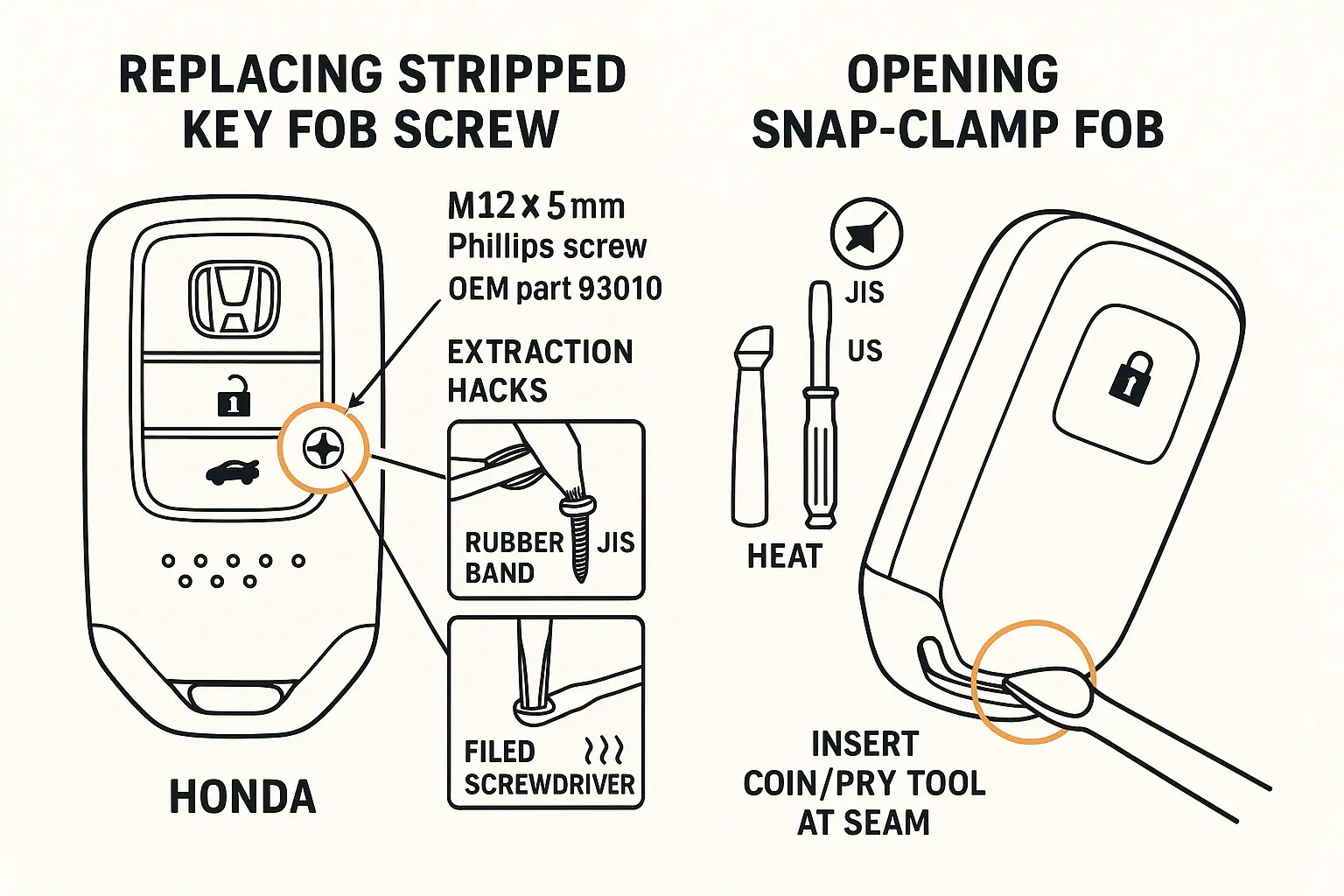
DIY maintenance comes with physical risks. Thousands of Honda and Acura owners (models 2003-2015) strip their remote head keys’ tiny M2 x 5mm Phillips holding screw (OEM part number: 35116-SDA-A11) when changing batteries. This happens because they use standard household screwdrivers instead of a Japanese Industrial Standard (JIS) screwdriver or a precision #00 tool.

Step-by-step memory aid for rescuing stripped key fob screws and opening screwless clamp fobs safely, preventing further damage during battery changes.

If you strip this screw, don’t panic. Place a wide rubber band over the screw head, press your screwdriver firmly into the band, and turn slowly. For screwless fobs (clamp-style), use a plastic pry tool along the seam to avoid cracking the internal circuit board.

If you find your standard key fob is too bulky, you can actually “shrink” your key fob. Many enthusiasts remove the internal printed circuit board (PCB), wire the battery separately, and seal it using tight heat-shrink tubing or transfer it to a custom, ultra-slim aftermarket shell for a cleaner pocket footprint.

Frequently Asked Questions


Can I buy an aftermarket key fob online and program it myself?

Only if your vehicle supports self-programming and you meet the necessary prerequisites. Many domestic models require two existing, active keys to program a new one. If you only have one key, or drive a European or modern push-to-start vehicle, you will need a professional with specialized programming equipment.

Why won't my retail-cut key start my car?

If the key opens your car door but the engine refuses to turn over, your car has an active immobilizer system. This means your new key is either missing an RFID transponder chip entirely or the chip has not yet been synced to the vehicle’s computer.

How do I open a key fob that has no visible screws?

These are clamp-style fobs. They rely on internal plastic clips to hold the shell together. To open them without breaking the delicate plastic tabs, insert a flat plastic pry tool or a coin into the seam indent (typically near the key ring attachment point) and twist gently.

Common Pitfalls: VATS and the LiftMaster Trap


Before ordering parts, watch out for these common mix-ups:

  • VATS Keys: Older GM vehicles (pre-1995) use VATS (Vehicle Anti-Theft System) keys. They look like they have a chip, but they actually have a physical, visible resistor pellet on the metal blade.
  • The LiftMaster Trap: Do not confuse your garage remote with your car fob. A LiftMaster key fob operates on garage-door-specific frequencies (310MHz to 390MHz) and cannot be programmed to your ignition security system.

Need more information? Get a free quote

Call us now

Get A Free Call From Our Experts!

Floating Button Form