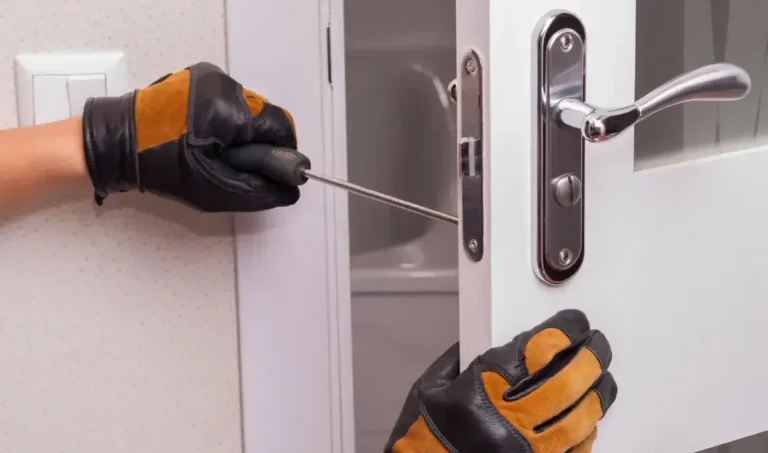
Many commercial property owners make a critical mistake: they spend hundreds of dollars on elite padlocks, only to mount them on standard hasps using basic hardware. A lock is only as strong as the surface to which it is anchored. If an intruder can bypass the entire locking mechanism by simply unscrewing the mounting bracket or shearing a soft steel staple, the security grade of the lock becomes irrelevant. True physical security requires looking at the hasp and its fasteners as an integrated defensive system.
Tactical Physical Security: High-Security Hasps and Anti-Tamper Metallurgy
Published: Sep 10, 2026 | Updated: Sep 15, 2026
The High-Security Hasp Ecosystem
To achieve commercial-grade physical security, your locking setup must rely on the Three Pillars of Structural Defense. First is the hasp body itself, which must feature heavy-gauge hardened steel and fully concealed hinges to prevent prying. Second is the lock interface—ideally a shrouded or hidden shackle (puck lock) that denies bolt cutters direct access to the shackle. Finally, the system relies on the fastener foundation: driver-less carriage bolts, security nuts, and tamper-evident cap seals.
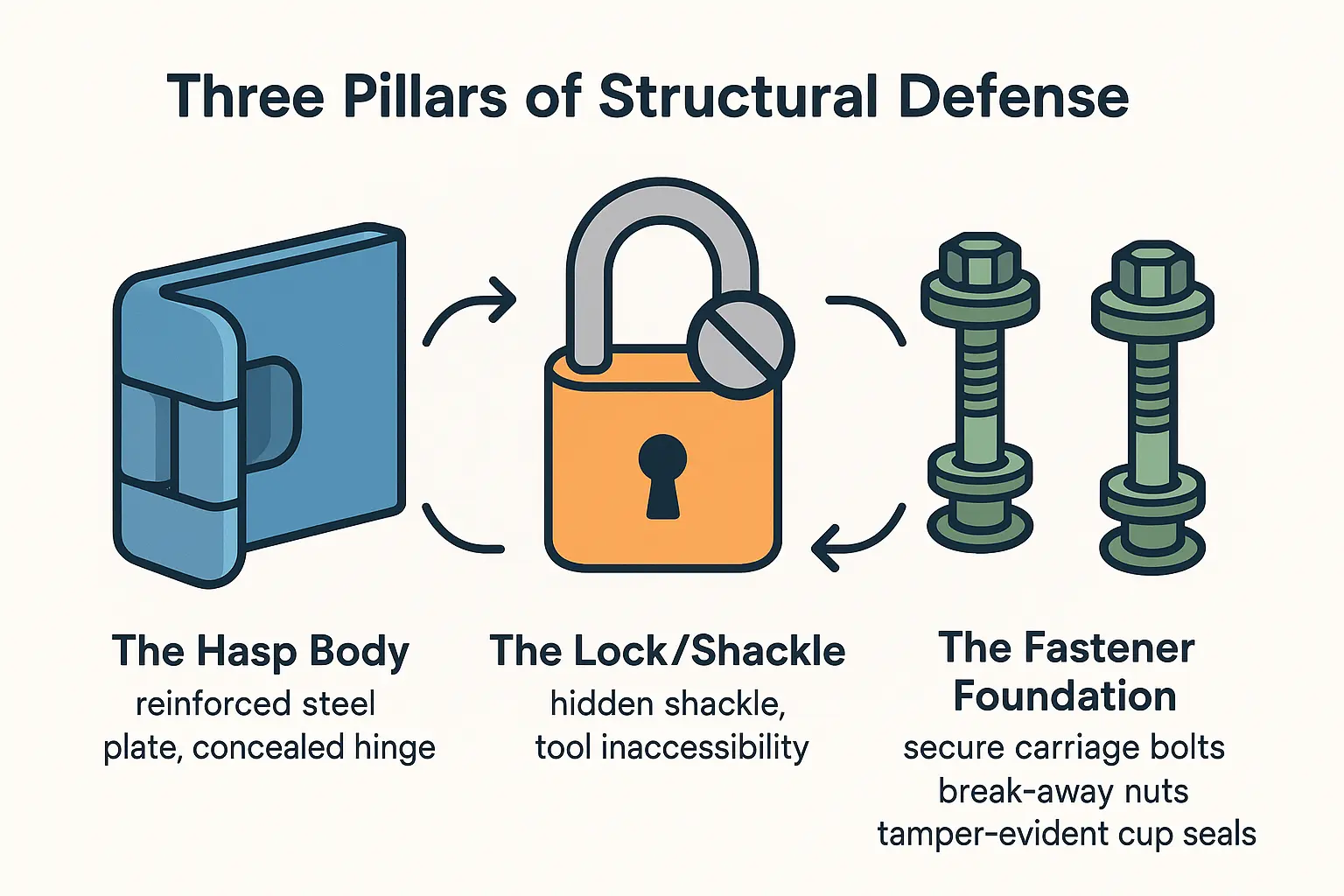 The Three Pillars of Structural Defense illustrate how a high-security hasp system integrates a robust steel hasp body, a concealed shackle locking mechanism, and tamper-resistant fasteners to create a unified defense against physical attacks.
By evaluating these three pillars as a singular ecosystem, security managers can eliminate structural vulnerabilities. For high-risk facilities, consulting an experienced locksmith company ensures that your heavy-duty physical barriers are anchored to stand up to aggressive entry attempts.
Evaluating Security Ratings and Metallurgy
When selecting physical security hardware, do not rely on vague marketing terms like “heavy-duty.” Instead, evaluate hardware using standardized European CEN (EN 12320) ratings, which scale from Grade 1 to Grade 6. For commercial properties, Grade 4 represents high security, while Grade 5 and 6 are reserved for ultra-high-security industrial or military applications.
The capability of attack tools scales strictly against metallurgy. Standard manual 36-inch bolt cutters exert approximately 4,000 lbs of pressure, easily cutting standard steel under 3/8 inches (10mm). To counter this, elite hasps utilize boron carbide or manganese steel alloys. Boron alloys possess a tensile strength exceeding 1,400 MPa, causing manual cutter jaws to dent or shatter upon impact.
 This chart visualizes the relationship between material hardness and security ratings, showing how boron carbide alloys and higher CEN grades provide superior resistance to bolt cutters, enhancing physical security effectiveness.
Eliminating External Attack Vectors
An experienced intruder always looks for the path of least resistance. If a hasp plate is mounted with standard hex bolts, a thief can easily back them out. Resolving this vulnerability requires tamper-proof carriage bolts. Because carriage bolts feature a smooth, rounded dome head on the exterior, there is no drive interface (such as a hex or Torx slot) to grip or turn.
On the secure interior side of the door, these bolts must be secured using specialized breakaway nuts or trident security nuts. A breakaway nut features a hexagonal head that snaps off once it reaches a specific installation torque, leaving behind a smooth, un-grippable cone. For additional security, tamper-evident metal cap seals can be pressed over standard fastener heads. If an adversary attempts to compromise the connection, they must destroy this metal cap, leaving an immediate, unmistakable visual alert of the tampering attempt.
Technical Troubleshooting: Removing Seized Anti-Tamper Bolts
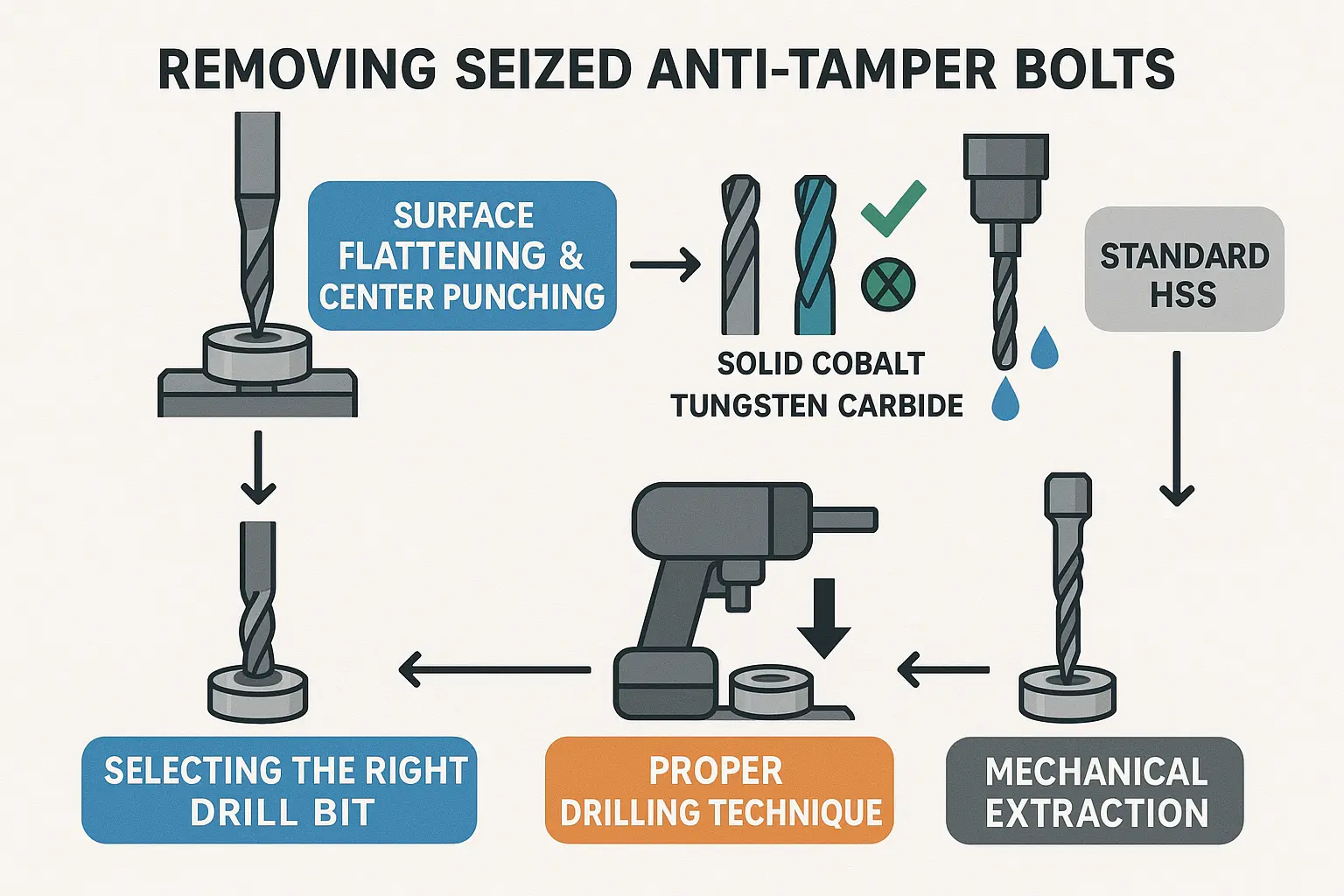
High-security fasteners protect your property from thieves, but they can also trap maintenance crews when hardware becomes rusted, seized, or keyways are lost. Standard drilling practices fail on hardened metals due to a phenomenon known as work-hardening. Under rapid drilling friction, specialized alloys undergo a thermal phase change, hardening past 60 Rockwell C (HRC) and instantly ruining high-speed steel (HSS) drill bits.
To extract a seized anti-tamper bolt successfully, follow this engineering-grade extraction protocol:
First, use a center punch to create a precise indent in the center of the bolt head. This prevents the drill bit from wandering and damaging the surrounding threads. Second, bypass standard HSS bits and select a Solid Cobalt (M42 with 8% cobalt) or tungsten carbide-tipped drill bit. Third, run your drill “low and slow”—aim for 300 to 400 RPM under heavy, consistent downward pressure, applying continuous cutting fluid to keep temperatures low and prevent work-hardening. Finally, insert a left-handed extractor tool into the pilot hole to back out the remaining threaded stud safely.
Frequently Asked Questions
What is the difference between case-hardened steel and boron-alloy steel?
Case-hardened steel has a hardened outer shell but remains ductile on the inside, which makes it resistant to sawing but susceptible to specialized hydraulic cutters. Boron-alloy steel is hardened throughout its entire structure, boasting massive tensile strength (over 1,400 MPa) that can shatter manual bolt-cutter jaws.
What CEN security grade do I need for a commercial facility?
For standard commercial gates and warehouses, hardware rated at CEN Grade 4 (high security) is highly recommended. For critical infrastructure, sensitive storage, or ammunition bunkers, you should utilize CEN Grade 5 or Grade 6 hardware.
Why did my drill bit instantly go dull when drilling a security bolt?
This happens because the frictional heat of high-speed drilling triggered work-hardening. This thermal process raises the metal’s surface hardness to over 60 HRC, which is harder than standard High-Speed Steel (HSS) drill bits. You must drill slowly (300-400 RPM) using cobalt bits and cutting fluid to avoid this.
Structural Physical Security vs. Electrical Code Compliance
It is easy to get confused when sourcing high-security physical components. For instance, search databases often display “tamper-resistant receptacles” alongside structural fasteners. However, these are fundamentally different. A tamper-resistant electrical receptacle refers to standard wall outlets equipped with internal, spring-loaded shutters designed to prevent accidental electrical shock—such as a child inserting a paperclip. True physical security, by contrast, relies on heavy-duty, hardened steel alloys designed to resist blunt-force mechanical attacks and physical intrusion.
Need more information? Get a free quote