Gate Access Control, Diagnostic and Repair Guide


Published: Aug 28, 2026

When a perimeter gate fails, security drops instantly, and operational costs rise. Whether you manage a residential estate, industrial site, or coordinate hoa gate access systems, diagnosing automatic gate issues quickly is critical to preventing costly downtime and liability. According to the International Door Association (IDA) and the American Fence Association (AFA), up to 87% of automatic gate failures are preventable through regular preventive care, and over 60% of emergency service calls involve minor, easily corrected electrical issues like misaligned safety photo-eyes or tripped GFCIs.

This guide outlines diagnostic workflows, seasonal care plans, and repair-vs-replace decision frameworks to help you maintain your security infrastructure reliably.
Interactive Symptom Diagnostic Matrix


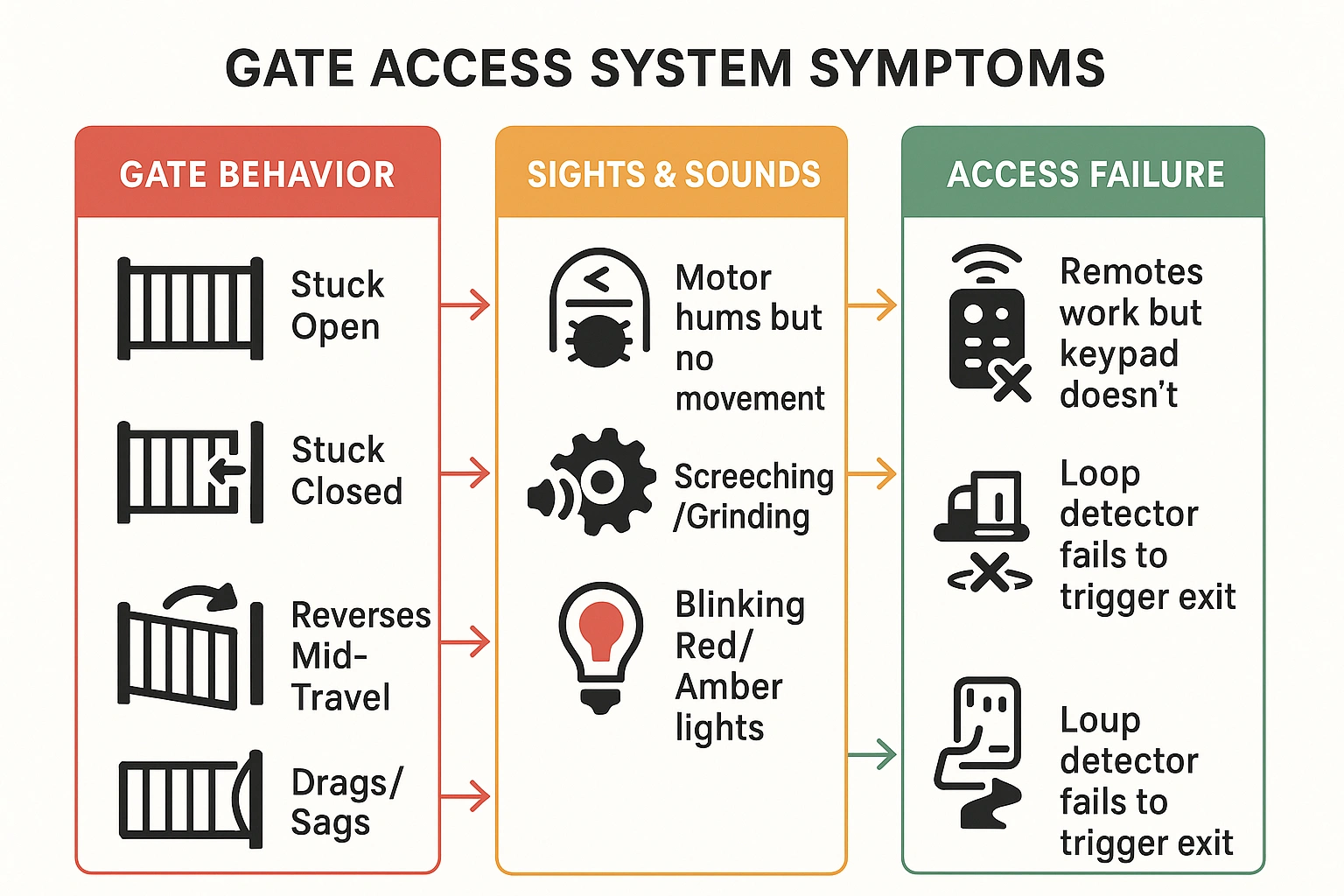
This symptom diagnostic matrix helps users quickly identify their gate's problem by visually categorizing common issues into behavior, sensory signs, and access failures, enabling targeted troubleshooting.

Use this symptom-based diagnostic matrix to isolate physical, electrical, or access-related faults in your outdoor gate access control system before scheduling service.

  • Gate Behavior: Stuck open/closed, reverses travel, or drags. Often points to physical track blockages, failed limits, or worn rollers.
  • Sights & Sounds: Humming motor without movement, screeching, or blinking red/amber LED codes. Typically signals bad capacitors, failing control boards, or misaligned safety photo-eyes.
  • Access Failure: System won’t respond to cards or loops. Points to low-voltage wire breaks, antenna issues, or faulty loop detectors.

STEP-BY-STEP Guide: The 6-Point DIY Safety Calibration Workflow


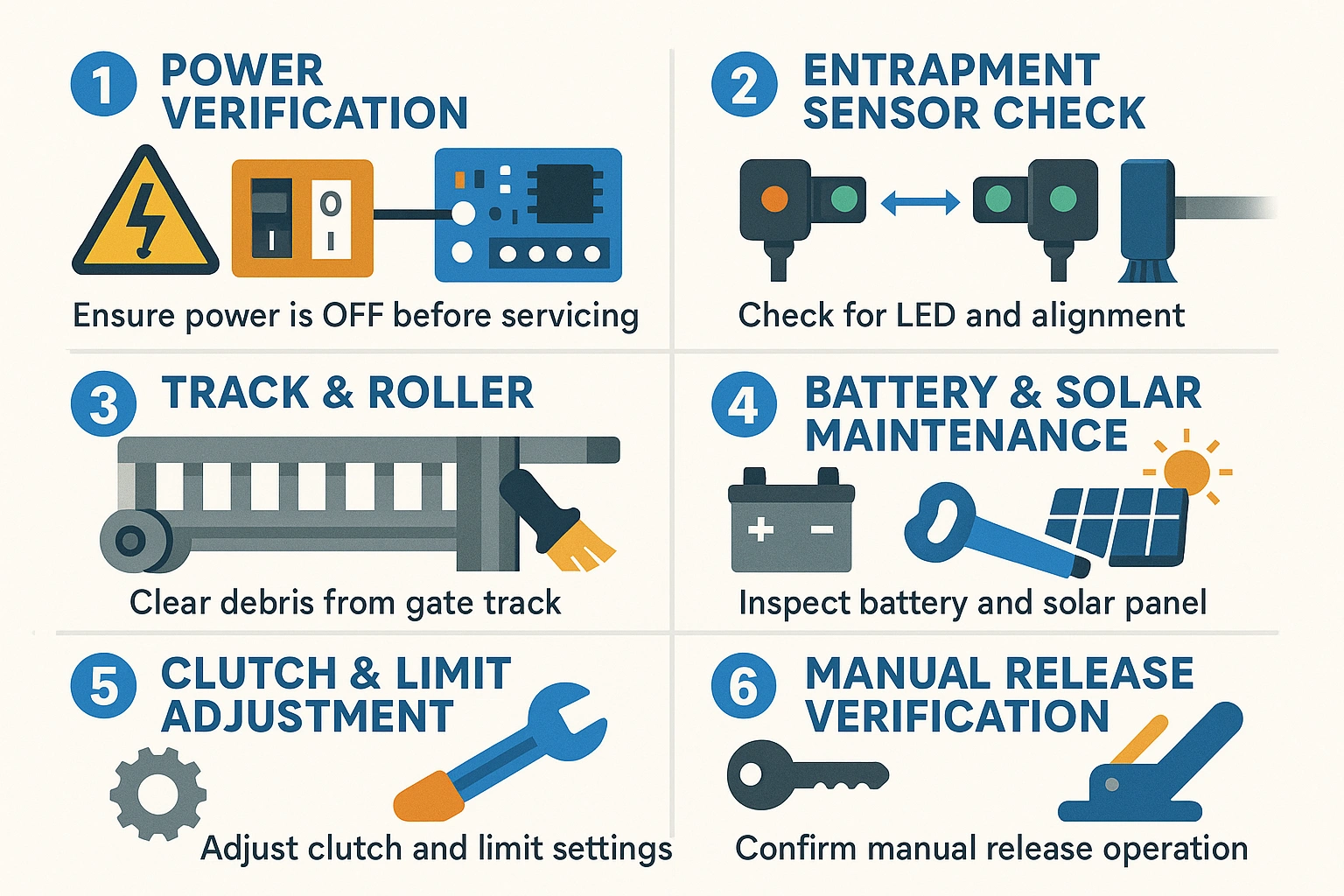
A clear and approachable workflow infographic guiding users through safe, technical maintenance tasks to troubleshoot and calibrate gate access systems, empowering DIY fixes with safety cautions.

Follow this systematic technical sequence to safely calibrate and troubleshoot your gate opener. If you must inspect internal wiring, always understand whether your system is configured as fail safe vs fail secure.

  1. Power Verification: Locate the circuit breaker, reset GFCIs, and verify your low-voltage transformer delivers the proper 12V or 24V AC/DC.
  2. Entrapment Sensor Alignment: For LiftMaster (LMRRUL/LMTBUL) or DoorKing photo-eyes, check the LED. A blinking light signals misalignment or obstruction. Pro Tip: Prevent sunrise/sunset “sun-blindness” by slipping a small PVC sleeve or cardboard hood over the receiving eye.
  3. Track & Roller Inspection: Manually check for debris. Ensure slide gate V-tracks are clear and swing gate hinges move freely.
  4. Battery & Solar Maintenance: Check solar operated gates for dust blockages on panels. Use a multimeter to ensure battery terminal voltage sits above 12.4V under load.
  5. Clutch & Force Limits: Adjust force margin dials. Setting force too high violates safety codes, while setting it too low causes unnecessary reversals.
  6. Manual Release Test: Pull the release cord or insert the bypass key to ensure smooth manual operation during an outage.

The Four-Season Preventive Maintenance Matrix


This seasonal maintenance matrix visually anchors essential preventive care tasks by time of year, helping users remember and schedule important activities to prolong gate access system reliability.

Environmental stressors cause the majority of system wear. Organize your maintenance around this seasonal matrix to preserve mechanical and electrical longevity.

  • Spring: Clear winter debris and lubricate hinges with silicone spray. Myth-Buster: Never use standard WD-40; its solvent base breaks down grease and attracts abrasive dust, destroying bearings.
  • Summer: Check for thermal expansion. Inspect brackets, wipe down solar panels, and clean proximity access control reader lenses.
  • Fall: Seal gaps in your control box. Pest Alert: Ants are attracted to electromagnetic fields on circuit boards, causing short-circuits. Place diatomaceous earth or pest strips inside the control housing.
  • Winter: Guard rubber gaskets against moisture intrusion. Keep slide paths clear of snow and ice, and verify battery capacity under cold-weather loads.

UL 325 Safety Standards & Professional Care


All automated gates must comply with UL 325 and ASTM F2200 standards to prevent entrapment and severe injuries. These codes require dual safety mechanisms, such as safety photo-eyes and contact safety edges, to safeguard pedestrian traffic.

While basic track cleaning is DIY-friendly, troubleshooting high-voltage loops or programming complex logic boards requires certified expertise. Whether you need to troubleshoot electric strike plates or service premium systems like DoorKing, LiftMaster, or HySecurity, choose a licensed, bonded technician.

Frequently Asked Questions


Why does my gate open on its own?

This is usually caused by a shorted exit loop detector, insect nesting on the control board relays, or RF interference on the receiver channel.

How often should our HOA service commercial gates?

High-traffic commercial and residential community entry points should undergo certified safety and mechanical inspections at least quarterly.

How do I diagnose whether an issue is mechanical or electrical?

Disengage the gate operator using the manual release mechanism. Manually push or swing the gate through its full range of motion:

  • If it binds, grinds, or feels heavy: The issue is mechanical (e.g., damaged tracks, bad bearings, alignment issues, or lack of lubrication).

  • If it moves smoothly by hand: The issue is electrical or electronic (e.g., control board faults, power supply issues, relay failures, or bad wiring connections).

How often do gate operator batteries need to be replaced?

Standard sealed lead-acid (SLA) backup batteries in gate operators typically last 2 to 3 years. In extreme hot or cold climates, battery life can drop significantly. If your gate fails to operate during a power outage or runs exceptionally slowly, test the voltage under load and replace the battery bank.

Professional Gate Maintenance and Support


A failing gate disrupts security and halts daily operations. For prompt, expert support, reach out to professional access control services near me. Our fully-equipped mobile service vans operate 24/7, providing certified technicians to handle complex repairs, mechanical alignments, and compliance upgrades. Contact us today to secure your property.

Need more information? Get a free quote

Call us now

Get A Free Call From Our Experts!

Floating Button Form