Navigating Front Door Paint Regulations: The Compliance-to-Completion Masterguide


Published: Aug 18, 2026

A front door makeover is one of the most high-impact, cost-effective updates you can make to your home. According to Zillow Group Research, choosing a dark charcoal or black front door can increase a home’s resale price by up to $6,271. However, before you buy your paint, you must navigate a complex web of rules.

With over 75.5 million Americans living in HOA-governed communities—representing roughly 30% of all US housing stock—compliance is a critical step. Failing to follow community guidelines can result in official violation notices, fines of up to $100 per day, or the frustration of being forced to repaint a completed project at your own expense.

This masterguide bridges the gap between regulatory compliance and aesthetic design, helping you achieve a sophisticated look that satisfies your local board.

The Regulatory Landscape: Navigating HOAs vs. Historic Districts


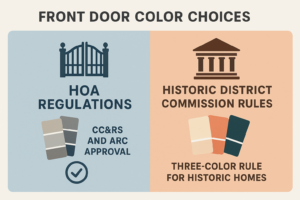
If you live in a managed development, your Homeowners Association (HOA) or Condo Association (COA) governs exterior changes through its Covenants, Conditions, & Restrictions (CC&Rs). An Architectural Review Committee (ARC) evaluates modifications to ensure community uniformity and protect property values.

Historic districts, managed by Historic District Commissions (HPCs), operate on historical preservation rather than modern uniformity. They often mandate period-accurate color schemes, such as those found on regional historic color charts, to preserve municipal heritage.

Regulatory Framework Infographic

To secure approval on your first attempt, submit a complete Architectural Change Request (ACR) packet. This should include your physical paint swatches, the manufacturer’s name, the exact color code, and the Light Reflectance Value (LRV). Be sure to check your governing documents for a “Silence is Consent” clause—some boards are legally required to respond within 30 to 45 days, or the project is automatically deemed approved. Additionally, different door material types require distinct surface preparations to ensure the paint adheres properly without violating local maintenance standards.

This infographic clarifies the distinct regulatory frameworks affecting front door paint choices, helping homeowners understand whether their property is governed by HOA rules or historic preservation guidelines, a crucial first step toward legal compliance.


HOA-Friendly Front Door Paint Ideas (Staying Chic but Compliant)


You can express your personal style while staying within ARC guidelines. To prevent visual monotony, many associations enforce a “Neighbor Duplication Rule,” which prevents immediate neighbors from choosing identical trim or door colors.

Choosing Colors and Safe Execution

Consider these classic, sophisticated shades that consistently win ARC approval:

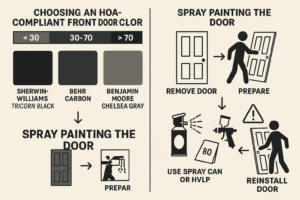
  • The Deep Neutrals: Sherwin-Williams Tricorn Black (LRV 3) or Benjamin Moore Iron Ore (LRV 6) offer a crisp, upscale appearance.
  • Classic Blues: Benjamin Moore Hale Navy (LRV 8) and Sherwin-Williams Cyberspace (LRV 6) complement brick and vinyl siding beautifully.
  • Organic Greens: Sherwin-Williams Riverway (LRV 16) or Benjamin Moore Thunder Gray (LRV 9) bring muted, earthy sophistication.
  • Subtle Warmth: Sherwin-Williams Urbane Bronze (LRV 8) is a beloved, versatile charcoal-bronze.

This flowchart educates homeowners on choosing compliant colors within HOA guidelines and safely executing the painting process, emphasizing procedural clarity to avoid common violations.


Technical Execution and Material Durability


Your paint’s longevity depends on your door’s material. Wood doors typically require repainting every 5 to 7 years. Metal doors are prone to thermal expansion and require updates every 2 to 3 years, while fiberglass doors hold paint well for 8 to 10 years.

For a premium finish, choose a specialized coating like BEHR PREMIUM Cabinet, Door & Trim Enamel. Its water-based alkyd formula resists sagging and provides excellent “block resistance,” ensuring your door does not stick to the vinyl weatherstripping when closed.

While refreshing your entryway, look beyond paint. Upgrading your hardware to some of the safest front door locks ensures your home is as secure as it is beautiful.


Can You Spray Paint Your Front Door?


Many homeowners prefer paint sprayers for a flawless, brush-mark-free finish. However, be cautious: many HOAs explicitly ban the use of paint sprayers on exterior surfaces due to overspray liability. Wind can easily carry fine paint mist onto your vinyl siding, your garden, or your neighbor’s vehicle.

To spray paint legally and cleanly, remove the door from its hinges, detach all hardware, and spray it flat on sawhorses inside a garage or a portable spray tent. If you use a high-quality aerosol can, apply three light, overlapping coats rather than one heavy layer to prevent dripping.


The Compliance Loophole: Painting the Inside of the Front Door


What if your HOA rejects your favorite bold color? There is a built-in legal boundary: the HOA and HPC’s jurisdiction strictly ends at the exterior plane of your property. They have zero authority over the interior face of your front door.

Inside Front Door Painting

This interior face is your creative playground. You can paint the outside a compliant charcoal and make the inside a vibrant mustard yellow, rich plum, or electric blue to act as an accent wall in your foyer.

This image anchors the important concept that HOAs have no authority inside the home, empowering homeowners to express personal style on the inside face of their front door while staying fully compliant outside.

While painting the interior, it is the perfect opportunity to consider a rekey door lock service or complete a modern smart door lock installation to protect your newly styled entryway.


Frequently Asked Questions


Can I paint my front door step?

Check your guidelines. Porch steps are often regulated under hardscaping or masonry rules rather than paint guidelines. Always use a specialized, slip-resistant product like BEHR Premium Porch & Floor Paint rather than standard trim paint to avoid slip hazards.

How often do I need to repaint my front door?

Wood doors require maintenance every 5 to 7 years, metal doors every 2 to 3 years, and fiberglass doors every 8 to 10 years due to environmental exposure.

What happens if I paint without approval?

Roughly 1 in 4 HOA residents receive an architectural or maintenance violation notice during their residency. You may face daily fines or be forced to repaint at your own expense.


Elevating Your Entryway Beyond Paint


A beautiful front door is only half the equation; it must also be secure. Once your compliance-friendly paint job is complete, ensure your entryway’s hardware matches its fresh new look. Upgrading your locks, installing smart entry systems, or rekeying your cylinders adds the ultimate peace of mind. For expert assistance with lock selection and precision installation, contact a trusted professional today.

Need more information? Get a free quote

Call us now

Get A Free Call From Our Experts!

Floating Button Form