Designing a modern commercial office space requires balancing visual elegance with robust physical security. When specifying frameless glass partitions, the decision between patch locks and floor locks represents a critical choice where design aesthetics meet daily functionality. For over 35 years, Sure Lock & Key has helped professionals navigate these complex commercial hardware decisions. Selecting the right locking mechanism ensures that your office space is not only beautiful but also compliant and durable.
The Architect’s Guide to Office Glass Partitions: Patch Locks vs. Floor Locks
Published: Oct 8, 2026
The Aesthetic vs. Ergonomic Dilemma
In commercial interiors, over 85% of modern office partitions utilize either 3/8″ (10mm) or 1/2″ (12mm) tempered safety glass. Architects often favor floor locks because they keep the sightlines of a nine-foot vertical glass panel entirely unbroken, creating a floating aesthetic. However, facility managers often find that requiring employees or security guards to bend down to floor level to lock or unlock the door daily creates immediate ergonomic friction. For high-traffic entrances, relying on premium commercial lock services helps balance these operational needs with professional design.
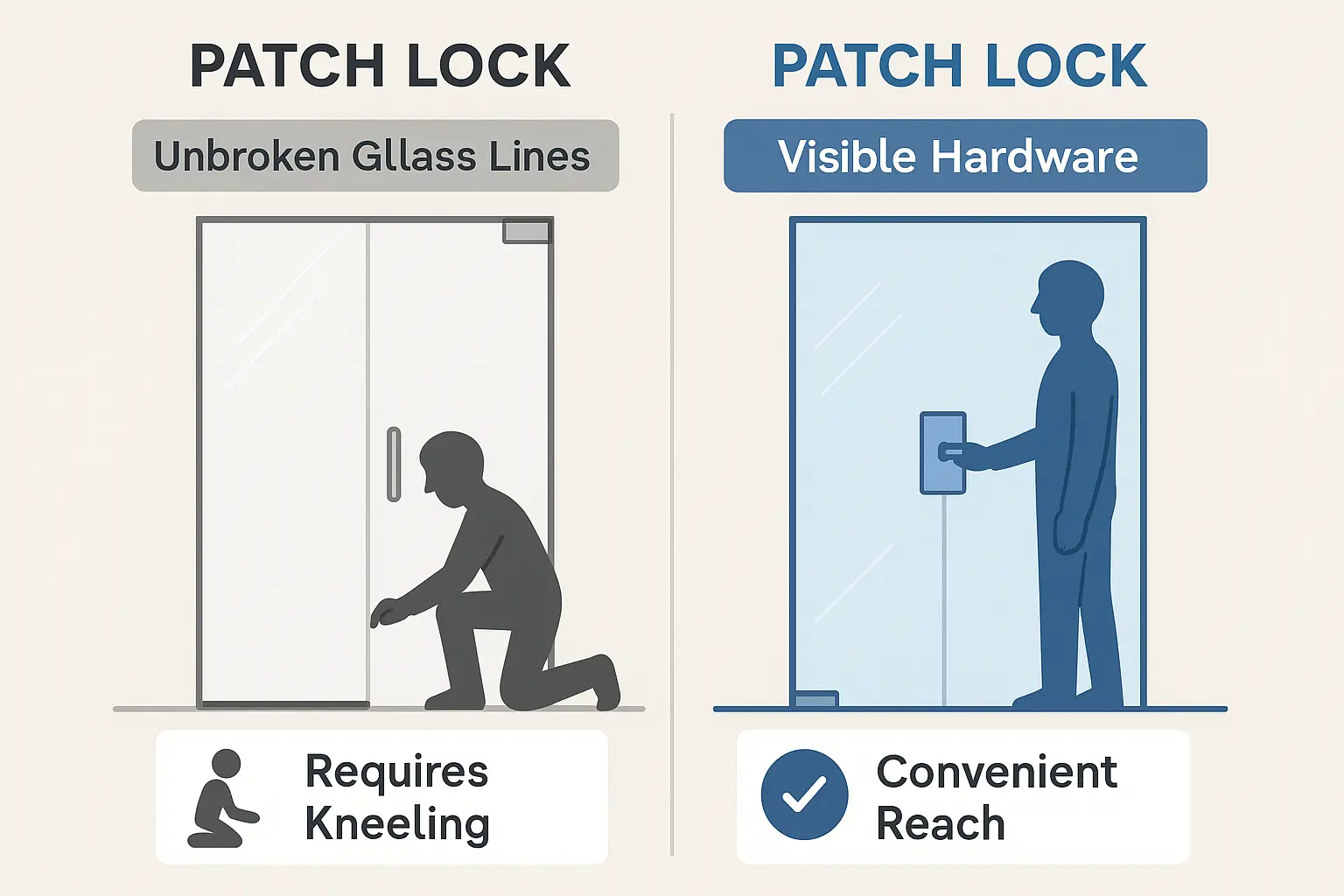 This image visualizes the core dilemma between Floor Locks and Patch Locks in office glass doors: Floor Locks preserve uninterrupted glass aesthetics but challenge daily ergonomics by requiring users to kneel, while Patch Locks are more ergonomic but visually intrusive. Understanding this trade-off helps architects and facility managers align on practical design choices.
Patch Locks: Center Latch vs. Corner Patch
Patch locks are metal-clad housings clamped to the edge or corner of a glass door. While corner patch locks sit subtly at the top or bottom, center-mounted patch locks align at waist height. This waist-height placement makes them highly practical, accommodating standard lever handles and security keys. For conference rooms or private glass offices, center patch locks can incorporate red/green occupancy indicators. When analyzing types of commercial door locks, center patch locks provide the most user-friendly interface for daily office operations.
Floor Locks: Mechanical Architecture and The Dustproof Strike Mandate
Floor locks utilize a deadbolt housed inside a bottom rail or small bottom corner patch, throwing a heavy bolt directly down into the floor substrate. While visually minimal, standard floor strike plates are open hollow pockets. Over time, these pockets accumulate floor dust, mop water, and wax. This debris solidifies, preventing the deadbolt from fully extending and stopping security systems from arming. To avoid this common point of mechanical failure, specifying a spring-loaded dustproof strike is mandatory. This self-sealing plunger keeps the keeper clean and is a core element of proper commercial lock maintenance.
The Fabrication Criteria (Shatter Prevention)
A common pitfall is opting for cheap, “no-drill” clamp-on friction locks. Glazing data shows that friction-fit locks suffer a 12% to 18% slippage rate over 18 months in active office spaces due to door slamming and structural vibration. When a clamp slips, the lock bolt misaligns, preventing latching and introducing localized stress that can shatter tempered glass.
To prevent structural failure, professional commercial door hardware installation requires factory-fabricated glass with precise notches and pre-drilled holes. High-density neoprene or polymer isolation gaskets must align on both sides of the glass to prevent metal-to-metal contact.
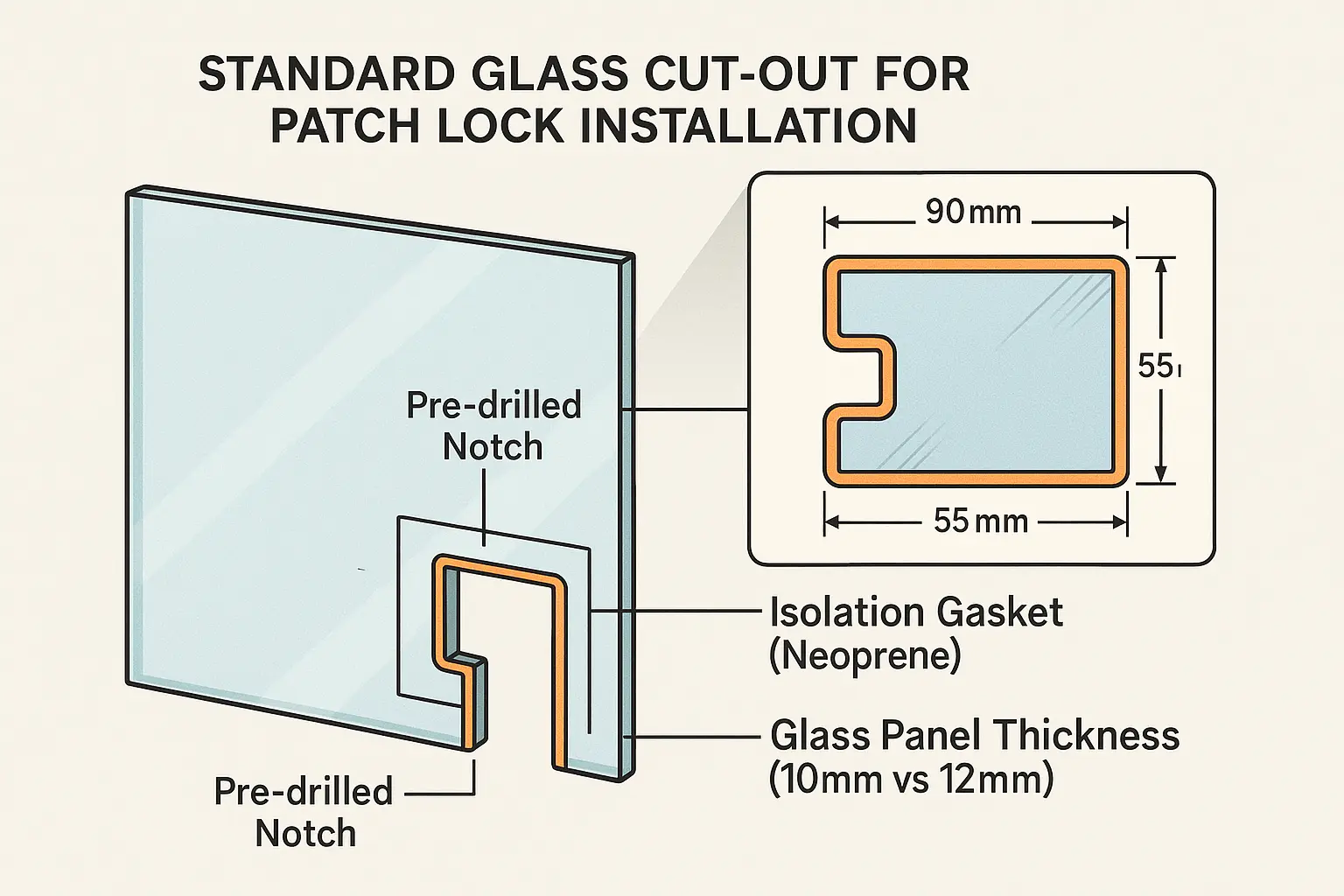 This diagram clarifies the crucial fabrication criteria for installing patch locks on frameless glass doors, emphasizing the necessity of precise notching and protective neoprene gaskets. It educates buyers and architects on why factory-prepared glass is essential to prevent shattering and ensure hardware longevity.
Life Safety & ADA Code Compliance
Before finalizing hardware, ensure your choices align with legal safety standards:
- ADA Accessibility: Lever handles and thumbturns must operate without tight grasping or twisting of the wrist. Standard keyed floor cylinders often fail height requirements, making center patch locks highly preferable. Ensure your threshold layout adheres to ada door threshold requirements for total accessibility compliance.
- Single-Motion Egress: Under NFPA 101, primary office exit doors must open with a single motion. Double-cylinder keyed locks that require a key to exit are restricted. Check modern guidelines for emergency exit compliance to avoid building department failures.
- Fail-Safe vs. Fail-Secure: Electronic locks must be specified carefully. A fail-safe setup releases on power loss to permit evacuation, whereas a fail-secure configuration keeps the door locked to protect high-value spaces. Understanding fail-safe and fail-secure functionality is vital for access control.
- Door Closer Configuration: To prevent violent slamming that damages glass-mounted hardware, ensure your door closer is adjusted according to the building’s specific closer code.
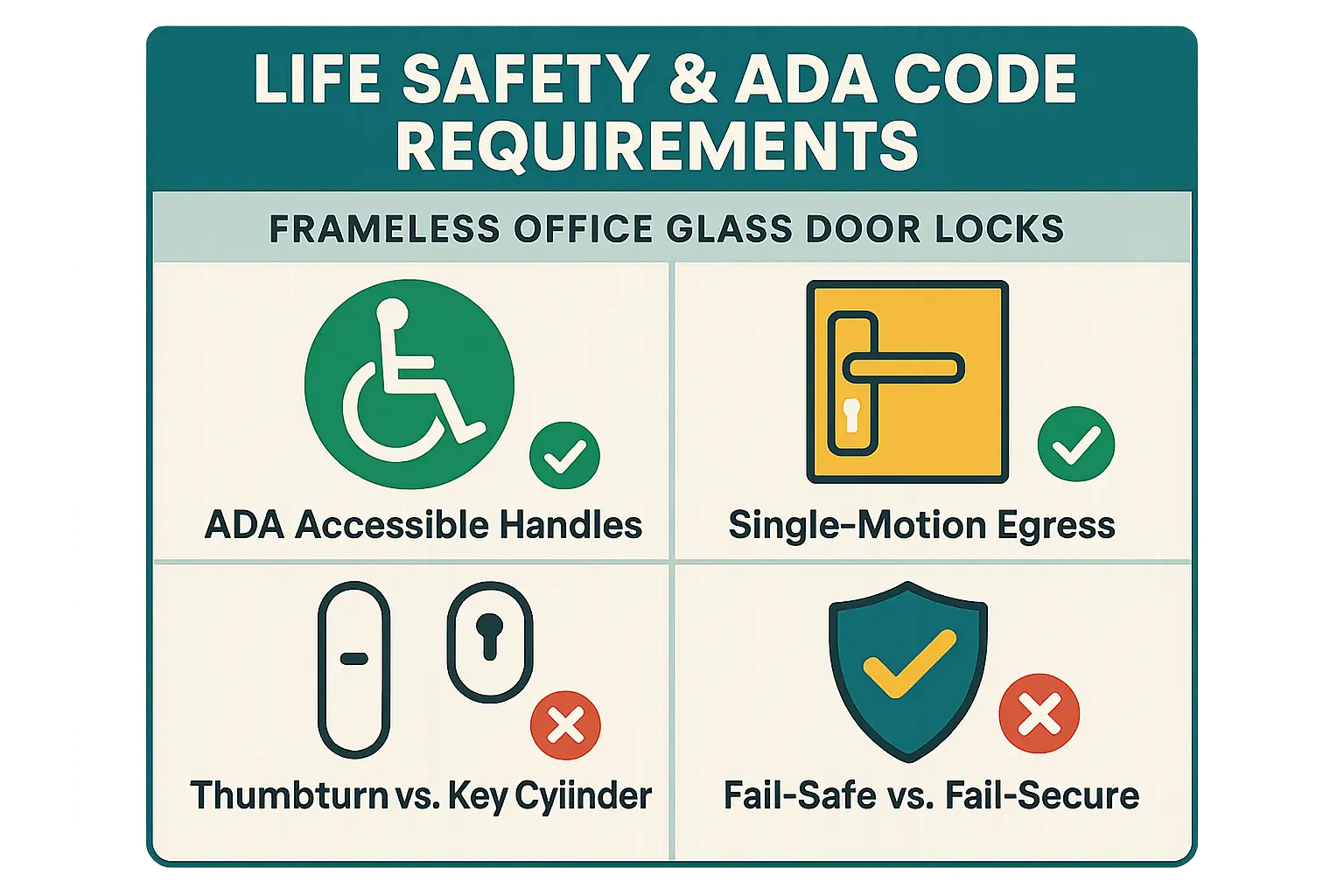 This infographic serves as a quick-reference memory aid highlighting crucial ADA and life safety code considerations for frameless office glass door locks. It simplifies complex legal requirements into clear, memorable icons and labels, empowering professionals to ensure compliant door hardware selections.
Frequently Asked Questions
Why do clamp-on glass locks slip over time?
Friction-fit clamp locks rely entirely on pressure. Daily door slamming and vibrations cause them to slip by 12% to 18% over 18 months, leading to lock misalignment and potential glass breakage.
What is a spring-loaded dustproof strike?
It is a floor-mounted strike plate containing a spring-loaded plunger. When the lock bolt retracts, the plunger rises to seal the opening, keeping out dirt, dust, and mop water that otherwise cause mechanical lock failures.
Can we retrofit a floor lock on an existing tempered glass door?
No. Tempered safety glass cannot be cut, drilled, or notched after fabrication. Attempting to modify existing tempered glass will shatter it instantly, meaning all lock fabrication must be done during manufacturing.
Architectural Decision Matrix
| Metric | Center Patch Locks | Floor Locks (Bottom Patch) |
|---|---|---|
| Aesthetic Impact | Moderate (visible at waist height) | Elite (virtually invisible profile) |
| Ergonomic Rating | High (operated at standard height) | Low (requires kneeling/bending) |
| ADA Compliance | Simple (accepts ADA thumbturns) | Complex (fails height requirements) |
| Maintenance Risk | Low (protected from dirt) | High (requires dustproof strikes) |
| Retrofit Viability | Low-Moderate (needs glass cutouts) | Low (requires precision floor drilling) |
Need more information? Get a free quote