Identifying and Rectifying Fire Door Deficiencies


Published: Sep 22, 2026

Facing a fire door deficiency log or preparing for an upcoming healthcare audit (CMS or Joint Commission) can feel overwhelming. Industry data reveals that up to 75% to 80% of inspected fire doors fail to meet compliance criteria during initial audits.

However, a failing grade does not have to mean a complete, expensive replacement. Understanding the line between cost-effective field remediation and mandatory door replacement can save your facility thousands of dollars while fully satisfying authorities having jurisdiction (AHJs).
The Diagnostic Phase (Fire Door Inspection Foundations)


Fire doors are critical safety barriers designed to compartmentalize fire, smoke, and toxic gases. Under US NFPA 80 standards, fire door assemblies must undergo rigorous inspections annually. In the UK and Ireland, high-rise and commercial properties fall under BS 8214 guidelines, requiring regular safety inspections to verify structural integrity.

A thorough audit checks the complete assembly—including the frame, hinges, door leaf, and latching hardware. Failing to monitor these components violates building codes and risks lives. For facility managers, ensuring your team is familiar with the necessary fire rated door hardware requirements is the crucial first step to maintaining a compliant, audit-ready building.

The Fire Door Gap Blueprint (Checking & Rectifying Clearances)


Excessive clearances are the single most common reason fire doors fail, accounting for 35% to 40% of all recorded deficiencies. Fortunately, you rarely need to replace the entire assembly to correct a gap.

To verify clearances, use a specialized gap gauge or a standard caliper at the top, latch edge, and hinge edge:

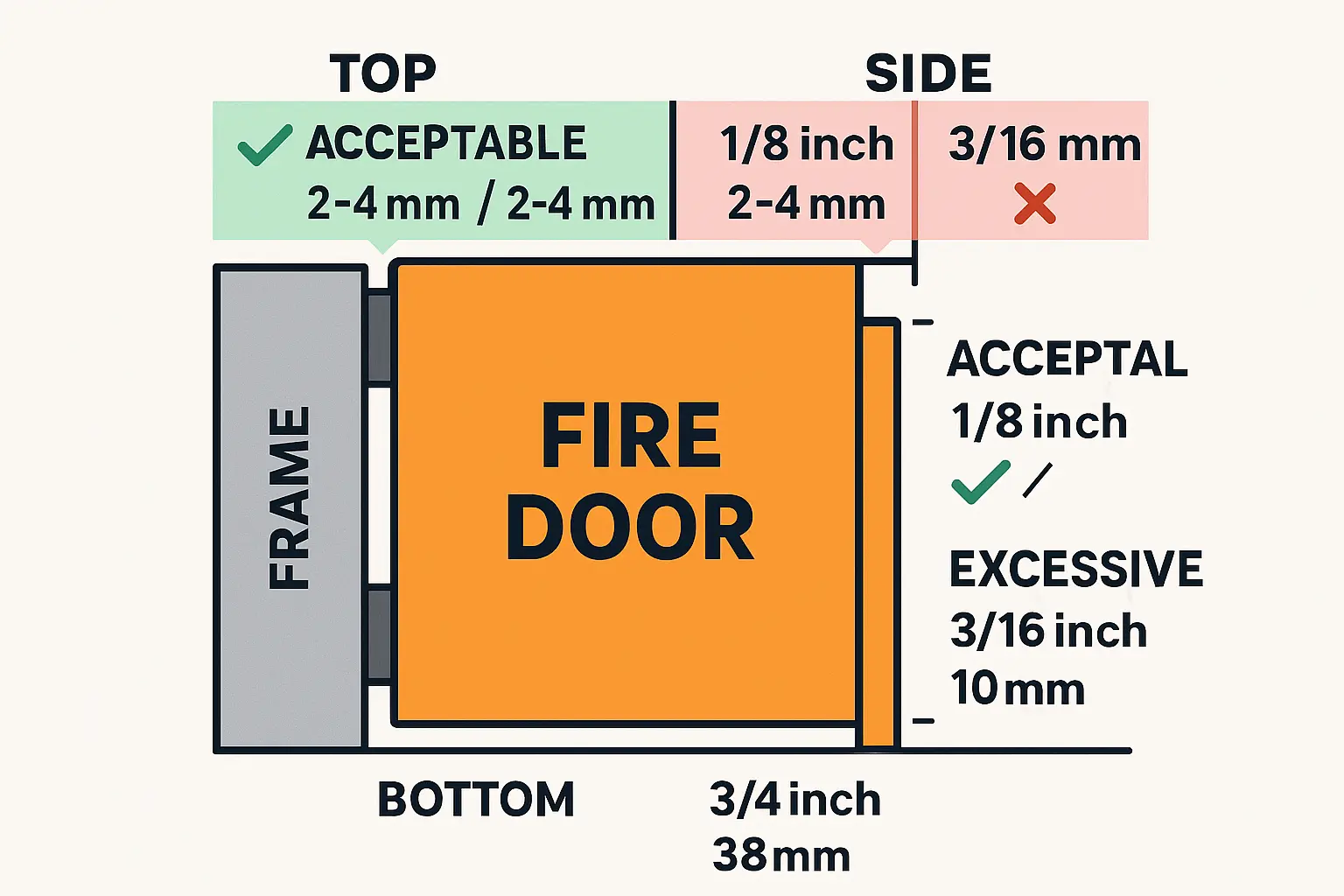
  • NFPA 80 (US) limits: Wood doors allow a maximum of 1/8″ clearance at the top and sides, and 3/4″ at the bottom. Steel doors allow up to 3/16″ at the top and sides.
  • BS 8214 (UK) limits: Typically allow 2mm to 4mm along the top and sides, and 3mm to 8mm at the bottom.

If your clearances exceed these limits, you do not need to order a new door. NFPA 80 allows the use of UL-listed gap-reduction solutions, such as certified intumescent sweeps, metal shims, or rated astragals. Using these listed accessories can resolve a clearance issue for $100 to $250, compared to a full replacement cost of $1,500 to $3,500.

This diagram clarifies how to measure fire door clearances and visually distinguishes compliant gaps from excessive ones based on US and UK standards. Understanding and applying these specific clearance limits ensures fire doors maintain their rated performance during a fire or smoke event.

The Big Five Deficiencies & Compliance Remediation Protocols


Resolving your deficiency log requires a systematic approach to the five most common field issues.

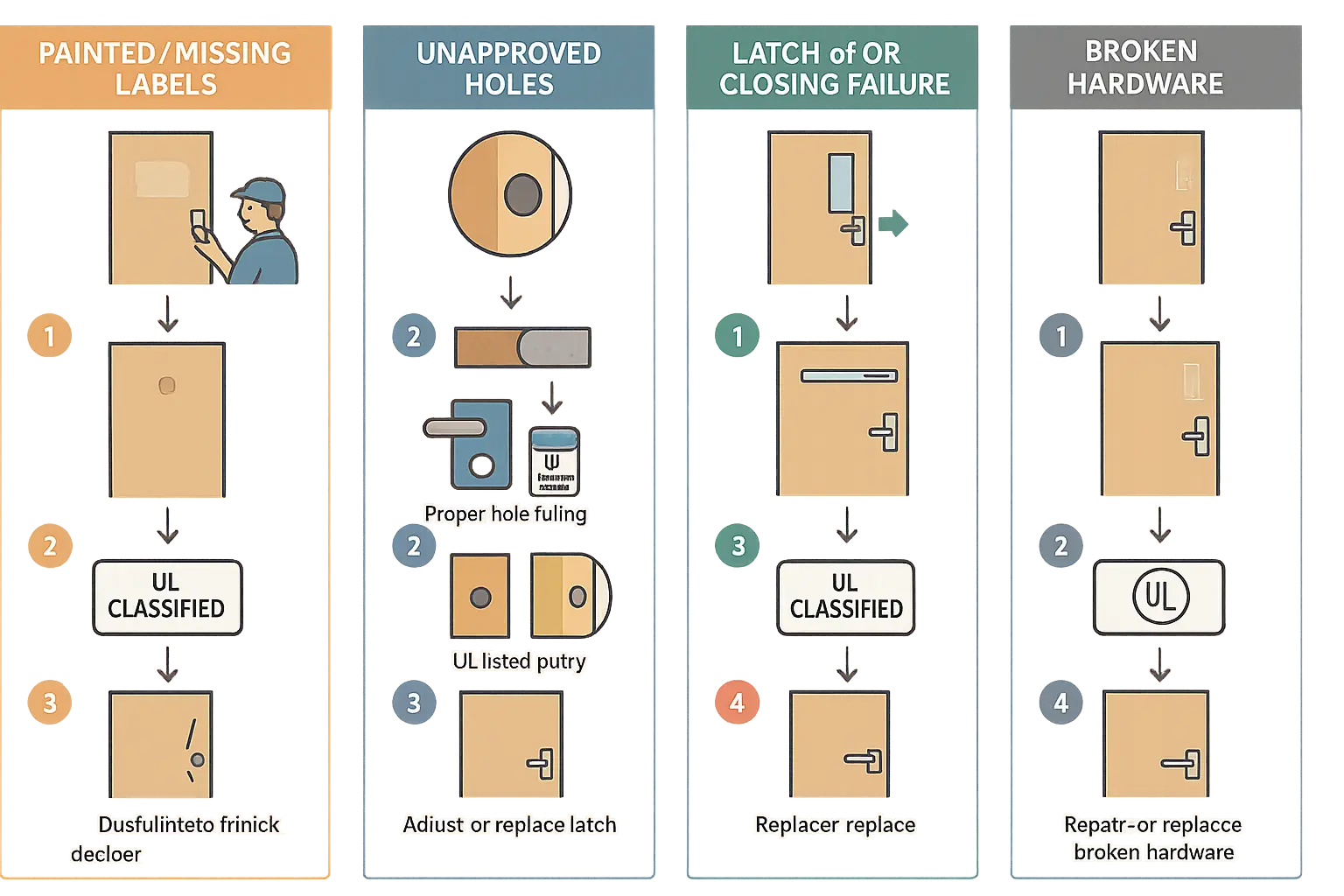
  1. Excessive Gaps (35-40% of failures): Corrected using UL-listed clearance sweeps. If the gap causes latch failure, adjust the hinges to improve door lock alignment so the active latch bolt fully engages.
  2. Damaged or Missing Seals (20-25% of failures): Intumescent strip degradation compromises the door’s smoke containment. Replace worn gasketing with products tested to UL 1784 or BS EN 1634-3.
  3. Latching or Closing Failures (15-20% of failures): The door must self-close and latch reliably from any angle. Adjust your closer tension in line with the closer code requirements. Note that using an unapproved panic bar dogging mechanism to keep a fire door unlatched is a severe violation.
  4. Painted-Over or Missing Labels (10% of failures): Never paint over metal or paper fire labels. If labels are missing or illegible, contact an accredited testing laboratory (such as Intertek/Warnock Hersey or UL) to perform an on-site field-labeling service ($150 to $300 per door), saving up to 90% over replacement.
  5. Unapproved Hardware & Holes (8% of failures): Holes left by retired locks must be plugged. Comply with NFPA 80 by filling holes with steel screws or listed fire-rated putty. Ensure any new commercial door hardware installation utilizes certified fire code door locks or a compliant keypad access lock for panic bars.

This visual breaks down the repair process for the five most common fire door deficiencies, showing clear, actionable steps from deficiency identification to NFPA 80-compliant remediation and certification. It empowers facility managers to understand how to resolve issues effectively.

CMS Fire Door Inspection & Survey Readiness (Healthcare Focus)


For healthcare facility managers, compliance directly impacts funding. Under CMS Survey Memo S&C 17-38-LSC, hospitals and skilled nursing facilities must document their annual fire door inspections. To satisfy a Life Safety surveyor, you must present a organized log answering four key questions:

  • Are all fire door assemblies checked annually?
  • Is there a written, dated record of the inspection?
  • Were all identified deficiencies repaired “without delay”?
  • Did a qualified technician perform the repairs using listed, fire-rated parts?

By maintaining this paper trail and acting swiftly on your deficiency log, you eliminate the risk of funding disruptions or costly compliance audits.

Frequently Asked Questions


Can our in-house maintenance team perform fire door repairs?

Yes, your internal maintenance staff can perform basic repairs such as replacing smoke seals or adjusting closers. However, any modification or replacement hardware must be UL-listed and labeled for use on fire door assemblies. For critical issues like excessive clearances or field-labeling, you must use certified professionals to avoid voiding the door’s fire rating.

What should we do if a fire door label is painted over or missing?

If a label is painted over, you should carefully remove the paint using an approved non-abrasive solvent without scratching the underlying metal plate. If the label is completely missing or destroyed, you must hire an accredited field-labeling service (such as UL or Warnock Hersey) to inspect the door, confirm its construction, and apply a new certification tag on-site.

How do we fix a fire door that fails to self-close or latch completely?

First, check for obstructions and inspect the hinges for wear or sagging. If the hinges are sound, adjust the hydraulic closing speed and latching power settings on the door closer. If the latch bolt still fails to engage the strike plate, verify that the lockset is properly aligned and lubricated, and replace any non-rated hardware with fire-listed components.

Global Regulatory & Local Inspection Guide (UK/Ireland/US Local)


Compliance requirements and licensing credentials vary depending on where your properties are located. Navigating these regional distinctions ensures your inspections remain legally valid.

  • In the United States: Look for technicians carrying certifications like Certified Fire Door Assembly Inspector (CFDAI) or Intertek IQP.
  • In the UK and Ireland: Work with inspectors certified through BRE Global, BM TRADA, FIRAS, or the Fire Door Inspection Scheme (FDIS).

Partnering with an experienced commercial locksmith team that maintains mobile service vans fully equipped with UL-listed components ensures that your physical repairs are completed quickly, correctly, and in total compliance with your local laws.

This comparative infographic anchors memory by mapping fire door standards and certification authorities across the US, UK, and Ireland. It helps users quickly recall which standards and inspectors apply to their region, simplifying global compliance navigation.

Need more information? Get a free quote

Call us now

Get A Free Call From Our Experts!

Floating Button Form