Navigating Commercial Lock Functions: The Ultimate Specification Guide
Published: Oct 7, 2026
The High Stakes of Commercial Lock Selection
Selecting commercial hardware is far more than an aesthetic choice; it is a critical operational decision with legal and safety implications. A single ordering error can lead to failed fire marshal inspections, operational bottlenecks, or security vulnerabilities. When choosing between different commercial door lock types, compliance must be top of mind.
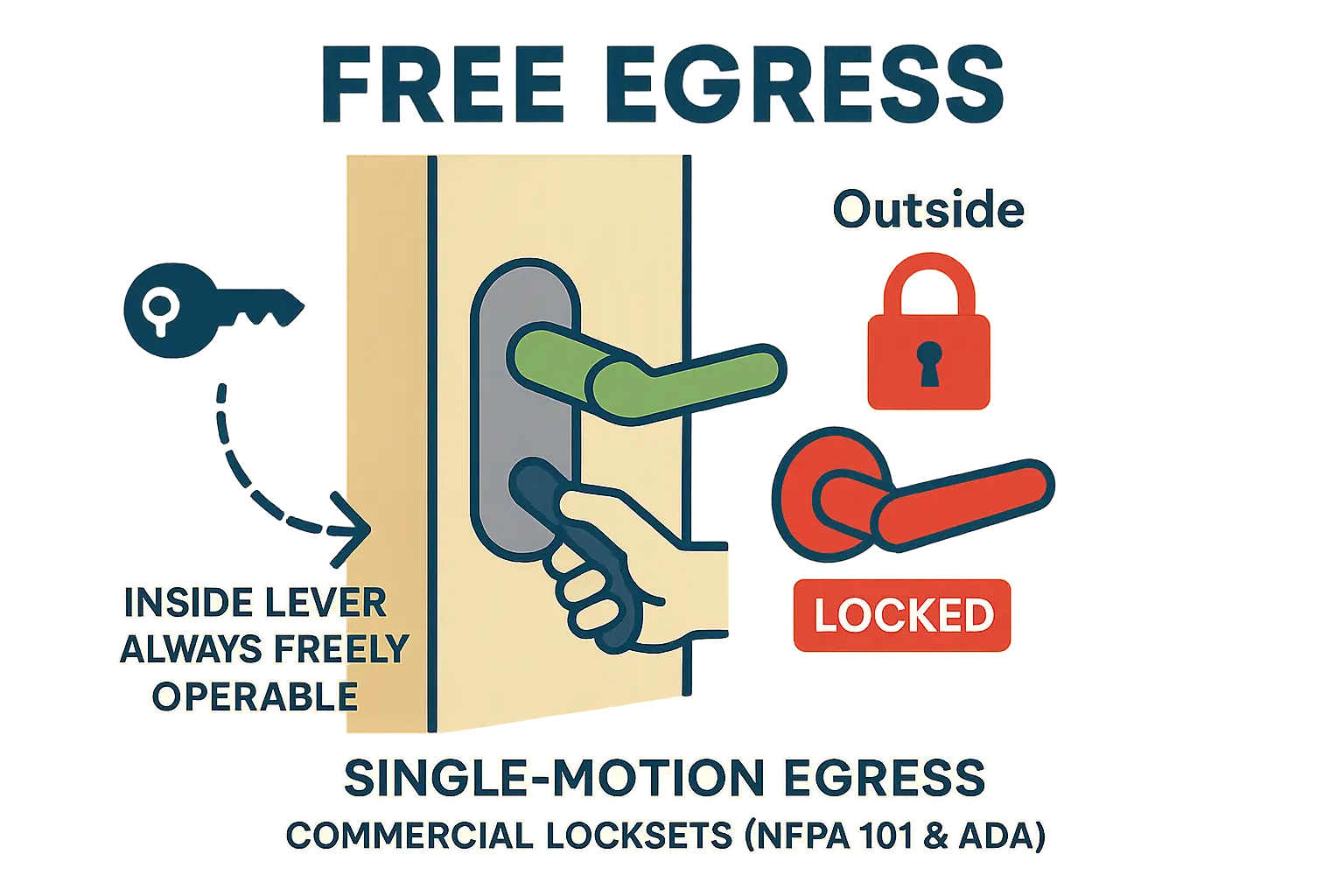
The absolute baseline of commercial door hardware is the “Golden Rule of Free Egress.” Under the National Fire Protection Association (NFPA 101 Life Safety Code) and the International Building Code (IBC Section 1010.2), egress doors must unlock from the inside in a single motion. This ensures that occupants can exit immediately in an emergency without needing keys, tools, or specialized knowledge.
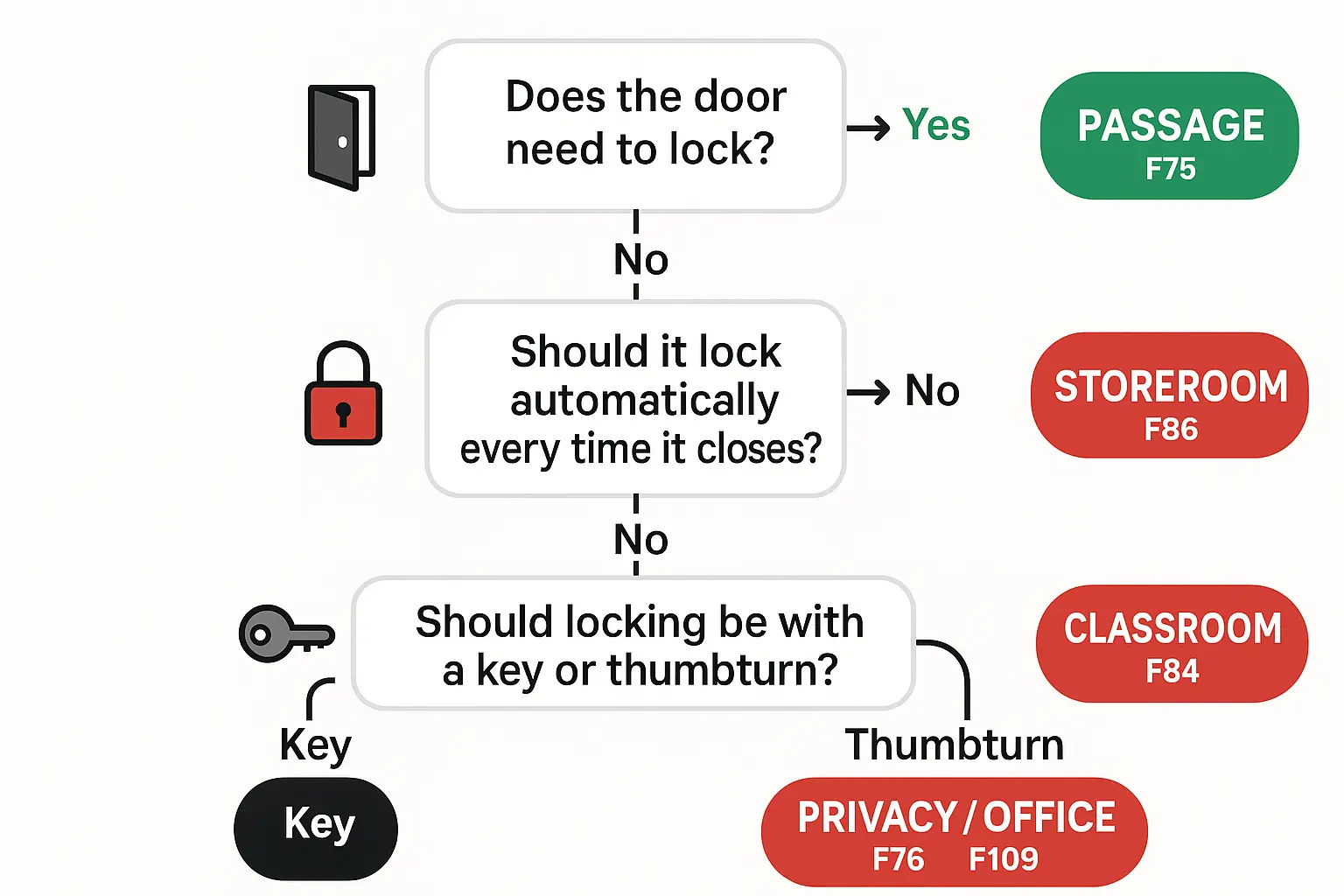
Interactive Decision Tool: "Find Your Lock Function in 3 Questions"
Identifying the perfect hardware configuration for a room does not require a degree in architecture. By answering three operational questions, you can narrow down the exact function needed for your door:
Deep Dive into the Core Lock Functions
Whether you are specifying standard cylindrical locks (ANSI A156.2) or heavy-duty mortise lock bodies (ANSI A156.13), understanding the exact operational mechanics of each function is essential.
Passage Function (ANSI F75 / Mortise F01)
- Operation: Both the inside and outside levers are always unlocked. The latch bolt retracts freely whenever either handle is turned.
- Lockout Risk: None.
- Best Use Cases: Interior hallways, closets, laundry rooms, and common transition spaces where privacy is not a factor.
Privacy Function (ANSI F76 / Mortise F22)
- Operation: The inside lever features a push-button or thumbturn that locks the outside lever. The outside lever remains locked until unlocked from the inside, or by opening the door (which automatically releases the lock). An emergency release slot on the outside allows entry with a flat tool or coin.
- Lockout Risk: Low.
- Best Use Cases: Single-occupant restrooms, dressing rooms, and private mother’s rooms.
Storeroom Function (ANSI F86 / Mortise F07)
- Operation: The outside lever is permanently rigid and locked. Entrance always requires a key to retract the latch bolt. Once the key is removed, the door is immediately locked from the outside. The inside lever always allows free egress.
- Lockout Risk: High (for occupants who step out without their key).
- Best Use Cases: Mechanical rooms, IT closets, janitorial spaces, and inventory storage where unauthorized entry must be strictly controlled.
Classroom Function (ANSI F84 / Mortise F05)
- Operation: The outside lever is locked or unlocked only by using a physical key. This allows the door to remain unlocked for heavy traffic periods or locked when unoccupied. The inside handle always remains active for emergency egress.
- Lockout Risk: Moderate.
- Best Use Cases: Classrooms, offices, and conference rooms where traffic levels vary throughout the day.
Classroom Security (F110) vs. Standard Classroom (F84)
A critical distinction exists in school safety environments. Standard Classroom locks (ANSI F84) pose an operational risk during lockdowns because a teacher must step into the hallway to lock the outside lever with a key.
The Classroom Security/Intruder Function (ANSI F110 / Mortise F32) solves this vulnerability. It features a double-cylinder configuration where a key can lock or unlock the outside handle from either side of the door. This allows staff to quickly lock the door from safely inside the room while keeping the inside lever fully operational for code-compliant egress.
Master Comparison Table Section
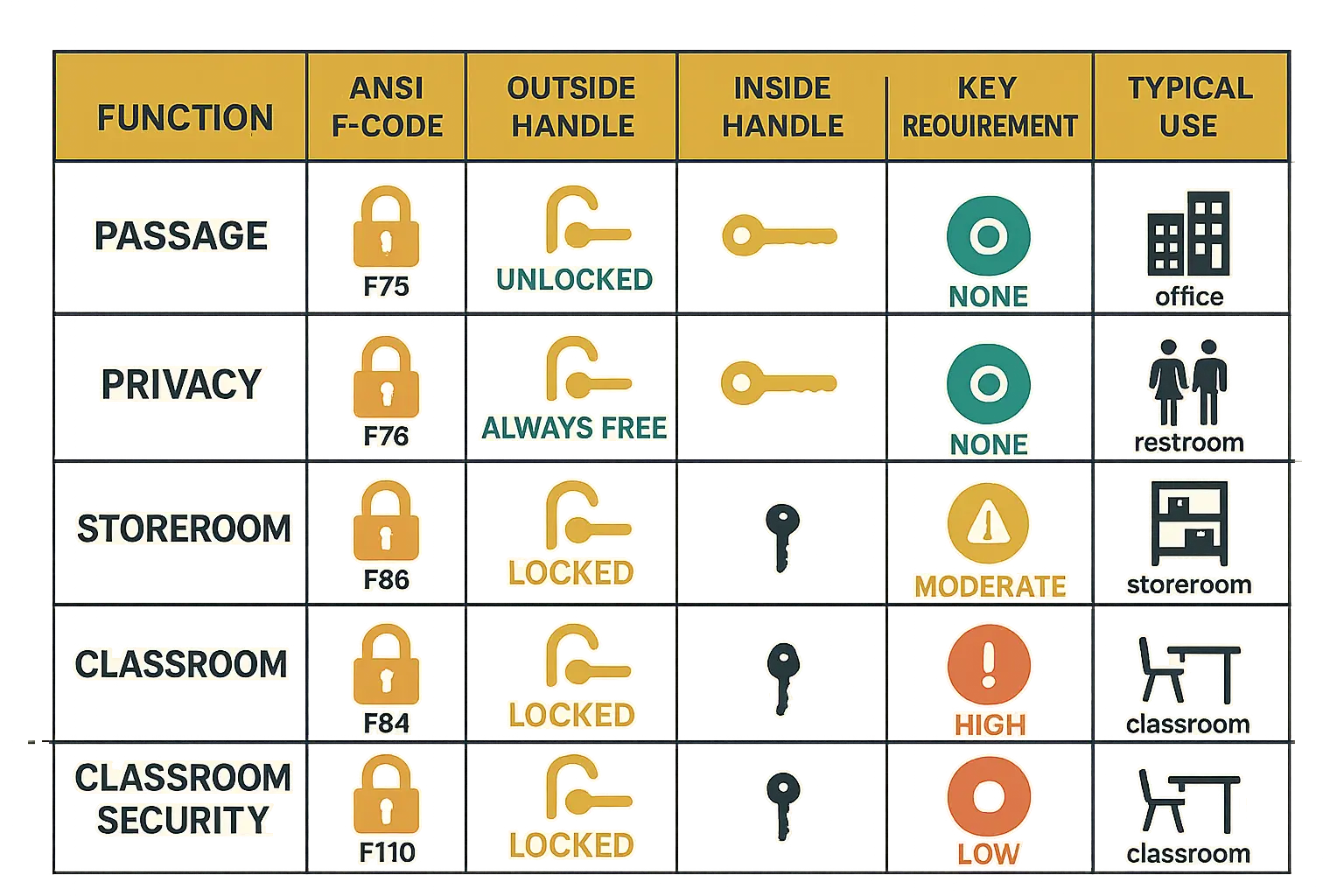
The following matrix summarizes these major configurations to help you make an informed purchasing decision.
| Function | ANSI Code | Outside Handle | Inside Handle | Key Required? | Typical Applications |
|---|---|---|---|---|---|
| Passage | F75 / F01 | Always Free | Always Free | No | Hallways, Closets |
| Privacy | F76 / F22 | Locked by button | Always Free | Emergency tool | Restrooms |
| Storeroom | F86 / F07 | Always Locked | Always Free | Yes, for entry | IT / Janitorial |
| Classroom | F84 / F05 | Key locked/unlocked | Always Free | Yes, to change state | Schools, Offices |
| Classroom Security | F110 / F32 | Key locked/unlocked from both sides | Always Free | Yes, to change state | Classrooms, Safe Rooms |
Frequently Asked Questions
Can a storeroom lock be left unlocked?
No. Storeroom locks are designed with a rigid outer lever that cannot be left in an unlocked state. Entry always requires a key, which helps prevent negligent security lapses in high-risk areas.
What is the difference between classroom and classroom security locks?
A standard classroom lock requires you to lock the outside lever by standing in the hallway and using a key. A classroom security lock is a double-cylinder system that lets you lock the outside lever using a key from inside the room, protecting staff during active threats.
When should I schedule a commercial lock replacement?
You should consider a commercial lock replacement if your existing hardware shows visible wear, fails to latch smoothly, or fails to meet current ADA and fire safety code regulations.
Compliance Checklist for Facilities Managers
To ensure your commercial facility remains fully secure and meets local and federal building regulations, adhere to this core hardware checklist:
- ADA Accessibility (ICC A117.1): Always use lever-operated mechanisms. Knobs are generally non-compliant because they require tight grasping or twisting.
- Mounting Heights: Hand-operated hardware must be installed between 34 and 48 inches above the finished floor level.
- Single-Motion Egress: Ensure that exit devices allow immediate egress in one clean motion, with zero special knowledge.
- Professional Advice: Always consult certified commercial locksmith services when planning master key schedules or complex retrofits.
Need more information? Get a free quote