Fixing Sagging Commercial Door Levers: The Complete Guide to Spring Cage Repair


Published: Oct 7, 2026 | Updated: Oct 29, 2026

A drooping, limp, or sagging lever handle on a commercial door is one of the most common maintenance issues in high-traffic facilities. Beyond being an eyesore, a sagging handle can compromise door security, make the door difficult to operate, and even lead to fire code or accessibility violations.

Many facility managers assume a drooping handle means they must replace the entire lockset, costing hundreds of dollars per door. However, the root cause is almost always a fatigued or broken internal return mechanism: the spring cage. By diagnosing this single component, you can resolve the issue for a fraction of the cost.
Introduction: The Anatomy of a Drooping Handle


To understand why commercial handles sag, it helps to look at the mechanics. Under ADA door requirements, commercial door hardware must be operable without tight grasping, pinching, or twisting of the wrist. This mandates the use of lever handles instead of traditional knobs.

However, lever handles are heavy. While a residential lever weighs under half a pound, a Grade 1 solid forged brass commercial lever weighs between 1.5 and 2.2 pounds. This weight creates constant gravitational torque on the internal mechanism.

While ANSI/BHMA Grade 1 cylindrical locks are certified to withstand 1,000,000 cycles, the auxiliary return springs inside the spring cages typically experience fatigue and micro-fractures between 250,000 to 500,000 cycles. Over years of heavy traffic, these springs snap, leaving the heavy lever with nothing to fight gravity.

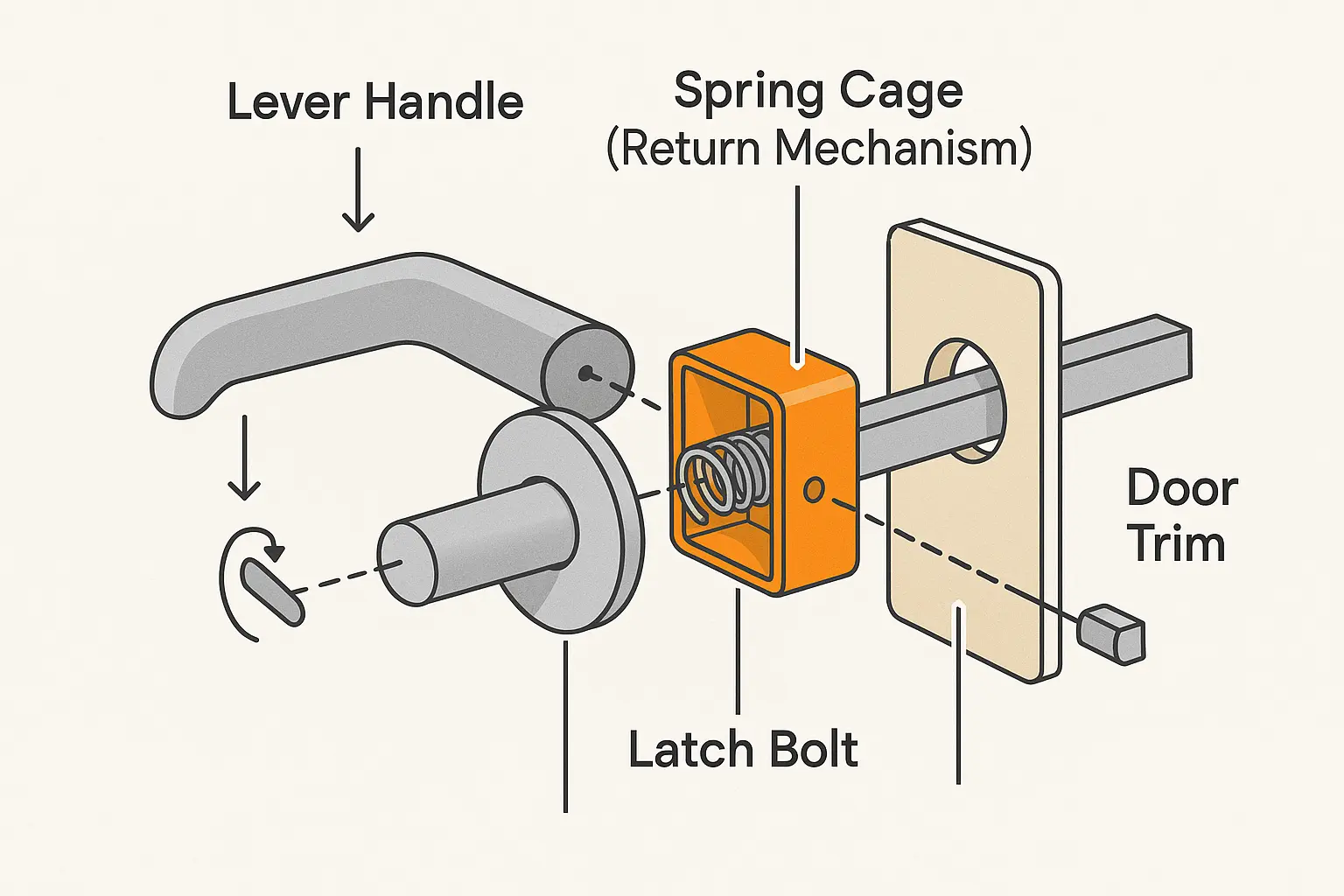
Visualizing the internal anatomy of a commercial door lever handle reveals why the spring cage is the critical component that fails due to constant gravitational torque, causing sagging handles.


The 3-Step Diagnostic Protocol: Is it the Spring Cage or the Lock Case?


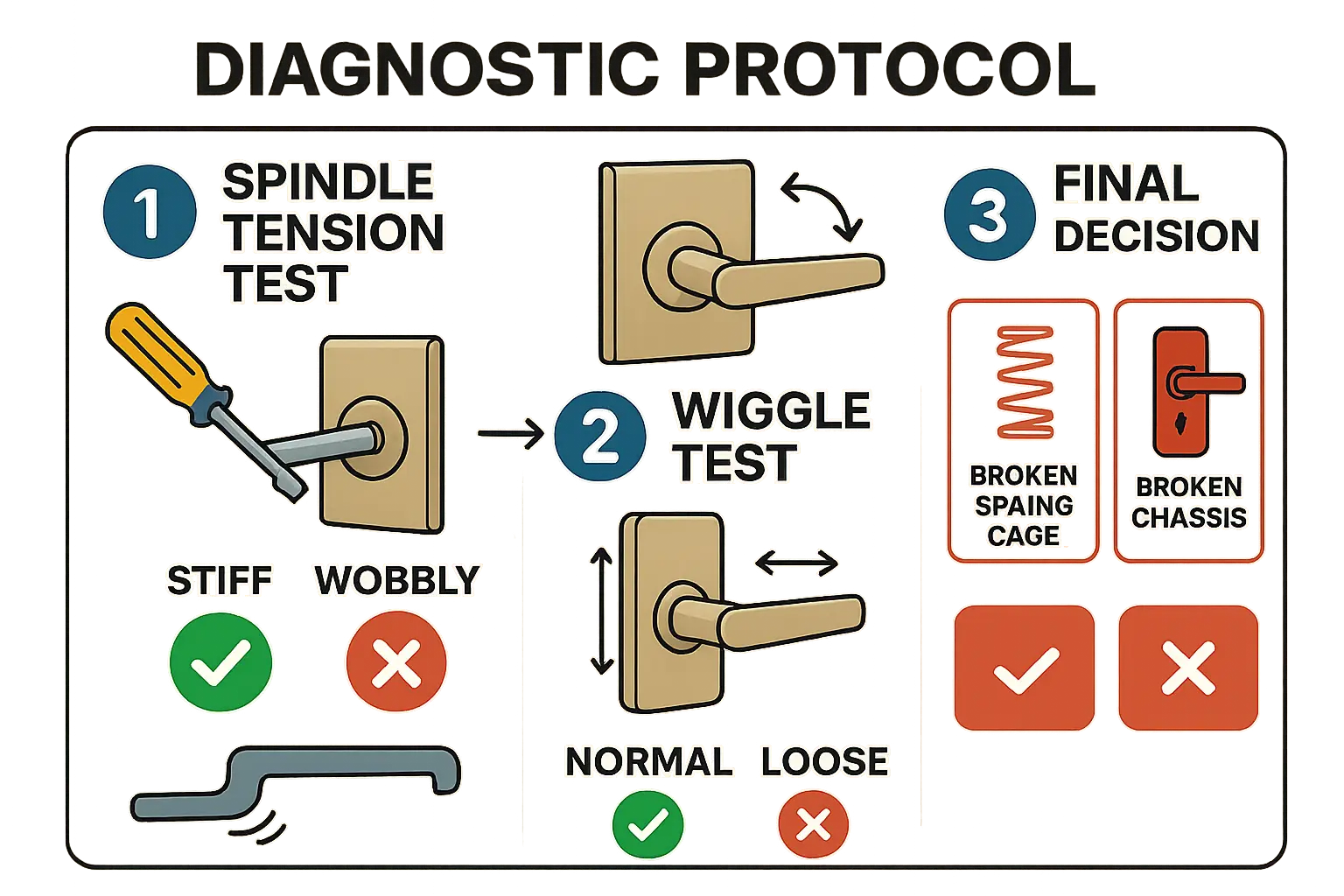
Before purchasing replacement parts or planning a complete commercial lock replacement, you must confirm that the spring cage is indeed the failing component. Use this simple diagnostic protocol:

The Spindle Tension Test

Remove the sagging lever handle from the door. Insert a flathead screwdriver into the hub spindle and rotate it.

  • If the spindle snaps back quickly and firmly: The internal chassis springs are functional. Your issue is isolated to a broken external spring cage.
  • If the spindle is floppy and has no resistance: The internal chassis hub spring or mortise case spring is broken. You will likely need to replace the core lock chassis.

The Wiggle Test

Grasp the lever handle and check for horizontal play (side-to-side) versus vertical sag (drooping down).

  • Horizontal play usually means the chassis mounting screws have backed out over time. This can be fixed by tightening the mounting plate.
  • Vertical sag with a firm horizontal mount indicates worn-out spring cage coil packs that can no longer support the weight of the lever.

Check for Binding

Slowly depress the handle. If it feels gritty or gets stuck halfway down, the spring cage may have shattered internally, leaving metal shards floating in the mechanism, or the door itself may have alignment issues. Consistent door lock maintenance can prevent this buildup, but once shattered, the cage must be replaced.

Follow this 3-step diagnostic guide to quickly and confidently identify if the sagging handle issue is due to a broken spring cage, helping avoid unnecessary lockset replacements.


Compatibility Matrix: Part Numbers by Manufacturer


Spring cages are not universally interchangeable. You must match the replacement part to the specific manufacturer and lock series installed on your door.

Lock Manufacturer & Series Lockset Type Spring Cage Part Number Key Visual Identifiers
Schlage L-Series (L9000) Mortise Lock L283-040 Square steel housing, flat spiral torsion spring
Schlage ND-Series Heavy Duty Cylindrical N523-218 (Outside) / N523-221 (Inside) Round cast steel cartridge, integrated lever-catch
Schlage ALX-Series Medium Duty Cylindrical 47267025 Round cartridge with integrated compression springs
Falcon Q-Series Heavy Duty Cylindrical Q330-271 Round zinc-plated disc with dual return springs
Yale 5400LN / 5300LN Cylindrical 14-5300-1021 Flat coil spring pack sitting directly behind the rose trim

This compatibility table is a quick visual reference helping maintenance staff match their commercial lock model to the correct spring cage part, simplifying purchasing decisions.


Step-by-Step Field Guide: Replacing a Commercial Spring Cage


Tools Required

  • Lever removal pin punch (or spanner key)
  • Phillips #2 screwdriver
  • Thread-locking compound (recommended)
  • Safety glasses

Remove the Lever

Locate the small wire-access hole on the neck of the lever handle. Insert your pin punch tool to depress the spring-loaded lever catch inside. While holding the catch down, gently slide the lever handle off the spindle.

Remove the Rose Trim

Using a flat tool or a screwdriver, gently pry the decorative rose cover off the mounting plate. Be careful not to scratch the door surface. Once removed, you will see the mounting screws holding the chassis and spring cage together.

Swap the Broken Spring Cage

Unscrew the mounting screws to release the old spring cage from the door. Slide the broken cage off the spindle. Slide the new spring cage onto the spindle, ensuring it sits flush against the door or chassis.

CRITICAL WARNING: Always check the orientation of the arrow stamped into the new spring cage housing. This arrow must point directly toward the latch bolt of the door. If installed backward or upside down, the lever will either sag immediately or operate in reverse (requiring you to pull up rather than push down to open the door).

Reassemble and Test

Reinstall the mounting screws (applying a drop of thread-locking compound to prevent them from loosening over time). Snap the rose cover back on, and slide the lever handle over the spindle until the lever catch clicks securely into place. Test the handle several times to ensure smooth operation and an instant return to a level horizontal position.


Frequently Asked Questions


Why does my commercial door lever handle sag?

The main cause is wear and tear on the return springs inside the lock’s spring cage. Because ADA laws mandate heavier lever handles, the springs must support constant gravitational weight. Over hundreds of thousands of cycles, these springs fatigue and break, causing the lever to droop.

Can I repair a sagging handle without buying a completely new commercial lock?

Yes. In most cases, the main locking mechanism is perfectly fine, and only the auxiliary return springs are worn out. Replacing just the spring cage takes about 15 minutes and costs a fraction of the price of a full lockset replacement.

What happens if I install the replacement spring cage upside-down?

If the spring cage is installed backward or upside-down, the lever will not return to its correct horizontal position. It may sag immediately or operate in reverse, meaning you would have to pull the handle upward to retract the latch and open the door. Always make sure the orientation arrow stamped on the cage points toward the latch bolt.

Cost-Benefit Analysis: Repair vs. Replace


When managing multiple doors in a commercial facility, maintenance budgets are always a priority.

  • Complete Grade 1 Lockset Replacement: A new high-security commercial lockset costs between $320 and $680, plus an additional $100 to $200 for professional locksmith installation.
  • Spring Cage Repair: A high-quality replacement spring cage costs between $10 and $80, requiring about 15 minutes of labor.

Choosing to repair rather than replace saves up to 90% in material costs, allowing you to allocate your maintenance budget where it matters most. However, if your doors are showing signs of widespread physical wear or if you require upgraded security features, contacting professional commercial locksmith services is the best way to evaluate your options and keep your facility secure.


Need more information? Get a free quote

Call us now

Get A Free Call From Our Experts!

Floating Button Form