Classroom Intruder Locks: How Lockdown Locksets Work


Published: Oct 6, 2026

Designing secure learning environments requires balancing high-durability hardware with rigid life safety codes. According to the National Center for Education Statistics (NCES), nearly 23.9% of public school classrooms cannot be locked from the inside, leaving one in four classrooms non-compliant with modern security standards.

This compliance gap is now a race against time. The upcoming 2027 International Building Code (I-Code) revision will mandate that all classroom doors must be lockable from the inside without opening the door. For school administrators and facilities managers, choosing the correct lockset is critical to protecting students while satisfying NFPA 101 and ADA requirements.
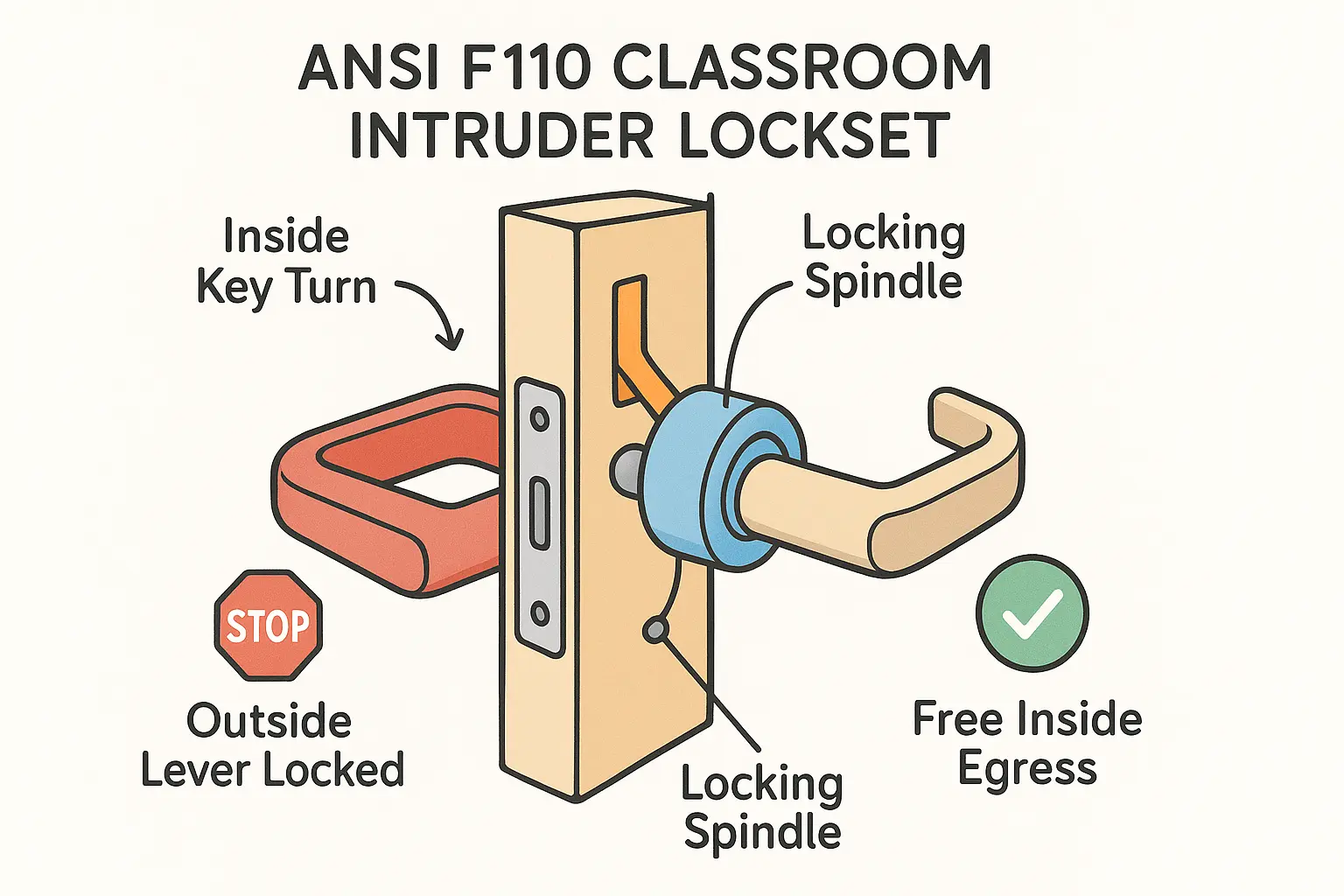
Anatomy of Lockdown: How an Intruder Lockset Works (ANSI F110)


This diagram clarifies how the ANSI F110 intruder lockset mechanically blocks the outside handle when the inside key cylinder is turned, ensuring lockdown security without restricting inside emergency exit.

The ANSI F110 Classroom Security lock is specifically engineered to resolve the “L-wrench” nightmare of older hardware. Traditionally, locking a classroom door required a teacher to open the door, step into the hallway, and manually lock the exterior lever. In an active threat scenario, this exposure is a catastrophic point of failure.

The ANSI F110 double-cylinder mechanism solves this by featuring key cylinders on both sides of the door. When a teacher inserts their key into the interior cylinder and rotates it, the mechanical linkage inside the chassis immediately locks the outside lever.

Crucially, the inside lever remains completely functional. This mechanism complies with life safety codes by ensuring single-motion egress—anyone inside can exit instantly by simply turning the interior handle, maintaining proper emergency exit door locks functionality at all times.

Traditional Classroom (ANSI F84) vs. Classroom Security (ANSI F110) vs. Storeroom (ANSI F86) Comparison Table


This comparison table helps readers quickly recall and differentiate common classroom and storeroom lock functions, emphasizing why the F110 function best balances security, safety, and compliance.

Selecting hardware requires comparing performance under pressure. Traditional ANSI F84 locks demand hallway access to secure. Conversely, ANSI F86 Storeroom locks keep the outside handle permanently locked, meaning doors are always secure but require a key for entry every single time—disrupting daily school workflows.

The ANSI F110 Classroom Security function balances both worlds. When choosing these systems, it is essential to source Grade 1 hardware. The ansi grade standard dictates that Grade 1 cylindrical and mortise locks must withstand 1,000,000 operational cycles, ensuring they handle high daily student traffic while standing strong in emergencies.

The 2027 I-Code Mandate: Why Your Current Hardware Has an Expiration Date


Waiting to update non-compliant school doors increases both physical risk and legal liability. The upcoming 2027 I-Code revisions explicitly ban any classroom lockset that cannot be locked from the inside.

Facilities planning upgrades should execute a comprehensive commercial door hardware installation strategy today rather than settling for temporary stopgaps. Upgrading directly to ANSI F110 Grade 1 mechanical locks ensures long-term compliance, saving school boards from purchasing and installing hardware twice.

Barricade Devices: The Costly Liability Trap


Under the stress of safety concerns, some districts resort to aftermarket door barricade devices. While cheap, these devices create immense liability. 100% of major building and fire codes (including IBC §1010.2 and NFPA 101) prohibit any locking mechanism that requires tools, keys, special knowledge, or multiple physical actions to exit.

Barricade devices fail to meet ADA-compliant accessible door clearances because they require tight grasping and twisting. Furthermore, they present severe state-by-state regulatory challenges:

  • California, Illinois, New York: Aftermarket barricade devices are strictly illegal under state fire and building codes.
  • Ohio, Arkansas, West Virginia: Temporary devices are permitted only under highly narrow emergency variances, provided they meet local accessibility oversight.

Installing unapproved barricades leaves school districts exposed to catastrophic egress failures and code violations. Utilizing code-approved fire code door locks is the only legal, safe way to secure classroom doors.

Frequently Asked Questions


How does an ANSI F110 classroom intruder lock prevent unauthorized lockouts?

Because locking the outside handle requires a physical key, a student or unauthorized actor cannot lock a teacher out of the room by simply pressing a button or turning a thumbturn. Key control is maintained entirely by authorized staff members.

Are door barricade devices code-compliant for school emergency lockdowns?

Generally, no. The vast majority of aftermarket barricades violate NFPA 101 and ADA codes because they require multiple actions to release or demand tight grasping and twisting, creating severe egress hazards during fires or evacuations.

Why should educational facilities choose Grade 1 locksets over Grade 2?

Grade 1 locksets are tested to withstand 1 million cycles, making them highly durable under the constant, heavy physical use common in school environments. Grade 2 locks are rated for lighter use and fail faster, leading to higher long-term maintenance and replacement costs.

Top Grade 1 Mechanical Lockdown Locks (The Buyers' Shortlist)


This infographic guides readers through the essential steps to select the right Grade 1 classroom lockdown lock, from compliance assessment to model selection and keying considerations.

When specifying mechanical lockdown locks, several Grade 1 options stand out for durability and functionality:

  • Schlage ND75 / ND78: Known for its heavy-duty design and an optional 180-degree visual indicator that clearly shows lock status.
  • Marks USA 195DB: An exceptional budget-friendly retrofit solution featuring a lifetime mechanical warranty.
  • PDQ XGT 135 LED: Combines mechanical reliability with a bright, physical red indicator/LED that instantly confirms lock status under stress.
  • Sargent 10G37: Designed for seamless integration into existing, complex master key systems.

To mitigate “lockout protection” risks—where an active shooter might lock responders out—these locks must be integrated into high-security restricted key systems. This ensures only authorized personnel hold the keys required to change lock states, preventing unauthorized lockouts.

Need more information? Get a free quote

Call us now

Get A Free Call From Our Experts!

Floating Button Form