Selecting the Right Level 2 Home Charger for Your EV Guide


Published: Jul 31, 2026 | Updated: Aug 14, 2026

Transitioning from public fast-charging networks to home charging is one of the most rewarding milestones of EV ownership. According to data from Grand View Research, fueling your vehicle at home costs on average 50% to 70% less than using public DC fast chargers, allowing most homeowners to fully recover their hardware and installation costs within the first year.

Just as you would prioritize secure door lock code management to keep your smart home safe, you must also plan carefully for your EV setup. To avoid costly electrical mistakes, code violations, or unexpected charging bottlenecks, it is crucial to understand your home’s electrical threshold and your vehicle’s specific onboard capabilities.
Technical Blueprint: Demystifying Charging Speed & Power Limits


The speed at which your vehicle replenishes its battery depends on a three-way compatibility check: your home electrical panel’s physical capacity, the charger’s maximum output, and your EV’s onboard charger acceptance rate.

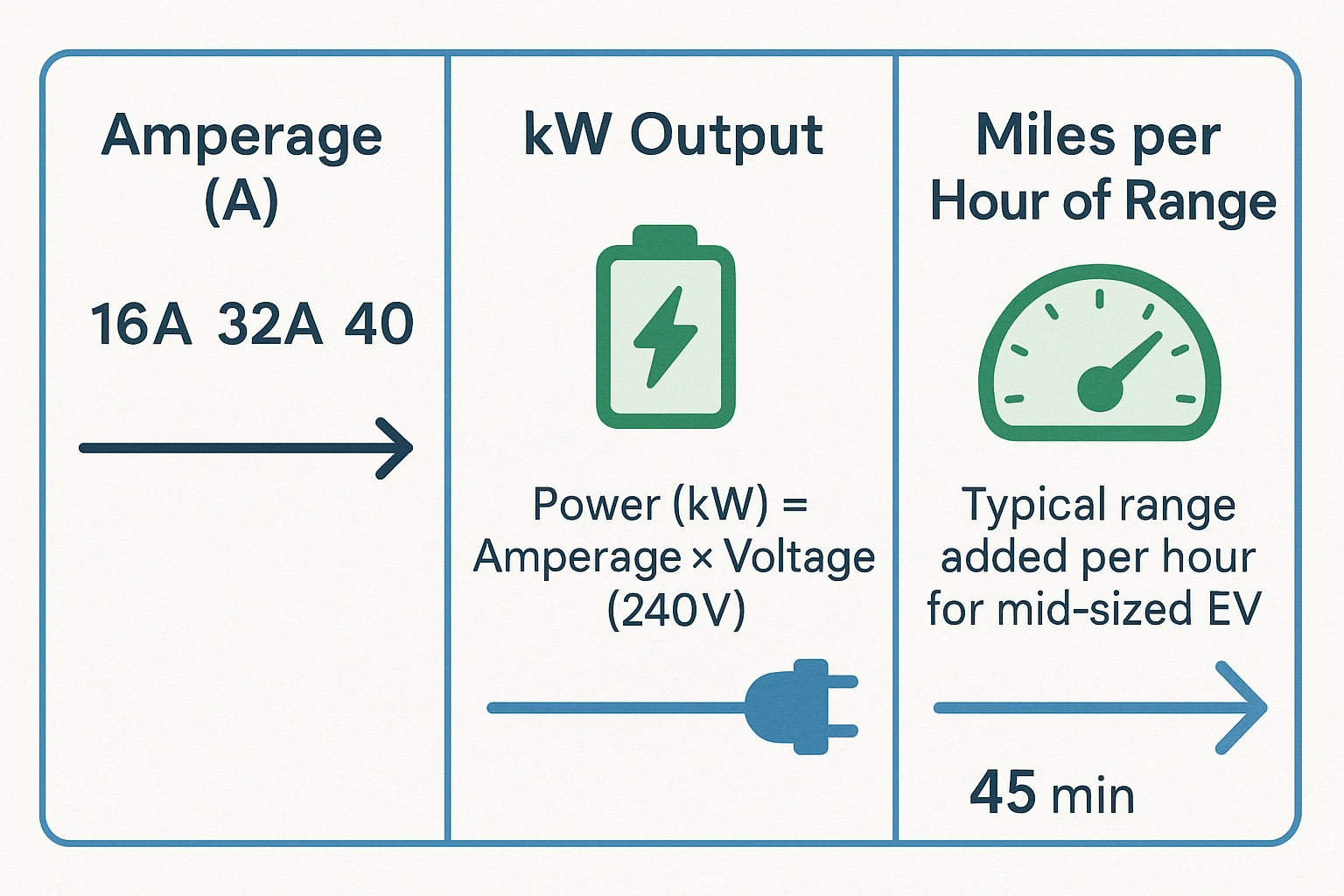
Level 2 chargers operate on a 240-volt circuit and generally range from 16 to 48 amps. When choosing your hardware, remember that electrical codes require a safety margin: your circuit breaker must be rated for 125% of the continuous load. For example, a 40-amp charger requires a dedicated 50-amp circuit breaker, while a high-output 48-amp charger demands a 60-amp breaker.

This infographic clarifies how different amperage levels translate into power output (kW) and how that affects the miles of range gained per hour of EV charging, making charging speed concepts tangible and easy to grasp for new EV owners.

Matching your charger to your daily driving habits prevents over-purchasing hardware. If your daily commute is under 40 miles, a highly reliable 32-amp charger (7.7 kW) will easily replenish your battery overnight. Opting for a 48-amp system (11.5 kW) is highly beneficial for larger electric SUVs or trucks, provided your home electrical panel can safely handle the load.


Compatibility Matrix: Navigating J1772 vs. NACS


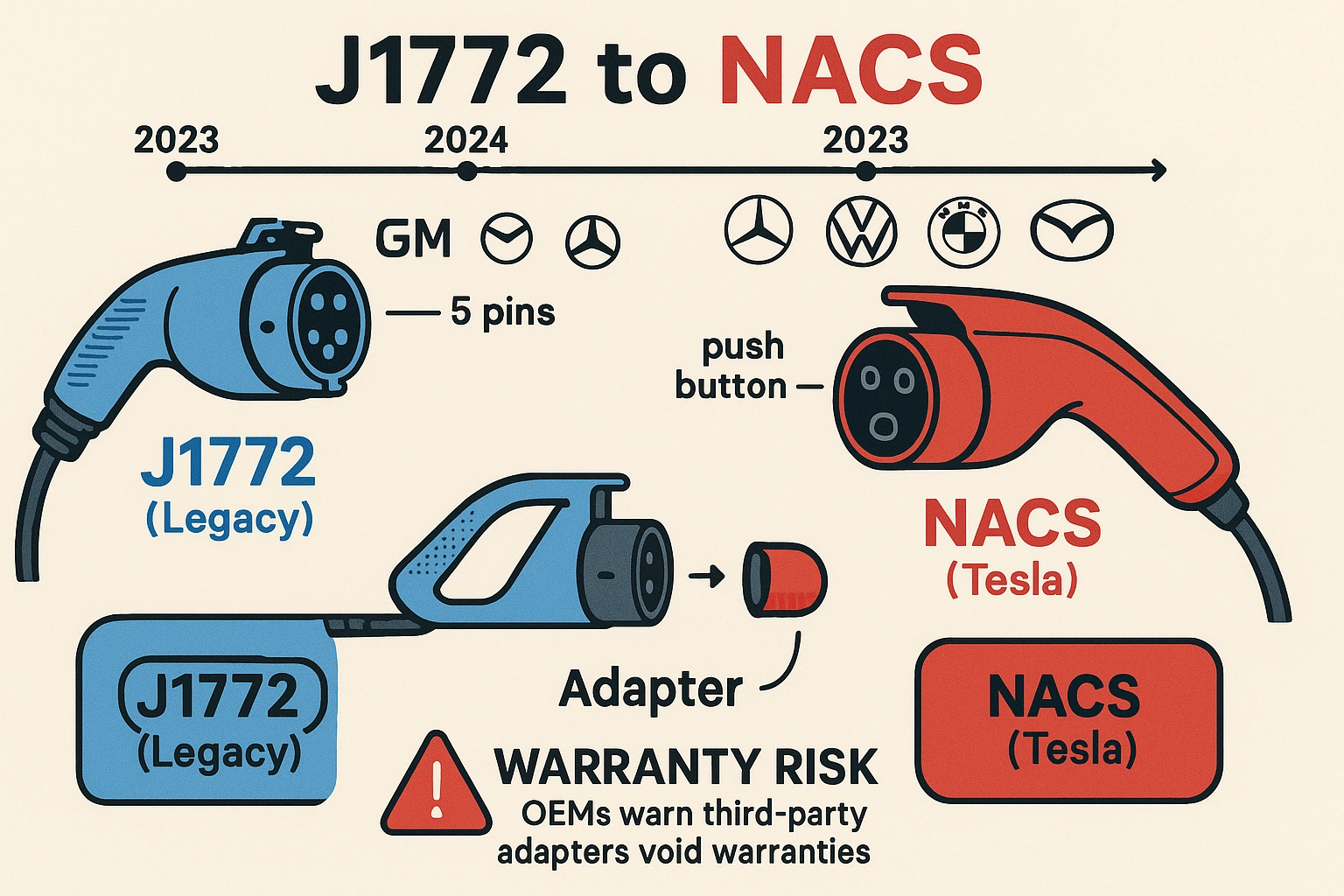
The North American charging landscape is currently in a transitional phase. Historically, non-Tesla vehicles utilized the J1772 connector, while Tesla utilized its proprietary design, now standardized as the North American Charging Standard (NACS / J3400).

This infographic acts as a visual memory anchor, clarifying the differences between J1772 and NACS connectors, the timeline of their adoption, and critical warranty risks involved with third-party adapters, aiding confident charger compatibility decisions.

When choosing a charger, buy for the future. If you own a legacy EV with a J1772 port but plan to upgrade in the coming years, look for dual-head systems or chargers like the Tesla Universal Wall Connector, which natively houses both connection types.

Additionally, be cautious of cheap, uncertified third-party adapters. Major automotive manufacturers like General Motors explicitly state in their vehicle manuals that damage caused by unapproved charging adapters can void your battery warranty.


Electrical Engineering Demystified: Hardwire vs. Plug


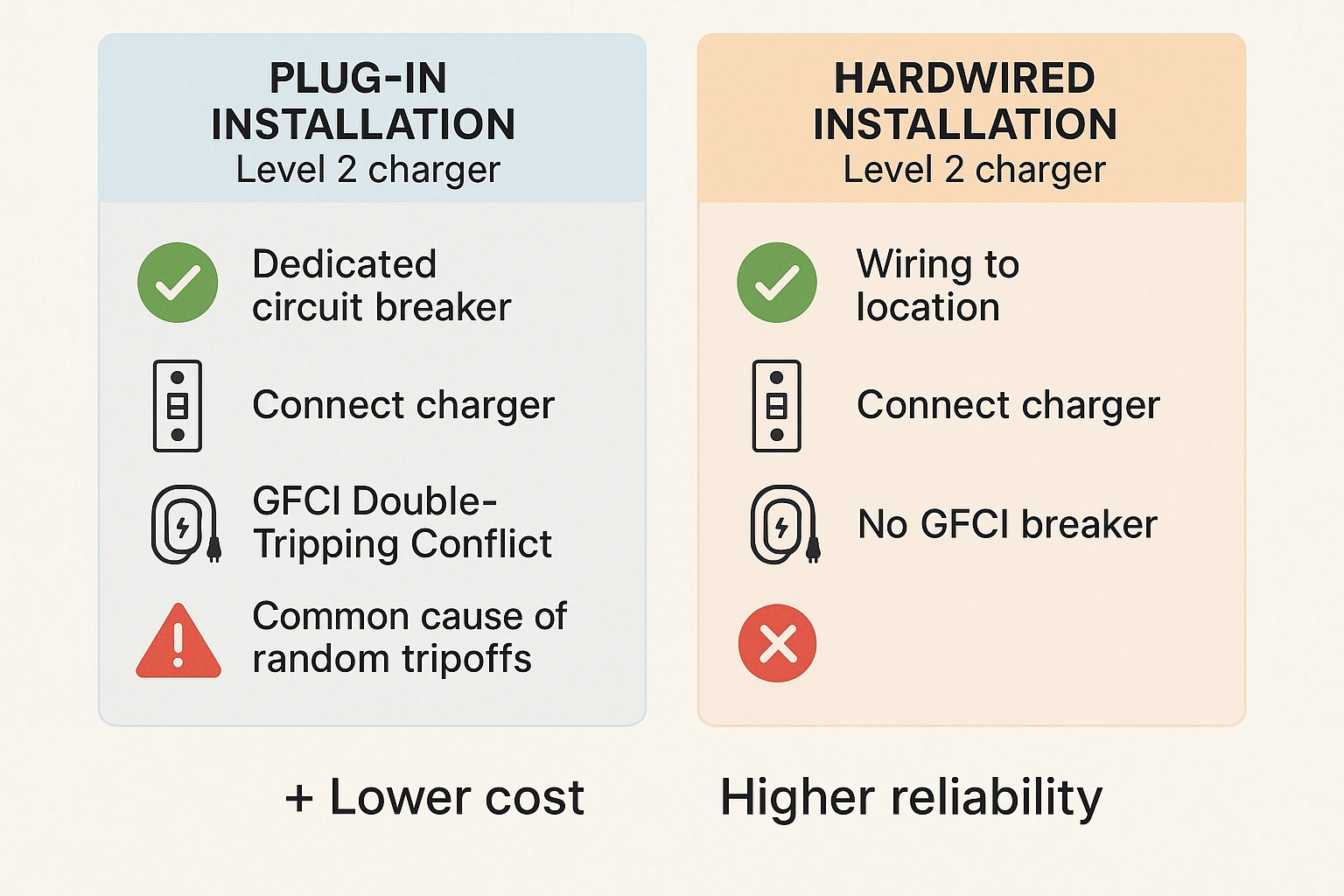
One of the most critical decisions is determining whether to plug your Level 2 charger into a 240V NEMA 14-50 outlet or hardwire it directly into your home’s electrical panel.

This chart educates readers on the key differences and safety trade-offs between plug-in and hardwired Level 2 home EV charger installations, empowering them to choose the right approach for reliable and code-compliant charging.

While a plug-in setup offers flexibility if you move, hardwiring is structurally superior for several key reasons:

  1. The GFCI Nuisance Loop: Modern National Electrical Codes (NEC) mandate GFCI breakers for 240V outdoor/garage outlets. However, almost all smart EV chargers feature built-in, highly sensitive GFCI monitoring. When you plug a smart charger into a GFCI breaker, these two monitoring systems can conflict, causing random, frustrating “nuisance tripping” that halts your charging sessions mid-way through the night. Hardwiring bypasses the need for an external GFCI breaker, entirely eliminating this conflict.
  2. Thermal Safety: High continuous amperage creates substantial heat. Cheap, builder-grade NEMA 14-50 outlets can degrade under continuous load over several hours. Hardwiring creates a direct, insulated copper connection that maximizes physical safety.
  3. Smart Power Optimization: If your home operates on an older 100-amp electrical service, installing a heavy-draw charger might normally force an expensive $3,000 panel upgrade. However, smart hardwired systems utilizing dynamic load-shedding hardware (such as Emporia or Wallbox) monitor your home’s real-time electricity usage. If you run your dryer and HVAC simultaneously, the charger automatically throttles its draw, ramping back up once household usage drops.

If you are evaluating options for temporary sites or commercial fleets, you might also consider investigating the logistics of portable ev charger rentals as an alternative transition path. For most permanent single-family homes, however, a dedicated, hardwired wall installation remains the safest standard.


Frequently Asked Questions


What is the difference between a smart charger and a basic charger?

Smart chargers connect to Wi-Fi, allowing you to schedule charging during off-peak utility hours to reduce electricity bills, track real-time power consumption, and integrate with local solar arrays. Basic chargers simply deliver power when plugged in. If your utility offers time-of-use (TOU) discounts, a smart charger typically pays for itself within months.

How do I prevent hardware issues during severe winter weather?

Freezing temperatures can make low-quality charging cables stiff and difficult to manage. Look for chargers with military-grade, rubberized jackets designed to remain flexible down to -22°F. To protect your investment, read our detailed technical breakdown on how to prevent charger hardware failures in extreme weather.

Do I need a professional to install my Level 2 charger?

Yes. Operating with 240V, high-amperage electrical lines requires precise torque measurements, correct wire gauging, and compliance with local permits. Professional installation ensures you meet NEC code safety requirements, protects your home’s electrical panel, and validates your manufacturer’s hardware warranty.


Taking the Next Step in Home Security and Energy


At Sure Lock & Key, we believe that true home security extends beyond secure locks and access control—it encompasses the structural safety of your family’s daily infrastructure. Ensuring your EV charging setup is safe, reliable, and expertly integrated into your property protects your home from electrical hazards.

If you want to ensure your home is fully equipped for modern demands, our experienced technicians are here to help. Whether you need residential security solutions, commercial access control, or specialized emergency support like our dedicated mobile ev charging service, we deliver prompt, professional, and reliable assistance 24/7. Reach out to our family-owned team today to discuss how we can secure your home for the future.

Need more information? Get a free quote

Call us now

Get A Free Call From Our Experts!

Floating Button Form