Getting behind the wheel of a modern vehicle used to be as simple as inserting a cut piece of metal, turning the ignition, and driving away. Today, starting your car requires a sophisticated electronic choreography. For vehicle owners evaluating security, upgrading aftermarket systems, or facing a sudden lockout, understanding this underlying technology is essential. Knowing what is a key fob and how it secures your vehicle helps you make informed choices about your vehicle’s safety.
Understanding Transponder and Proximity Car Key Tech
Published: Sep 7, 2026 | Updated: Sep 9, 2026
The Core Technologies - Functional Taxonomy
To understand modern vehicle security, we must categorize automotive entry systems into three distinct technological generations:
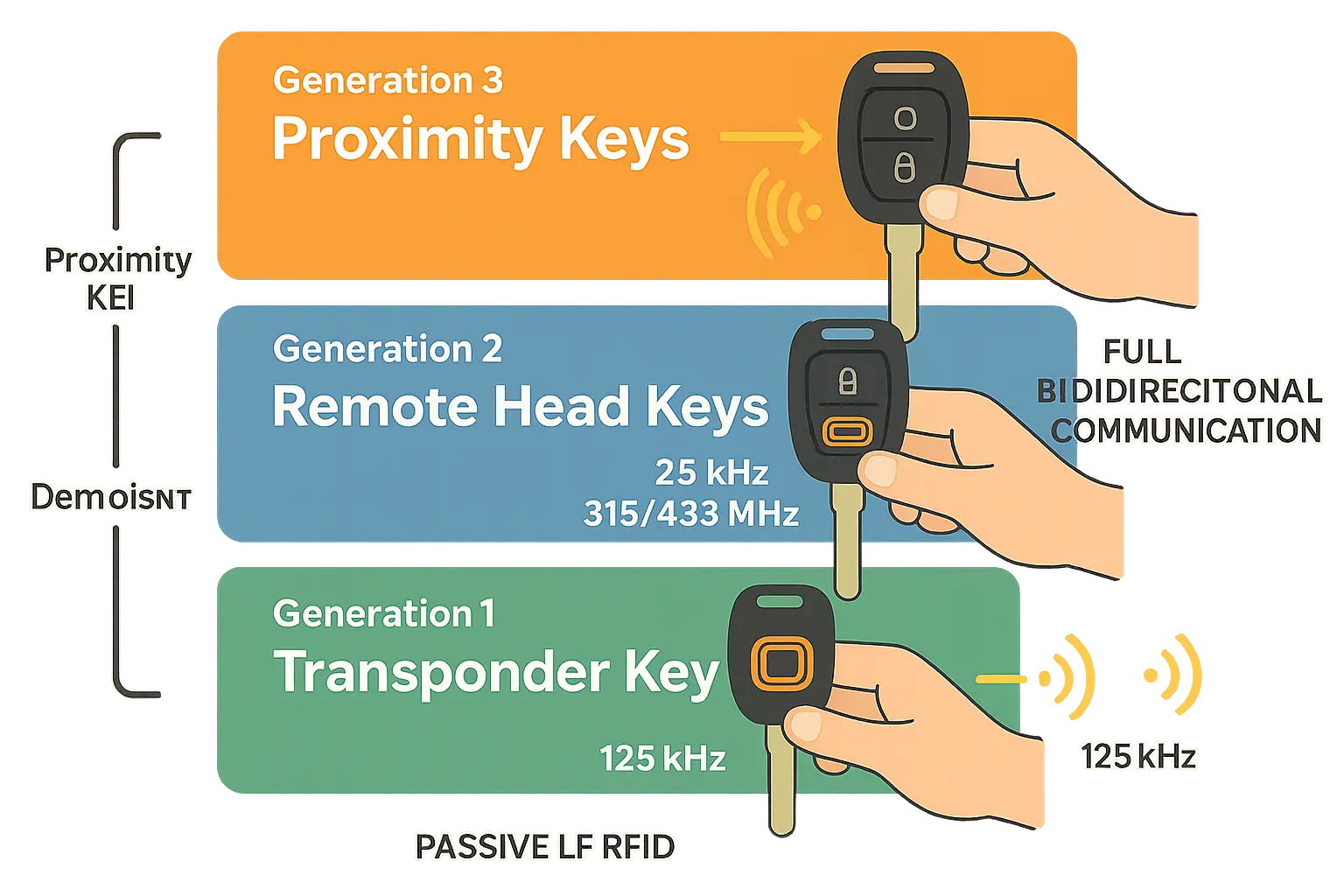
- Transponder Keys (Gen 1): These keys utilize passive RFID chips embedded inside a plastic head and function entirely without a battery. When you insert the blade, the magnetic field of the ignition coil induces a current to power the chip, allowing it to send its unique ID. If you need a car transponder replacement, a professional technician must program this unique digital signature directly into your vehicle’s engine control unit.
- Remote Head Keys (Gen 2): This hybrid combines different types of car keys. The physical blade retains a passive transponder to start the engine, while the head contains a battery-powered active RF transmitter operating on UHF bands to lock and unlock doors remotely.
- Proximity Keys (Gen 3 / Smart Keys): Operating on Passive Entry Passive Start (PEPS) technology, these systems eliminate physical keys entirely, allowing hands-free locking, unlocking, and ignition via automated bidirectional communication.
Frequencies & Physics: How the Dual-Band Handshake Works
Passive proximity keys rely on a highly coordinated dual-band radio frequency (RF) architecture:
- Low Frequency (LF – 125 kHz): Magnetic coils within the vehicle continuously broadcast localized polling signals (typically up to a range of 0.8 to 1.5 meters) to detect the key’s presence.
- Ultra-High Frequency (UHF – 315 MHz in North America / 433.92 MHz in Europe & Asia): Once the key fob detects the LF poll, it responds by broadcasting a high-speed, encrypted UHF signal back to the vehicle’s central receiver.
This architecture includes a critical backup known as inductive coupling. If your smart key’s battery dies, disabling its active UHF transmitter, you can hold the fob directly against the Start Button. The low-frequency coil embedded behind the button magnetically powers the passive transponder chip inside the dead fob, allowing you to start your car immediately.
Cryptographic Security - From KeeLoq to AES-128
To prevent unauthorized replication, modern entry systems have transitioned from static codes to advanced cryptographic protocols.
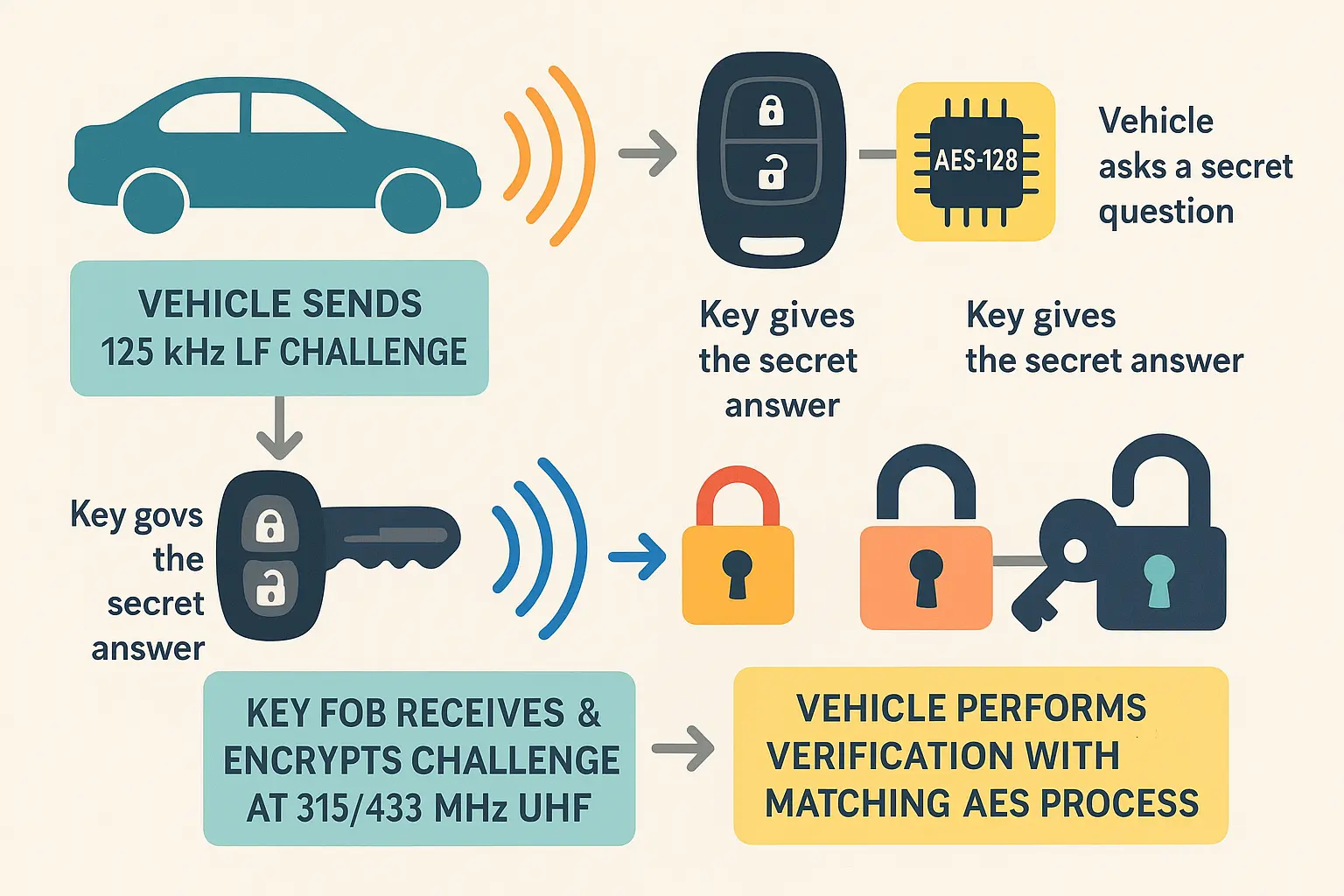
Rolling Codes and the Look-Ahead Sync Window
Early keyless entries used fixed codes, which were vulnerable to interception. Modern systems use the KeeLoq algorithm, which changes the code with every button press. The vehicle’s receiver holds a synchronization window of 256 steps. If the fob’s button is pressed more than 256 times out of range, the vehicle’s Body Control Module (BCM) will reject the next code because the rolling sequence has fallen out of synchronization.
AES-128 Challenge-Response
High-security proximity keys use AES-128 bidirectional encryption. Rather than the fob broadcasting a pre-calculated code, the vehicle initiates a challenge-response handshake:
- The vehicle generates a random, one-time 128-bit number (the challenge).
- The key fob encrypts this challenge with its unique secret key using the AES-128 algorithm.
- The fob returns the result. The vehicle runs the same calculation, and if they match, access is granted.
Because AES-128 utilizes $2^{128}$ possible combinations, brute-force mathematical cracking is physically impossible.
Security Vulnerabilities - Real-World Risks & Countermeasures
While digital encryption is incredibly secure, physical-transmission bypass vectors still exist.
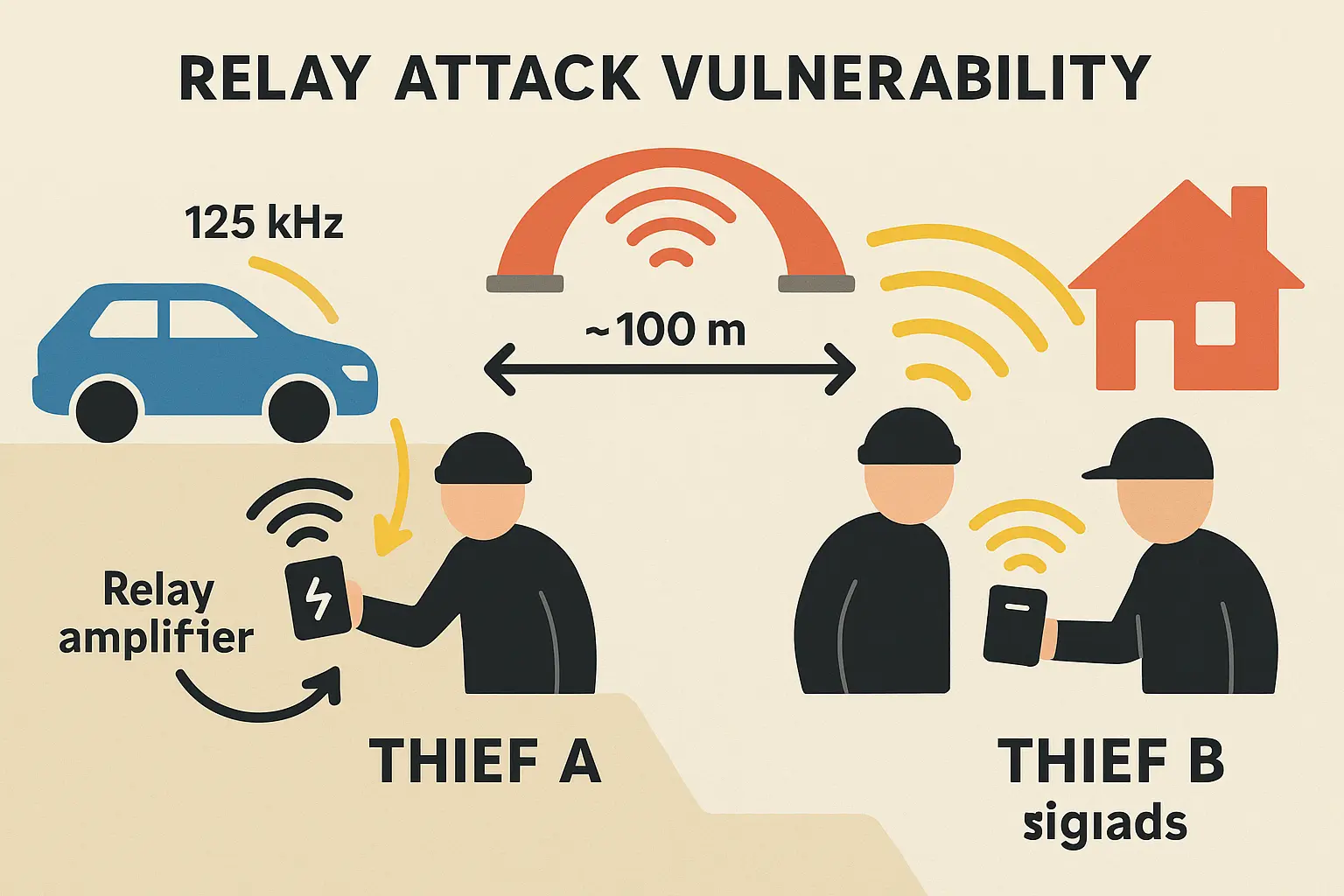
Relay Attacks
During a relay attack, thieves use high-powered amplifiers to extend the vehicle’s 125 kHz low-frequency polling signal up to 100 meters, reaching inside a nearby home to trick the key fob into responding. This allows criminals to unlock and drive away with the car in under 30 seconds. To mitigate this risk, keep your keys in a Faraday bag or disable passive entry in your vehicle’s settings.
RollJam (The Jam-and-Capture Attack)
This vector uses a device to block the vehicle’s receiver while capturing the user’s first unlock signal. When the user presses the button again, the device jams that second signal while broadcasting the captured first code. This leaves the attacker with a valid, unused rolling code to use later.
Frequently Asked Questions
Can a car key transponder be cloned without the vehicle present?
No, modern high-security transponder keys using AES-128 bidirectional encryption cannot be cloned without the physical vehicle present. Professional programming requires connecting a diagnostic tool directly to the OBD-II port to sync the new key’s unique rolling ID with the vehicle’s immobilizer unit.
Why did my key fob suddenly stop working even after a battery replacement?
If you require a car key battery replacement and find the key still does not work, it may have fallen out of sync. This occurs if the fob button was pressed more than 256 times out of the car’s range, causing the rolling code counter to drift outside the BCM’s synchronization window. A professional locksmith can reprogram the fob to restore pairing.
Is a proximity key system less secure than a traditional mechanical key?
While proximity keys are susceptible to relay attacks if unprotected, they are vastly more secure against traditional theft. Traditional mechanical ignitions are vulnerable to physical hotwiring and lock picking, whereas a proximity system’s cryptographic engine lock makes unauthorized vehicle operation virtually impossible without matching electronic verification.
Navigating modern car keys requires deep expertise. If you need a reliable car key fob replacement or professional security programming, Sure Lock & Key offers 24/7 mobile locksmith vans staffed by licensed, experienced technicians across multiple states. Contact us today for seamless lock and security solutions.
Aftermarket Push-to-Start Integration
If you are looking to upgrade an older vehicle with an aftermarket keyless entry and push-button start kit, understanding the bypass mechanics is vital. Instead of tape-mounting an old transponder under your steering column—which compromises your safety—modern installations utilize integration bypass modules (such as Fortin or iDatalink). These modules securely read your transponder’s cryptographic code during initial setup and safely emulate it across the vehicle’s CAN-bus network only when the ignition sequence is initiated.
Need more information? Get a free quote